
Summary: A Chaos sorcerer from the Age of Strife has sealed himself, his three brides, and several mutant minions into an ancient castle. Sustaining themselves on the blood of mortals, without they have entered into torpor. His mutant minions, able to live on through nothing but the pure energies of the Warp, have waited in seclusion for civilization to return, waiting for someone to happen across their fortress and become food for the master.
Hoard of the Dragon Queen: Fan Art From My Brother
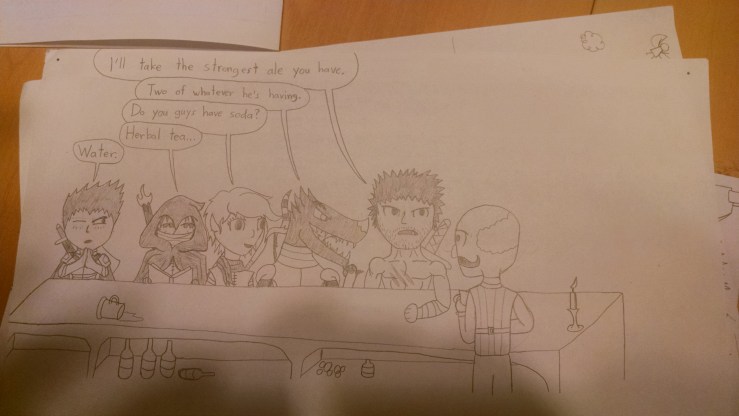
As anyone who’s been following this blog knows (these people know nothing, because they do not exist), my younger brother moved away recently. He won’t be in regular contact with civilization for a while, and he left behind a few things, including some drawings he made of our old D&D game. The campaign we played before the one that finished at Phlan. This was one Hoard of the Dragon Queen. I asked him if it was okay if I scanned them onto the internet before he left, and he said sure. Then I realized I don’t actually have a scanning machine, so here are some terrible phone pictures of them instead.
Continue reading “Hoard of the Dragon Queen: Fan Art From My Brother”
The Defense of Phlan
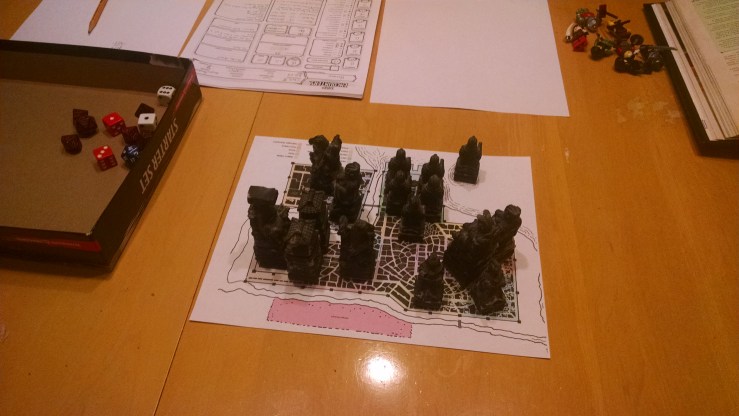
Another one in the “shameless blogging” category, this post is dedicated entirely to a brief recollection of the battle for Phlan. It’s the last session of D&D I ran for my younger brother before he left. I was running the Tyranny of Dragons campaign initially, but by the end things got…different. I squished several different adventures together into a single finale, and ran them with an improvised mass battle system.
The Quest Log For Meat Space
Seeing as how this is basically just my blog, now, let’s talk about my goal for the year.
Let’s Play Chrono Cross
Here’s a miscellaneous project that wrapped itself up recently. I did a Let’s Play of one of the first JRPGs I’d ever played, Chrono Cross, with my younger brother playing the game for the first time. The idea was that he’d be experiencing the game for the first time, contrasted against my having played the game as a kid, so his perspective would balance out any nostalgia I have for the game. We wound up losing half the commentary audio, so we wound up ending it halfway through the game at the end of one of the major plot arcs.
It’s…okay. I learned a lot about video editing while making it, but the main thing I learned is that my analytical commentary, which requires long stretches (2+ minutes) of uninterrupted monologue to make a detailed and nuanced point, doesn’t really gel well with my younger brother’s off-the-cuff jokes well at all, since he needs to deliver his punchline immediately after the game gives him a setup to work with. It’s not until later in the game that my analysis tended to get more focused, less rambling, and fast enough to avoid interruption, so the early stuff was pretty heavy on us just joking back and forth to varying amounts of quality and me occasionally starting in on something potentially interesting before losing my train of thought. It doesn’t help that the two plot arcs that we didn’t lose the commentary for pretty much work, and there’s a lot less to talk about when something works, especially off-the-cuff, than when something’s awful. It’s a shame that our best work was lost, because he just moved halfway across the country and we won’t be doing this again for a while.
Ruling Towns in Vestitas
Every town in the Vestitas hexcrawl is, in theory, a place you can take over and either own directly or give to a friendly and grateful ally. Several towns are ruled over by secretly (or, as you get further outside the Imperium’s sphere of influence, openly) heretical rulers, so an Inquisition party may find themselves toppling them and selecting replacements as part of their job. A Chaos Cult party might find themselves toppling governments and taking over to drive the Imperium out, to consolidate control over disparate Chaos cults, or just for the lulz.
The Lord Mayor’s Son
Summary: The Lord Mayor of a town on the Grey River has become obsessed with reanimating his son, a captain in the PDF expected to go into politics once he was out of the prime of his youth. He was killed when he personally led a platoon of his men to crack down on a riot in the slums, and it turned out to be an ambush. His order to the rest of his company for backup was overridden by the PDF colonel stationed there, who feared that the rest of the company would be lost along with the captain and his platoon. Now the Lord Mayor desires only two things: To have his son returned to him, and revenge on the colonel, and he’s willing to turn to Chaos to get it. His son’s body has rotted away to a few bone fragments and dust, but the mayor has preserved his son’s brain and heart and believes he can use them to reanimate his son into a body assembled from corpses pulled from the cemeteries of the town he rules.
Dungeons and Dragons and Philosophy: “Others Play at Dice…”
The title quote (“others play at dice”) comes from Aristotle, and the essay is dedicated entirely to explaining Aristotle’s categorization of friendship through the lens of D&D groups and fantasy stories. So, essay author Jeffery L Nicholas intersperses the essay with examples from fantasy stories like Lord of the Rings and also from his own gaming group. Hearing about other people’s gaming stories is eye-glazing by default and Jeffery doesn’t have the talent to climb that hill, but he doesn’t lean on it too strong so it doesn’t hurt the essay that much.
Continue reading “Dungeons and Dragons and Philosophy: “Others Play at Dice…””
Dungeons and Dragons and Philosophy: Berserker in a Skirt
Today we’re talking about sex and gender in Dungeons and Dragons, so this oughta be a hoot. I’ll go ahead and get things started with this quote, not directly from the essay, but instead from Shelly Mazzanoble and which appears in the essay:
One of the coolest things about D&D is gender equality. As in real life, whichever gender you choose to play is a matter of personal preference but unlike the real world, female and male characters are equals.
So trans people willingly choose to experience discrimination and dysmorphia for, I guess, the street cred? We’re not off to a good start, here.
Continue reading “Dungeons and Dragons and Philosophy: Berserker in a Skirt”
Dungeons and Dragons and Philosophy: “Kill her, kill her! Oh God, I’m sorry!”
D&D didn’t used to be on podcasts, but now it is. If this is a YouTube video this is where I’d do the fake roll credits gag. That’s only slightly oversimplified. This essay spends almost its entirety talking about how D&D was the basis for some reality TV shows, kind of, and there was a cartoon, then later on popular video games like World of Warcraft gave mainstream gamers a few points of reference that made learning D&D easier, and then D&D podcasting took off and became a big deal. It’s worth noting that this history of D&D in other media doesn’t seem to be aware that the Gold Box and Infinity Engine games were a thing. This kind of “history of a hobby” thing can be interesting (although I didn’t find the text here particularly engaging), but it’s not philosophy. There’s no philosophical argument being made here, no real idea being played with. It’s just a brief history of D&D as portrayed in other media, and how that affected how easy it was for people who didn’t yet play D&D to get started. That’s not philosophy. That’s history. They’re different.
Having one of those trendy double last names, essay author Esther MacCallum-Stewart is pretty easy to track down…I assume. I’ve found staff pages for her at Staffordshire University and the University of West England, but not for the Digital Cultures Research Centre or the University of Surrey, the two places where the contributors page says she actually works. Maybe the last three years she’s taken a swerve a bit?
As abbreviated as this post is (it’s not even long enough to justify a page break), that’s kind of it? There’s no philosophy to discuss, it’s just an uninspired history of D&D in popular media.
 Chamomile Has A Blog