
You can find appropriate vehicle stats to whatever era you’re using in the various Saga Edition sourcebooks. The generic ones I give here can be used to plug in some holes, although many of them are closely based on stats taken from various sourcebooks to begin with. The main draw for this post is going to be the organization of armor or artillery companies, and that is going to be interesting mainly to the extent that your players are fighting an entire enemy regiment, in pieces or all at once as a massive and spectacular set piece.
Star Wars: Company Stats
Continuing on where we left off yesterday, here we have stats for troops that show up at what I call “the company level,” but in retrospect I can’t remember why because they aren’t actually company-level assets at all. I mean, the commandos in particular are guys who are specifically designed to work as individual squads. Oh, well.
Star Wars Saga Edition: Platoon Stats
I run a Star Wars: Saga Edition campaign. This campaign takes place in the misty recesses of the early Republic, so it doesn’t use standard stormtrooper or Sith trooper stats, and in any case I find those statlines to be pretty bland after a while. Granted, they’re only supposed to be first-level encounters, but it’s not like there’s a whole ton of variety as you get into higher levels if your enemy remains more or less “the Empire” (or period equivalent). When Emperor Xim (yes, that is a legends character and not an OC) shows up with an army, is he going to have nothing but “stormtrooper” and “stormtrooper but level 8?” That can work, and for my first campaign, Birth of the Republic, I largely relied on these kinds of things, using combat largely as filler between political scenarios.
For Nine Thrones of Xim, however, I statted out a much more complex and balanced set of military mook stats. I then lost those stats. I have combed over every one of my notes documents and as far as I can tell the full stats for these guys are no longer on my machine. What I do still have are the shorthand stats I use for running them in combat, so that’s what I’m posting to celebrate the upcoming release of Episode VIII: Barely usable abbreviated stats for an edition that stopped publishing nearly a decade ago. That said, even in their abbreviated form they are usable and add a lot of interesting flavor to what would otherwise just be ten identical stormtroopers.
Monkeys With Guns: Fin
Though I originally planned to ship Monkeys With Guns with a sample campaign, I ultimately decided that was an awful lot of work playtesting and fine-tuning for a game that no one was really asking for. Considering how many unfinished projects I have left to get to, it’s pretty hard to justify spending so much time on this one, especially since many of the others (Project Soul Stone, Project Blood God, Project Erinyes) are more likely to be things that people will actually want. Monkeys With Guns is a complete and playable war game and that certainly meets the minimum project requirements, so I’m calling it finished. You can view the Google Doc here.
Ensemble Outlines
Plot outlines are a thing that people do sometimes. What I’ve discovered in November, however, is that character outlines are also an important part of my process. I’d been doing them on autopilot as part of the standard idea percolation process preceding a novel that I didn’t notice how damaging they were until I forced a first draft on a very specific schedule for the sake of the NaNoWriMo creative writing challenge. So if nothing else, that writing has taught me the importance of these outlines.
So, you’re probably wondering how a character outline can even work, and if you have any idea at all, you’re probably expecting some kind of template or form that you fill out. That’s not how I do it (although apparently the Snowflake Method works for some people, and it involves doing that). I do ensemble outlines, and not in a Five Man Band “make all characters fit into this kinda loose formula” kind of way. I’ll explain below the break.
Sky Wolves: Day Three
When you live on Carrier Strike Group Thirteen, “vacation” means “we’ll just blow up a little bridge and call it a day.”
Sky Wolves: Day Two
“Come on, Commander,” Kermit was pleading, “put me on the flight! I can take it! I’m as cool as a cucumber!”
“We’re all full up, kid, take a breather,” Wedge said.
“What about that laboratory mission? Are we just going to leave that lab functioning?” Kermit asked, “they could be making chemical weapons or something!”
“It’s a secondary objective, kid, and way too far inland. You couldn’t carry enough bombs to blow it up,” Wedge said.
“What about Hunter? Load him up with the bombs. It’ll be good for him! Prove that he can bomb things just as well as Cowboy!” Kermit pleaded.
“Hunter is still convinced that the missiles have followed him back to the Coolidge and are hiding in the lower decks waiting to strike,” Wedge said, “just let it die, kid. There’ll be other missions.”
Sky Wolves: Day One
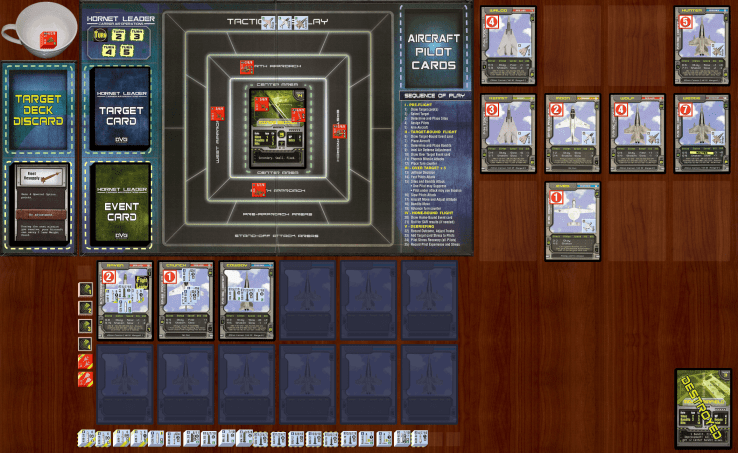
Raven is leading the first flight off the Calvin Coolidge and into Libya. Launching just behind are Hunter and Cowboy with their state of the art F/A-18C Hornets, their Eyes in the sky in the AWACS, Dirk Hardpeck flying support in the EA-6B Prowler ECM plane, and air-to-air expert Waldo in the F-14 Tomcat. Their objective: To blow up Libya’s oil. The plan is to fly in from the west, where reconnaissance shows that Libyan air defenses are entirely low-altitude. The oil field is extensive. Cowboy is an air-to-ground specialist, so it goes without saying that he’ll be loaded down with high-yield guided munitions, but the field is too extensive for him to bomb on his own, so Hunter gets loaded up alongside him. It will be Waldo’s job to keep the bandits off their back while Rip Steakface keeps their radar signatures covered up with his Prowler’s ECM field. Raven’s ancient A-7 Corsair II can hardly hold onto two relatively close range AIM-9 sidewinders, while Waldo’s more modern Tomcat can carry not only a full load of eight missiles, but is also capable of mounting the longer range, radar-guided AIM-7 sparrow model. As such, Raven will be carrying some cheap unguided munitions on his Corsair II to finish any targets that Hunter and Cowboy miss. The weight of the munitions will make him a poor dogfighter on the approach, so Waldo’s going to have to keep them busy on his own.
On the same day, Wedge and Wolf are taking Kermit out to get his feet wet with a quick fighter sweep. There are 3 Mig-25s and 4 Mig-23s in the targeted squadron. Since the Sky Wolves are dumping tons of money into all the guided munitions used in the oil rig attack, Wolf decides to forego any hyper long range AIM-54 phoenix missiles and instead equip Kermit’s F-14 Tomcat with only AIM-7 sparrows and AIM-9 sidewinders, the same armament as Wedge and Wolf’s F/A-18C Hornets. They also each bring an ECM pod to keep the long range Mig-25s from downing any of them while they move into range.
It was a solid plan, a strong start to the Libyan incursion. Nothing could possibly go wrong.

Sky Wolves: Hornet Leader
Hornet Leader is a solitaire tabletop game about a squadron of fighters stationed on a US carrier from 1983, the introduction of the eponymous F/A-18 Hornet, to the present, carrying out missions to defend freedom, eliminate the enemies of democracy, and liberate the shit out of the oppressed peoples of the world. This is the story of the USS Calvin Coolidge, flagship of Carrier Strike Group Thirteen, and its famous fighter squadron VA‽-101, aka the Sky Wolves.
The year is 1984 and president Ronald Reagan has decided to launch punitive strikes on Libya because of terrorism or something. Strike Group Thirteen is moving in to execute this series of surgical strikes, aerial engagements, and carpet bombings that shall under no circumstances be called a war because otherwise we’d have to talk to Congress about it and nobody wants that. Our hero goes by the callsign Kermit, fresh from training and assigned to the Sky Wolves as a pilot of an F-14 Tomcat, an older plane, but one capable of extreme long range engagements as compared to the more modern multirole F/A-18s. In this, he is paired with one of the squadron’s best pilots, Waldo, famous for being practically impossible to track on radar, especially when there’s a lot of red-and-white striped things around.

A Second Invocation
Fifty thousand words complete,
A sparrow spreads his wings,
Kindled, now, with newfound heat,
A power that softly sings,
Far now from my heart’s desire,
Much distance from here to there,
To win I must yet fly much higher,
A sparrow can’t save a bear,
Time now to spread newfound wings,
I’ve never outflown this doom,
But I’ve got precious little choice,
‘Lest my friend find a rav’nous tomb,
Clio give me patience,
Urania give me sight,
Erato give me passion,
Calliope help me fight,
Terpsichore make me agile,
Euterpe help me rhyme,
Klaus and Jullianne stay with me,
Polyhymnia give me time,
To win this day I must ascend,
To the plane of much larger birds,
Goddesses please guide my flight,
I must first reach one million words.
 Chamomile Has A Blog