You Play A Benevolent God In Okami

Abrahamic religion is no fun. A single omnipotent deity overseeing the universe just sucks all the drama out of everything. Western developers have a tendency to import a lot of Abrahamic assumptions even when making games clearly based on pagan concepts. For example, Black and White. Each civilization has exactly one god, that god is a disembodied entity with arbitrary control over natural forces. This ain’t no Zeus or Poseidon, it’s an off-brand Yahweh with a video game karma system bolted on.

Okami, however, makes you feel like you’re actually playing a benevolent deity in a polytheistic paradigm. Okami is a reboot of Japanese mythology that recycles characters while ignoring their exact relationships and character arc in the traditional stories, so you are Amaterasu, sun goddess of Nippon, except also you are a wolf. Susano is not your irresponsible younger brother, but rather the irresponsible descendant of a great warrior who fought alongside your previous incarnation, Shiranui, and who struggles to live up to that legacy. Issun is not an unrelated character, but instead is your sidekick, and when you find his magic mallet, it shrinks you down to his size instead of growing him to yours. The basic personality and theme of each character is intact, even though everything else is original – which means that you, playing as Amaterasu, are the benevolent goddess of the sun and protector of the Japanese people.

Okami is a Zelda-style adventure RPG sort of game, where you gain items and level up certain stats, but the emphasis is more strongly on your skill in combat than on your raw numbers. So, naturally, one way in which you are a benevolent deity is by running around beating up demons, and upon completing a certain dungeon or defeating a certain boss, you will bring an end to a curse zone, restoring life and beauty to a place that had become poisoned and desolate. That much is obvious, anyone who sets out to make an adventure RPG where you play as a benevolent deity can get that far.

Where Okami shines is in lots of smaller things you can do for XP. A lot of the side quests in the game involve performing small miracles, using your magic brush powers to help random peasants accomplish things they ordinarily wouldn’t be able to. For example, one early side quest involves an old woman who’s lost the pole she uses to hang drying laundry from. It fell into the river and was swept away. You can use your brush powers to magic up a new pole from thin air. Ordinary mortals can’t perceive your true form, that of a wolf painted with divine markings with a flaming mirror floating over your back and a tail dripping with magic ink. They just see a white dog. So, they have no idea you’re responsible and they don’t thank you directly, but instead offer up praise to the heavens ambiguously. There’s lots of little side quests like this, so everywhere you go, you’re performing miracles. Many of them are a simple and straightforward use of your magic powers, as easy as “use the cut power to help this samurai cut a tree” or “use the bomb power to help this firework maker make a bigger bomb,” but the fact that they’re quick and easy is an important part of it: You happen across someone having a problem that they’ve been bashing their head against for hours or days, wag your magic tail a little, and bam: Solved. For them, it’s a miracle. For you, it was Tuesday.

Plus, one of the collectible side quests is to find animals and feed them, which requires you to keep a stock of a couple of different kinds of food (seeds, herbs, fish, and meat) so that you have the right kind whenever you stumble across a wandering animal, or else make trips back to the merchant to buy exactly enough food and then head back to the animals you found (they hang out in the same place like a proper collectible, rather than spawning randomly or something else super annoying). Every time you feed them, you get a neat little cutscene of the animal eating while Amaterasu watches over them, with calm music in the background.

Okami portrays a benevolent deity not just as beating up bad guys, but as directly helping people (and animals) everywhere she goes, and it makes me feel more like a hero than the vast majority of games I play.

The Book/Movie Backlog

My video game backlog project has worked out pretty great for its intended purpose: Pushing me to try new games instead of revisiting old favorites over and over again, replaying them about as soon as I stop being completely sick of them. The problem I’d identified long ago is that every time I wanted to play a video game for a while, it almost always meant I was kind of tired and unfocused and needed to recharge, which means I was in no state to scroll through a list of 500+ video games in my Steam library and pick out something new. I’d play a spate of new games about once a year or so when I’d give myself a goal to play through a specific category, like every Star Wars game in my library, or every Metroidvania. This would work for a while, but after a few weeks I’d get sick of that category and drift back to playing whatever.

During my Star Wars kick after this year’s May the Fourth sale, I felt my interest in the project ebbing, noticed the pattern, and decided to solve it by creating a list of every video game I wanted to play. The broader subject matter means that, when I got tired of one category, I would switch to a different one, not replaying old favorites yet again. And it worked: My Star Wars playthrough has been on hiatus for months, but once I’m in the mood again, I’ll pick up where I left off, rather than feeling like the project is abandoned and starting a new one. Anyone following the blog will remember that I’ve mentioned exorcising Ubisoft from my soul, getting closure on their series and then moving away from them, and while that project has successfully carried me through to the end of the Assassin’s Creed series and into Far Cry, I’ve intermixed tons of other games with it. The “make peace with the fact that Ubisoft sucks and maybe always did” project tends to dominate my chunky, 20+ hour playthroughs, but since I’m also playing lots of 5-10 hour games, I’m not getting burnt out on it the way I have in the past.

But also, video games have completely taken over my hobbies. It used to be, when I needed to recharge, I would scroll over Steam and Netflix and my Kindle library until something popped out at me. Video games were always a plurality if not majority, but I’d also watch movies/shows and read books semi-regularly. Now, the process of finding a new game is much easier, which means I gravitate towards that. The solution, plainly, is to create similar backlogs for books and movies. The problem is, that’s going to be much harder.

The creation of my video game backlog has a lot of prerequisites. The backlog was over 180 games long at start and new games are added on a monthly basis. I didn’t just pluck out a half-dozen games that I’d never gotten around to, and that was the point: By being really huge, it’s easy for me to pass over a game that I don’t feel like playing right now and come back to it later. But in order to build that huge list, I needed to have 500+ games sitting in my Steam library, a list that I cut down to less than 200 by going through game by game and asking myself if I really cared if I never played this video game.

The reason why I had 500+ Steam games in my library was because of 10 years of accumulation from Steam wishlist/sales, Humble Bundles, and Humble Choices. Each of these sent new games past me on a more-or-less monthly basis for something like $5. Steam sends me a steady stream of recommendations based on what I’m already playing, and I’ll wishlist anything that looks interesting. During major sales, I’ll grab a few games if they’re heavily discounted enough. Humble Bundles regularly serve up packages of games that usually include one or two headline titles along with a dozen or so others, and while most of the other dozen never make it to my Steam library, some catch my eye and I give them a shot. The Humble Choice works the same way, except that the games aren’t even grouped by publisher or category, which is how games like Yes, Your Grace and Crypt of the Necrodancer find their way into my library.

And this is what books and movies/shows are missing. If I’d embarked on this project five years ago, Netflix probably could’ve served me on the movies/shows angle, if only minimally. Their recommendations and new releases would’ve served a similar role to Steam, and being a one-stop shop for all audio-visual media meant that once I paid my monthly subscription, everything was free. This means I don’t have to decide whether I want to risk money on a show I might like or might not – anything that looks interesting goes on the list (the video game equivalent being a combination of Steam wishlist and games from Humble bundles that I was already buying for other titles in the bundle). Unfortunately, the Balkanization of streaming services means that nobody has access to the data they need to offer me recommendations that are more hit than miss, and nothing like Humble Bundles – a package deal that includes several more obscure titles alongside one or two attention getting big ones – has ever existed.

Books are even worse. While Amazon certainly has an algorithm, it doesn’t seem to be very good at its job, and I still have to pay for every single title I take a chance on. I’ve tried using Amazon/Audible the way I use Steam, and the end result is that I spent a lot of time on books I abandoned halfway through because they were bad. Humble Bundle has book bundles, but they’re usuall either graphic novels or non-fiction, and the rare occasion on which I’ve tried one of their book bundles, I found its quality was abysmal. It has a lot of short story collections, which I have learned tend to be two or three short stories from really good writers to draw people in and fifteen from the publisher’s poker buddies. Instead of Yes, Your Grace, I get Shipwrecks Above. That collection also had the phenomenal Coldest Girl In Coldtown, but the only reason I realized that story was good and read it is because someone told me about it, and I doublechecked the one book of vampire short stories I had lying around to see if it included that one. There’s probably one or two other good stories in there, but I’d have to sift through a bunch of junk to find them. My video game backlog isn’t like that. September had 4 Regrets to 6 Complete, and I considered that a bad month for Regrets, plagued by technical difficulties!

The recommendation for Coldest Girl In Coldtown worked out great, so that presents a potential solution: Get recommendations. The problem is, if you ask a random individual for their favorite books/TV shows, you will mostly get an inventory of things they read when they were fifteen or which remind them of things they read when they were fifteen. If you ask a broad group for their favorites, you will get things that have broad appeal, with nary a trace of any Yes, Your Graces or even Crypts of the Necrodancer. People who can give reliable recommendations do exist (the guy who recommended me Coldest Girl In Coldtown has a really good track record), but they’re rare. I can’t easily find a group of 50 of them, ask them for recommendations, and assemble a 100+ entry list from each of them giving me 2 or 3 recs each.

I’ve begun assembling book and game backlogs in text files. It took ten years to build up my video game backlog, so even if the tools are not ideal, getting started on the book and movie backlogs right away seems prudent. So far they’ve all got a single digit number of entries, though, and I’m not sure how to open myself up to the steady stream of recommendations that would allow them to expand.

October Humble Choice

October’s Humble Choice is out the day I’m writing this (October 4th). What’s in the box?

Deathloop is an assassin-y kind of FPS like Dishonored (it’s from the Dishonored guys) where you have to kill eight targets before the timeloop you’re stuck in reinitiates. There’s also a rival assassin who’s trying to kill you, who can be played by another player or by an AI. Could be a flop, but could be cool. I’ll try it.

Monster Train is a roguelike deckbuilder game and I have had enough of those. I’m glad I got lucky with Banners of Ruin and stumbled into a winning build fairly early, because otherwise it probably would’ve wound up in Regrets. Monster Train has a weird and kinda cool premise where you’re demons on a train repelling an angelic invasion into Hell (and presumably counterinvading into Heaven at some point), but I’m just done with the gameplay on this one. Turns out, Slay the Spire is probably the only deckbuilding roguelike game I need.

The Dark Pictures Anthology: Little Hope is a collection of branching-narrative games in the “games that wish they were movies” genre. This is a bad genre. Just make movies.

Disciples: Liberation is a dark fantasy RPG with inquisitors and undead and stuff, and I’m on board for that. We’ll see if it sticks the landing or not, but I like the premise.

Maid of Sker can’t wait to gush about how cool Welsh ghost stories are. It’s a horror game where the gimmick is some kind of sound-based thing? This seems less like a movie with some QTEs slapped onto it to provide the ghost of gameplay and more like one of those horror walking simulator games born from gamer culture’s collective grief for the cancellation of Silent Hills. I like that genre well enough to try its best examples, but not enough to go digging for more after that, and Maid of Sker definitely looks like it’s in the strata where I’d be digging for more.

Epic Chef is about being a chef, presumably in an epic way. There’s some kind of gameplay for cooking stuff, some kind of gameplay for farming stuff, some kind of gameplay for chef duels. Kinda looks like Stardew Valley crossed with Cook Serve Delicious, but I think I’d rather play those games. It doesn’t help that I’m not much of a fan of the low-poly art style.

Railroad Corporation is a railroad tycoon game. How many of these do we have now? Too many. I don’t know if Railroad Corporation is the best of the genre, and I don’t care enough about this genre to find out.

Golf Gang is a golfing game. I do not want to play a golfing game.

That’s two pick-ups, but also I got some wishlist items from assorted Steam sales (and, in one case, from realizing that the listed price is $5): Hades, Drug Dealer Simulator, Hacker Simulator, and Ori and the Blind Forest. The math on How Long To Beat doesn’t seem to be adding up, though. Prior to adding these games, I had (according to the website) 167 games on the list. After adding these six games, I have…170? All of the new games are on the list, as CTRL+F confirms. Some of the stats screens (which do helpful things like tell me that 100% of my games are either unlisted platform or PC) are adding up to 173 like they should be, but the number indicating the total number of games on the list is 170.

Still, I know I added six games this month, which is the same number of games that went on the Complete list (Out of Space, Thief Simulator, Far Cry 2, Okami, Iron Harvest, and Crypt of the Necrodancer), plus some went into Regrets (Little Big Workshop, Industria, Magicka, the Lord of the Rings Adventure Card Game – no big story behind the last one, I just consistently passed it over when looking for a new game even though it’s got one of the shorter playtimes on my remaining list, and realized this means I don’t really want to play it). I’ve got two games that I should be able to unload from the backlog fairly quickly, too – Ori is only about 10-15 hours long, and I’m nearly done with Project Highrise, a game I’ve been picking at here and there since June. So there’s some reason to be optimistic about the backlog shrinking despite continued acquisitions.

On the other hand, when I’m looking for a new game to play, I usually look at the How Long To Beat backlog sorted by shortest average completion time. That means the games I play are skewed towards the very shortest. Sure, sometimes I play a game like Far Cry 2, chosen because I’ve played it and liked it, just never finished it, and I’d had a bunch of Regrets lately and wanted something I knew I’d like and wasn’t broken, but mostly I’m going through games more or less in ascending order of average time to beat, and I’ve pretty much run out of games with a single-digit hour completion time. Will my backlog keep shrinking over time, or will it eventually start to expand again once I finish chewing through all the short games?

Of course, this isn’t really a problem. It’s not like finishing the backlog would represent some kind of accomplishment. It’s just a means of getting myself to try out new games that I’m very likely to enjoy. And since it isn’t a real problem, I don’t plan on putting much effort into a solution, particularly since the only three obvious solutions defeat the point of the project in favor of number-goes-up: I could cut off incoming games as much as I like, but then I’d be missing out on games I want to play. I could increase the amount of time I spend playing games, but then I’d be interfering with other parts of my life for the sake of a goal that doesn’t really mean anything. I could try to finish games more quickly, but I’m naturally a thorough and methodical player, so I’d be having less fun if I switched to playing just the main story in the name of finishing games as fast as possible.

So instead my solution is to shrug my shoulders and not worry about it. My backlog is steadily shrinking right now anyway.

Crypt of the Necrodancer

I just finished Crypt of the Necrodancer earlier today. It’s a rhythm-based dungeon crawling roguelike where every move has to be done in time to the beat of the song. The dungeon crawling is, naturally, pretty simple, limited purely to movement in the four cardinal directions, but learning enemy patterns to hit them properly is very satisfying. A lot of realtime RPGs like this end up with a sort of “dance” you can do to optimize damage output, and Crypt of the Necrodancer puts the dance front-and-center and puts the steps of the dance in beat with the level music, then backs it up with a soundtrack that slaps. It’s a ton of fun, although unfortunately hard to describe – you just kind of have to see it, or better yet, play it.

I say “finished,” but there’s a strong argument that I gave up two-thirds of the way through, instead. Crypt of the Necrodancer has four different dungeons and eight different characters. The starting character is Cadence, with no special features, and then there’s special characters like Dove, who can’t attack enemies and thus has to race through all the levels avoiding all attacks, or Monk, who dies if he ever touches gold (he took a vow of poverty), which means every enemy he kills leaves a lethal hazard behind, or Bard, who doesn’t have to step in time with the music (the enemies move whenever he does, so you can take as much time as you need to decide where to move next – I’m pretty sure he’s an accessibility character). Some of the characters are part of the story, but non-canon, like Cadence’s bomb-happy uncle Eli, who told her not to seek out the Crypt of the Necrodancer, or her slow but powerful father Dorian, who went missing in the Crypt and needs to be rescued by Cadence (his run is sort of canon, except in that he canonically loses at some point).

But there’s also two unlockable characters who further the story: Cadence’s mother Melody and her grandmother Aria. Melody wields a special weapon, the golden lute, which damages every enemy who gets adjacent to Melody. This isn’t as invincible as it sounds, because some enemies block damage from certain directions, attack from range, or have multiple HP, and unlike Cadence, Melody can’t damage enemies with regular attacks. She has to use the lute’s damage aura exclusively. Still, the golden lute is more powerful overall than almost any of Cadence’s weapons (and it’s way better than the default dagger that Cadence starts a run with) and being restricted to it means that all weapons are removed from Melody’s item pool, which means chests and merchants are more likely to stock other things instead, like armor, spells, charms, or healing items. It took me at least a couple of tries to beat each dungeon with Cadence, and I needed a lot of practice to defeat the final dungeon and the Necrodancer, but Melody was more like a victory lap, tearing through the first three dungeons effortlessly and only requiring about an hour of practice to defeat the Necrodancer.

But dear god, Aria. Aria, Cadence’s grandmother, is a difficulty wall. For starters, her story is not about seeking out the Necrodancer at the bottom of the crypt (he’s truly, completely dead by the time Aria’s leg of the story begins), but about escaping the crypt after his demise. This means you start in the fourth, hardest dungeon and have to make your way up. Worse, due to the specific way in which Aria is undead (it’s not really clear how – Cadence’s heart was taken by the Necrodancer and beats in time with his music, and Melody was using the golden lute to keep herself alive, but Aria just kind of pops out of her coffin and clocks the Necrodancer at the end of Melody’s story, with no explanation as to how), she can only wield the basic dagger as a weapon, she takes damage if she ever misses a beat, and she has only one HP (plus a special item that revives you at full HP if you die – for Aria, this gives her one extra hit point but leaves healing items useless). Like Melody, items she can’t use are removed from her item pool, but since that includes not only all weapons, but also all armor and healing items, what you’re left with is spells, charms, and accessories.

You can argue that Cadence is the main story and once you’ve defeated the Necrodancer with her, you’ve won the game. Melody and Aria, like all the other non-Cadence characters, are side/post-game content. They even fit into common post-game content niches: Melody is an overpowered character of the sort frequently given out as a reward so you can stomp all over the game now that you’ve beaten it, and Aria is a massively more difficult character for people who want to keep going.

But they’ve got cut scenes that pick up where Cadence’s story left off, and the conclusion of both Cadence and Melody’s story is found in the opening cut scene for Melody and Aria’s stories (respectively). Like, Cadence’s story ends with her and her father standing at Melody’s grave, Dorian promising that he’s going to show Cadence why the golden lute was worth braving the Crypt of the Necrodancer. It’s not hard to figure out what happens next, but the scene where Melody actually gets revived is the start of her story, rather than the end of Cadence’s. The game goes out of its way to make Melody’s story seem not like a sequel to Cadence’s, but Act II.

I suspect these stories were assembled as they went along, though. That originally, Crypt of the Necrodancer was made with just Cadence, telling just Cadence’s story. I think it’s clear that by the time Cadence’s story was complete and playable, they had already decided to add Melody (after all, Cadence’s ending cut scene is clearly intended to set up Melody’s, to the point where it almost doesn’t work on its own), but I think the game’s original outline ended with Cadence and Dorian defeating the Necrodancer. Cadence’s story has a really good ending. Reaching the bottom of the Crypt of the Necrodancer, she is confronted by her father Dorian, who has been enslaved to the Necrodancer’s will, but she is able to break the curse. Then, she and her father fight together (you control both of them simultaneously, upping the complexity for the final boss) to take the golden lute and use it to defeat the Necrodancer. Triumphant, they return to the surface, where Dorian uses the golden lute to revive Melody, reuniting their family.

Melody and Aria’s endings are comparatively a lot more lame (I looked up Aria’s cut scenes on YouTube). Melody returns to the Crypt of the Necrodancer with the golden lute to revive him and demand answers. He says no, so Melody uses the lute to destroy him again. Melody’s playthrough has a lot of flashback cut scenes about how her mother Aria used the lute to bring back plague victims, but then the greedy villagers wanted its power for themselves, so she set out to destroy it and never returned, but the main plot of her playthrough is that she set out to find information and failed, and then Aria pops out of her sarcophagus to take over. And the entirety of Aria’s story is reaffirming that the golden lute needs to be destroyed, and then they do that.

It’s a lot of backstory and lore and what traces of character drama exist aren’t nearly as compelling as Cadence’s story had. Melody establishes that she never knew why Aria had left her and then in the very next line says she understands now and reconciles, but it wasn’t established earlier on that Melody felt abandoned by Aria. It’s vaguely implied that Dorian has some kind of impure intention for the power of the golden lute, but he only ever uses it to bring his wife back to life, which seems like a perfectly good thing to do, and Melody comes across as pretty ungrateful talking about how she could “see the greed in his eyes, behind the desperation” when he told her about his plan to retrieve the lute while she was dying of plague.

And then Aria has to die in order to destroy the golden lute, but apparently Meldoy doesn’t? For that matter, neither do Dorian or Cadence? Cadence smashes her skull on a rock in the opening cut scene and then the Necrodancer pulls her heart out of her body to restart it to the beat of his music. While she looks perfectly healthy, she is strongly implied to be some kind of undead. Melody is revived directly and explicitly by the golden lute, and she says she has to keep playing it to stay alive, so when it’s destroyed, she should re-die pretty much instantly. But apparently not, it’s only Aria who dies.

Given the difficulty wall with Aria’s story, this game is definitely going into either Complete or Regrets – there’s no way I’m beating this game with a one-hit-point-wonder who can’t even equip a reach weapon. Since Cadence’s story has a better ending than Melody’s or Aria’s anyway, I’m calling it Complete.


Miscellaneous Games

There’s a couple of games I played and finished and never really talked about on the blog. I didn’t have much to say about them. My buffer’s also shrank to less than two weeks, so I figure it’s time to get less picky about subjects, so here’s a post on a couple of games which individually I had little to say about, but which collectively I might get four or five paragraphs out of, we’ll see.

Party Hard is one of the first games I played after assembling my huge list of games. It’s an indie pixel art game where you play as the Party Hard Killer, a serial killer who goes to big parties and kills every single person there. It’s a stealth-ish kind of game where you have to use a combination of booby traps and a knife in the back to kill unsuspecting party guests while avoiding being seen by anyone but your victim. If anyone survives to call the police, the cops will show up to arrest you. It’s possible to outrun them if you know the level layout well, and they will get bored and leave after a while, a surprisingly realistic depiction of the rigor with which the police have traditionally handled serial killer investigations, but trying to outrun the police is still risky. They’re faster than you, and shortcuts or obstacles which allow you to manipulate their AI into running around in circles until they give up aren’t totally reliable.

I like Party Hard for a similar reason to why I like Assassin’s Creed games: It’s a video game that sticks me in a cool location and gives me something to do there. The fact that the thing to do is murder everyone does mean that the location goes from popping to literally dead the more successful I am, and the pixel art isn’t nearly as immersive as AC’s AAA graphics, but no one else is making video games set in party locations, so Party Hard is what I’ve got and it’s not bad. There’s a house party and a frat party and a Halloween party and a beach party, a party on a pool atop a skyscraper and a party on a cruise ship, a biker barbeque and at the end a subway party being thrown by the kind of maniac-idolizing dipshits who think it’s a cool idea to throw a party and have everyone dress like the Party Hard Killer.

Carrion is a Metroidvania where you play as a shoggoth. You escape from containment in a lab, sneak through vents to kill humans and absorb their biomass, and steal back bits and pieces of yourself that the scientists hacked out for study in order to reabsorb your alien shoggoth powers. At the beginning you are a wolf-sized blob of tentacles and teeth that’s pretty reliant on the old “make noise in one direction, then pop out from the opposite direction” trick. At the end, you gain complete shapeshifting abilities and walk out into the city as John Carpenter’s Thing. It’s pretty good, but it desperately needs a map. The structure of the game is that there is one hub map and then many levels leaidng off from it, with each level being small enough that you can explore and semi-memorize the layout, and that works but doesn’t particularly add to the experience over just having a map. Worse, one level entrance is actually inside another level, not directly connected to the hub. These kinds of nested levels are usually no problem in a Metroidvania, but in mapless Carrion, it’s excruciating. Also, I feel like I’ve brought up Carrion’s lack of map before, but I can’t find it anywhere on the blog, so hopefully it was on Discord or something.

I sort of talked about Spellcaster University, and the only thing I really have to add besides what I talked about in that post is that I really wish someone would take the build-a-magic-academy concept and do it better. Like Party Hard, Spellcaster University is a game that I played to completion because a C is still a passing grade, and that’s good enough if you have no competition.

Salt Lake Comic Con 2022

Given the reputation of vacation photos, I wouldn’t be surprised if nobody actually likes these Comic Con photo dumps, but it’s easy content and my buffer has been dwindling lately.

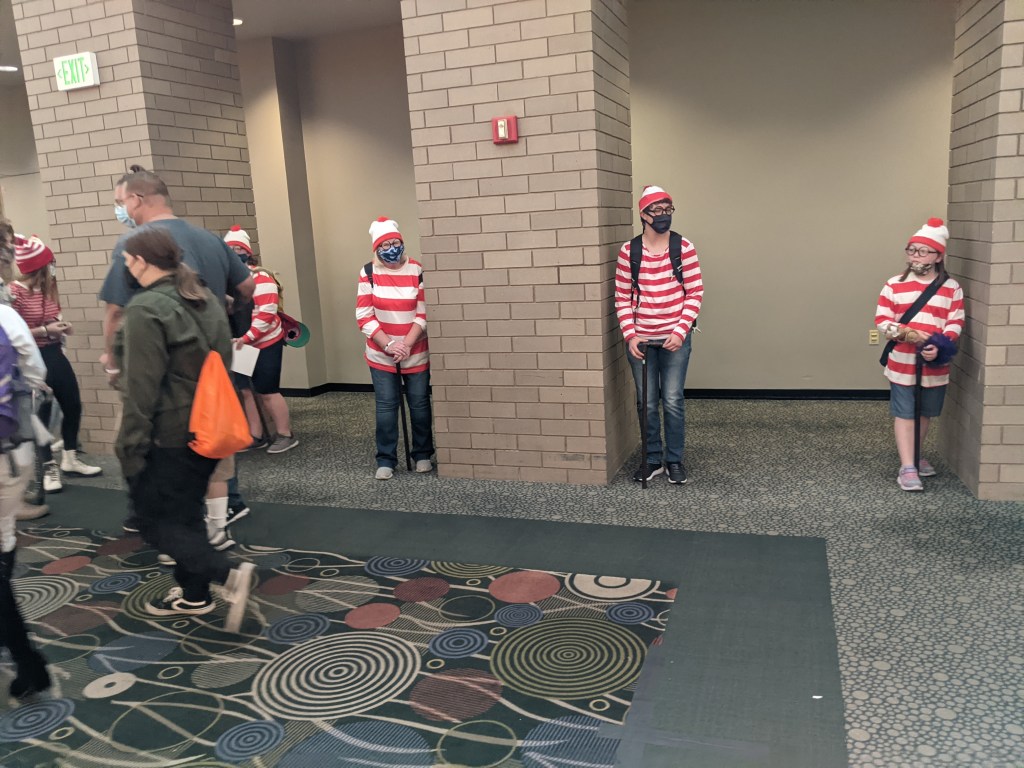
I got Waldo on the way into the convention this year.
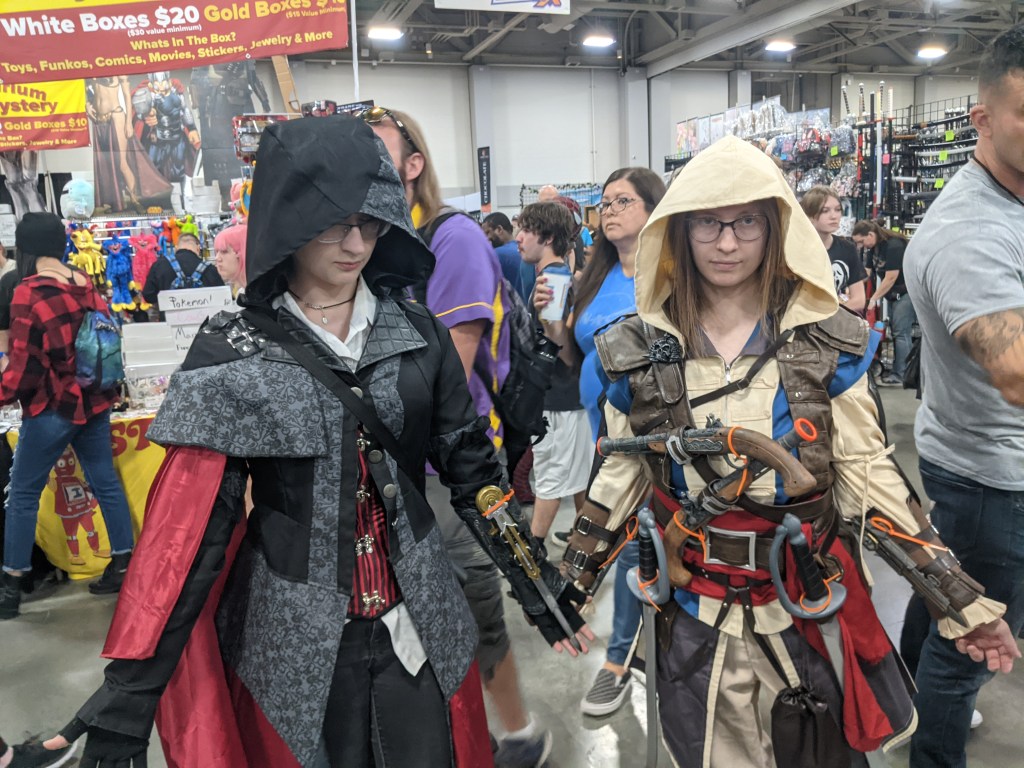
There was an Ezio back in, like, 2014 who was the reigning champion of Salt Lake Comic Con Assassin’s Creed costumes for years, but these two are finally giving him some competition.
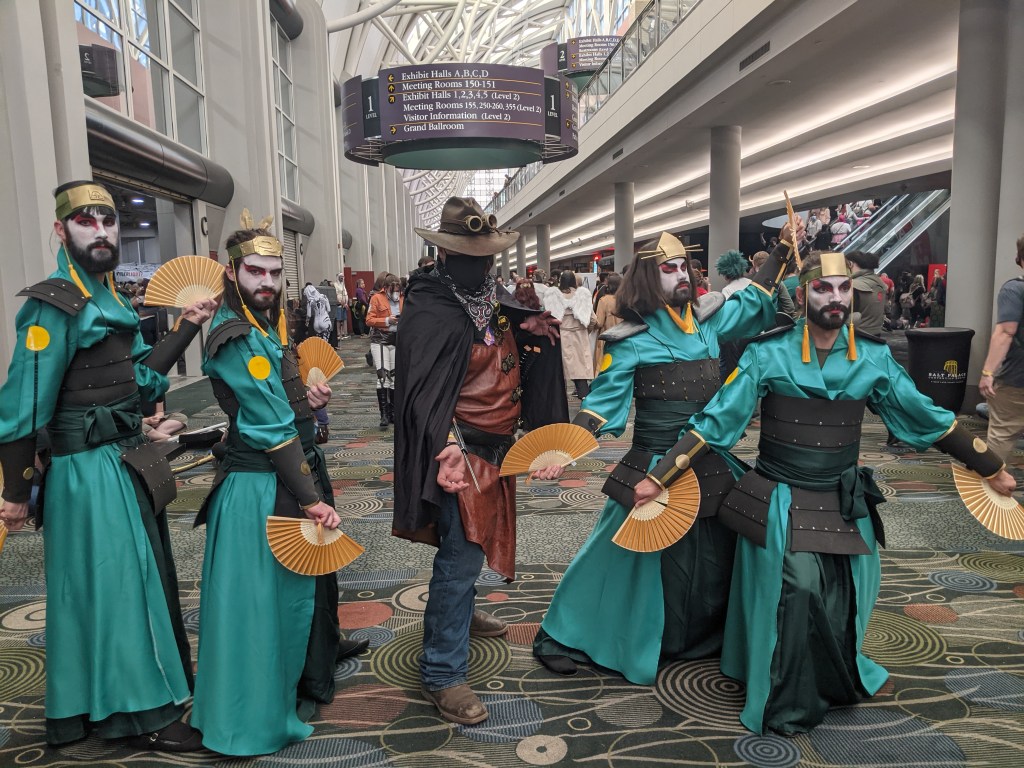
Milo is probably only identifiable when Kida’s there to clue you in, but as a couples costume, it works.
Star Wars Imperial costume design is some of the best villain costuming in all of modern media.

I still want to see an expanded Kung Fury that has an extended Barbariana arc where Thor has a kaiju fight with mecha-Jormungandr and Kung Fury beats up an evil wizard. Maybe some more Hackerman stuff, too.

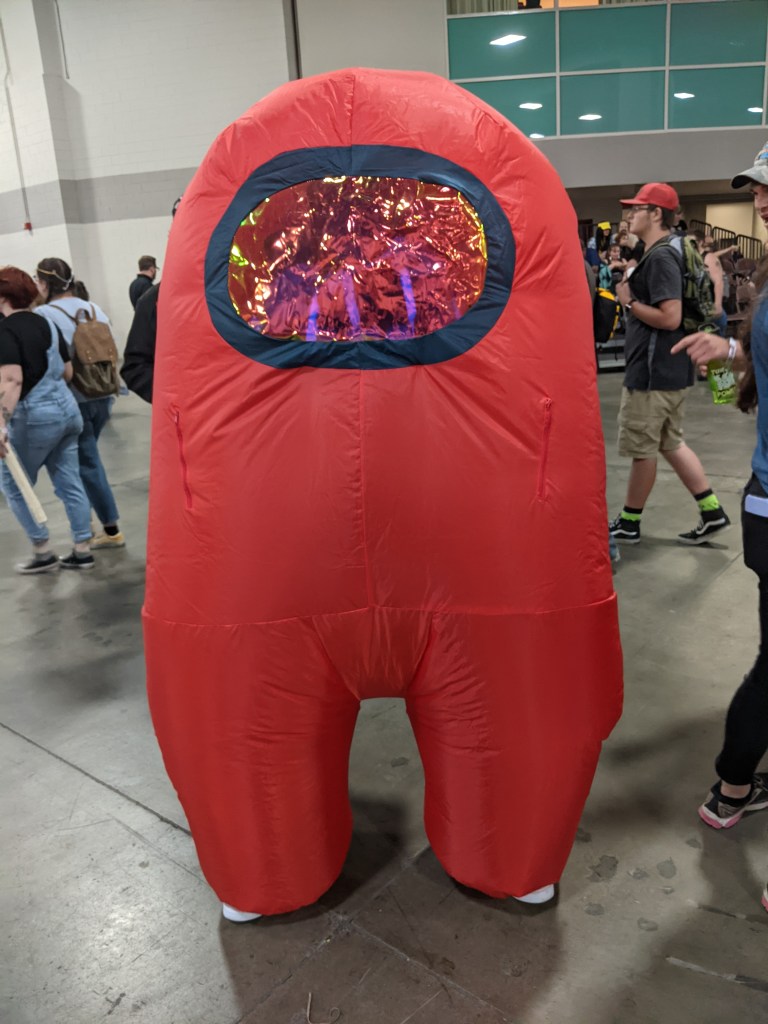
I never saw them together, but there were a bunch of Among Us costumes at the con.
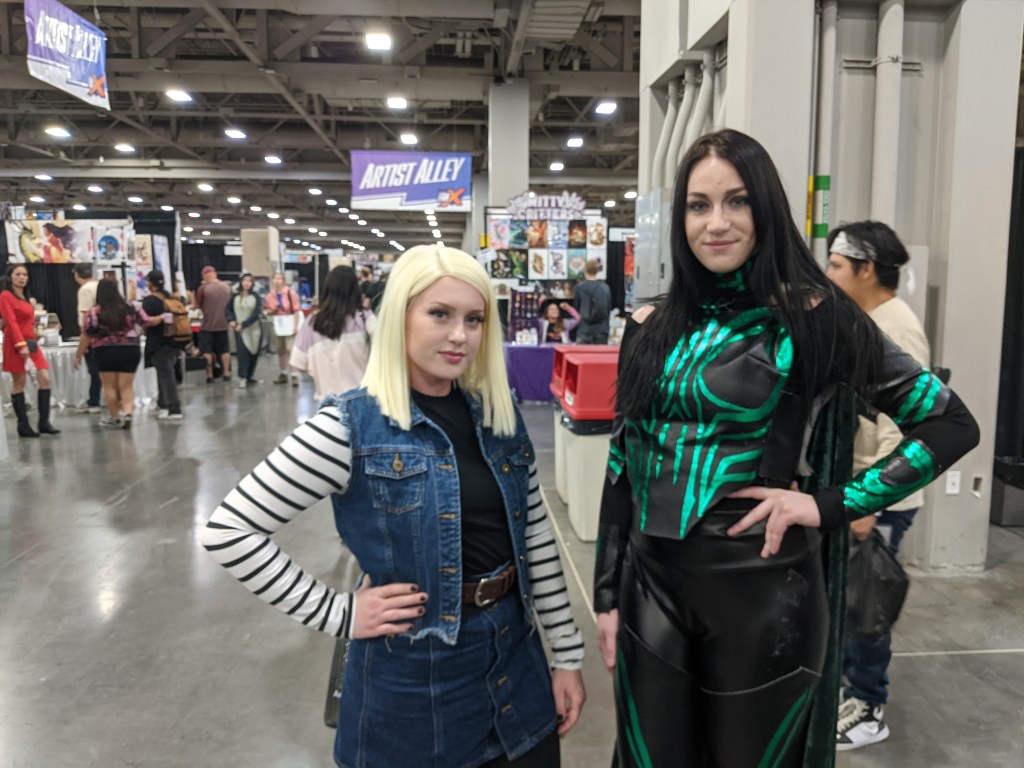
The androids are some of the most underused characters in DBZ. Seventeen and Eighteen especially. Not sure who that is on the right.

I found these two separately. Not sure if they came together.

There were actually two distaff Pyramid Heads at this con, but I didn’t realize the second one was different from this one until she was too far away to get a good picture.
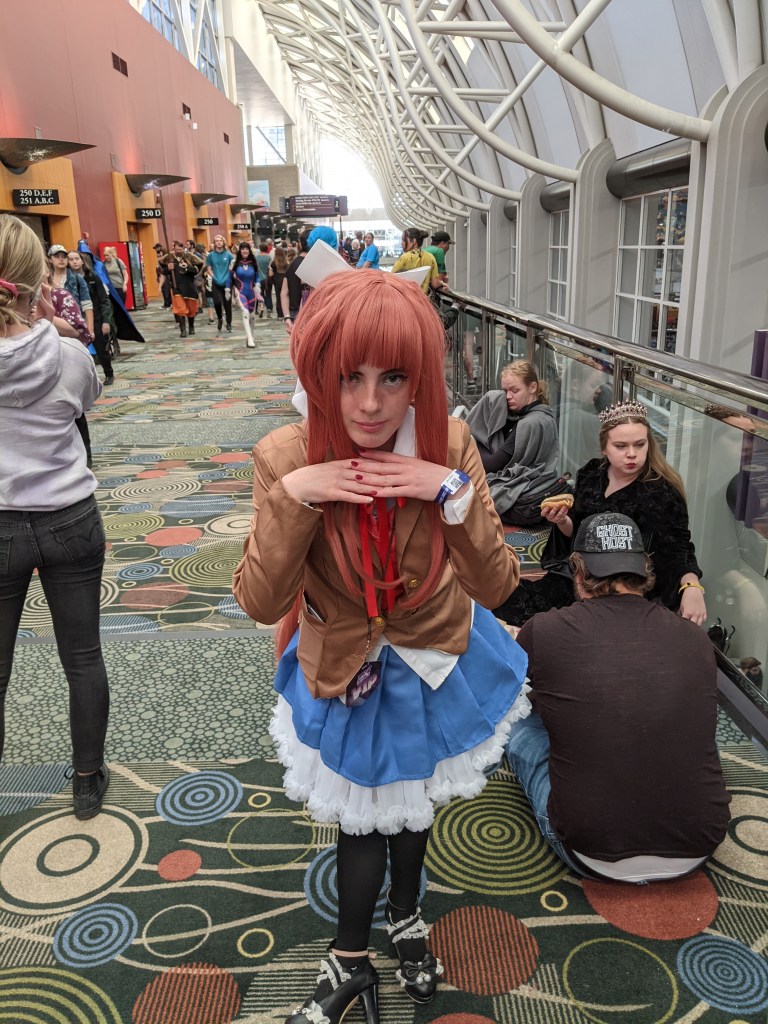
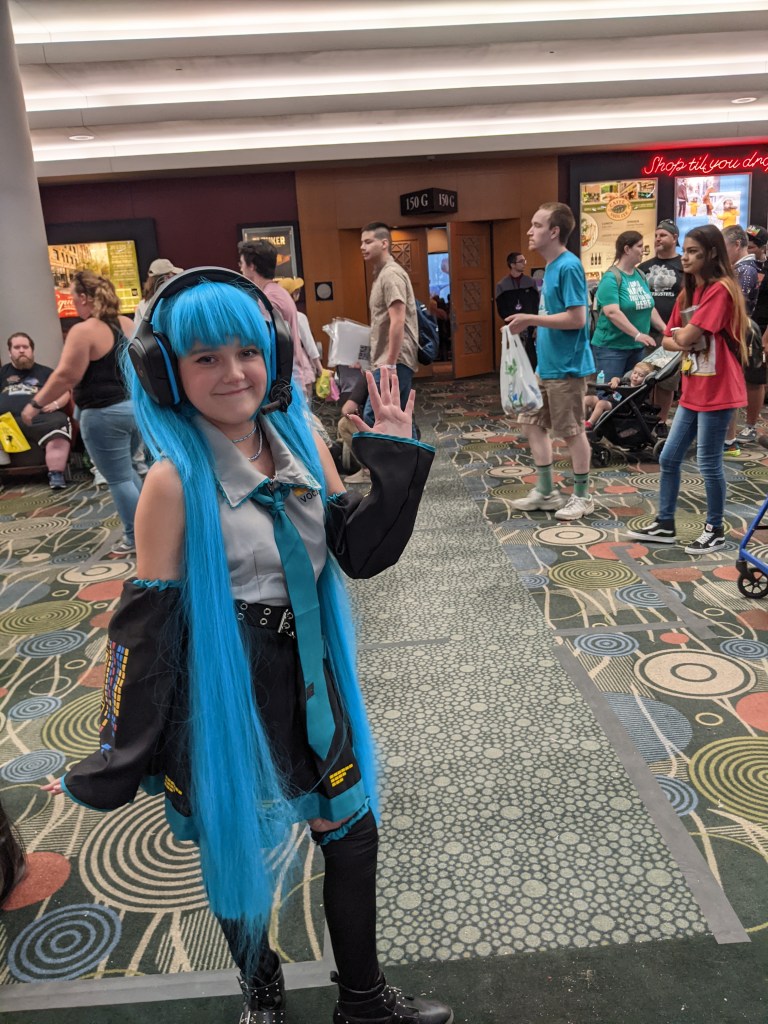
Vocaloid has some pretty strong character designs. I’d love to see a group costume for them.
Helluva Boss continues to represent.
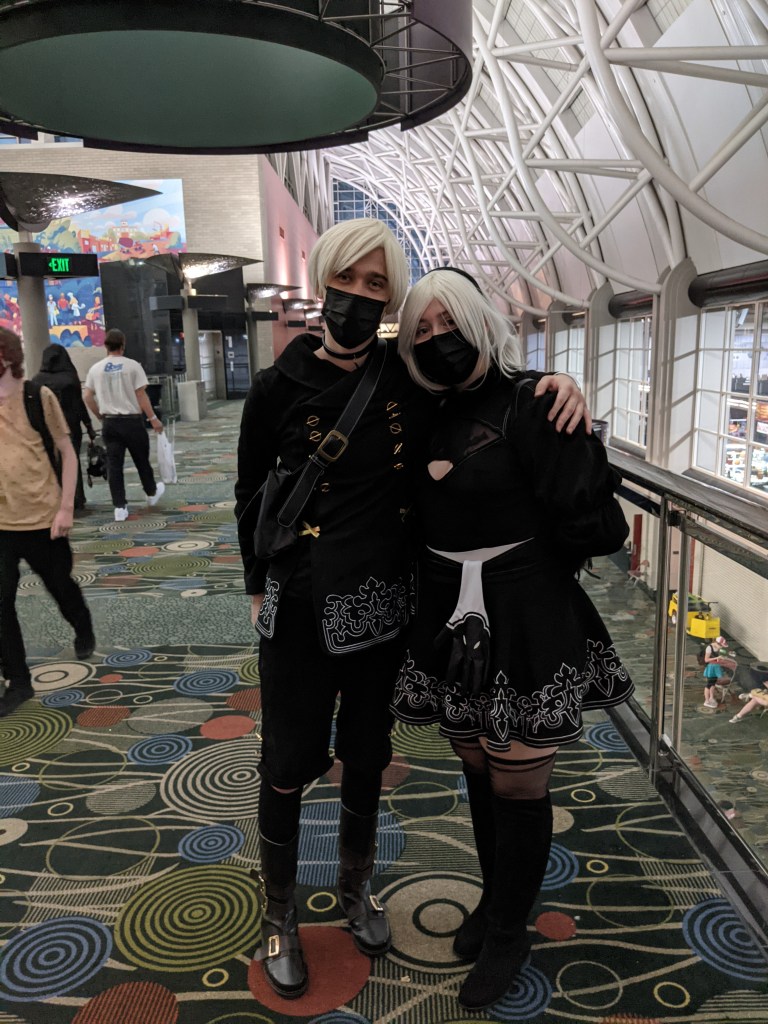
There’s almost no piece of either of these costumes that can’t be bought from a regular clothing store, yet they’re very recognizable. I expect they’d work just as well separately as together.

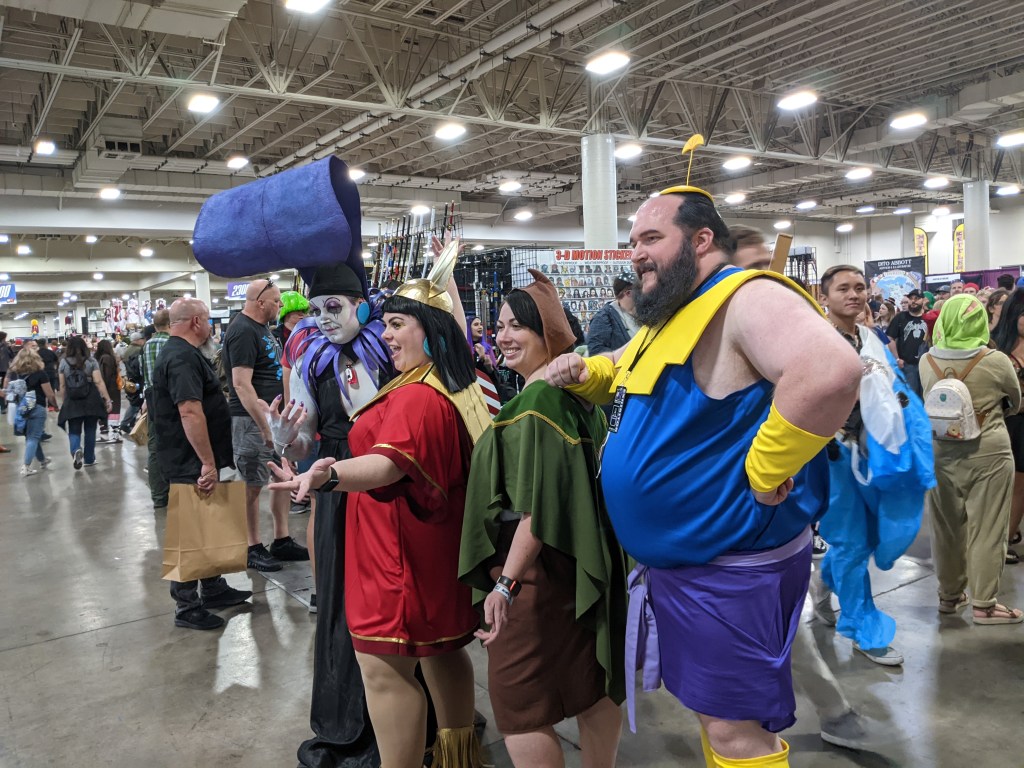
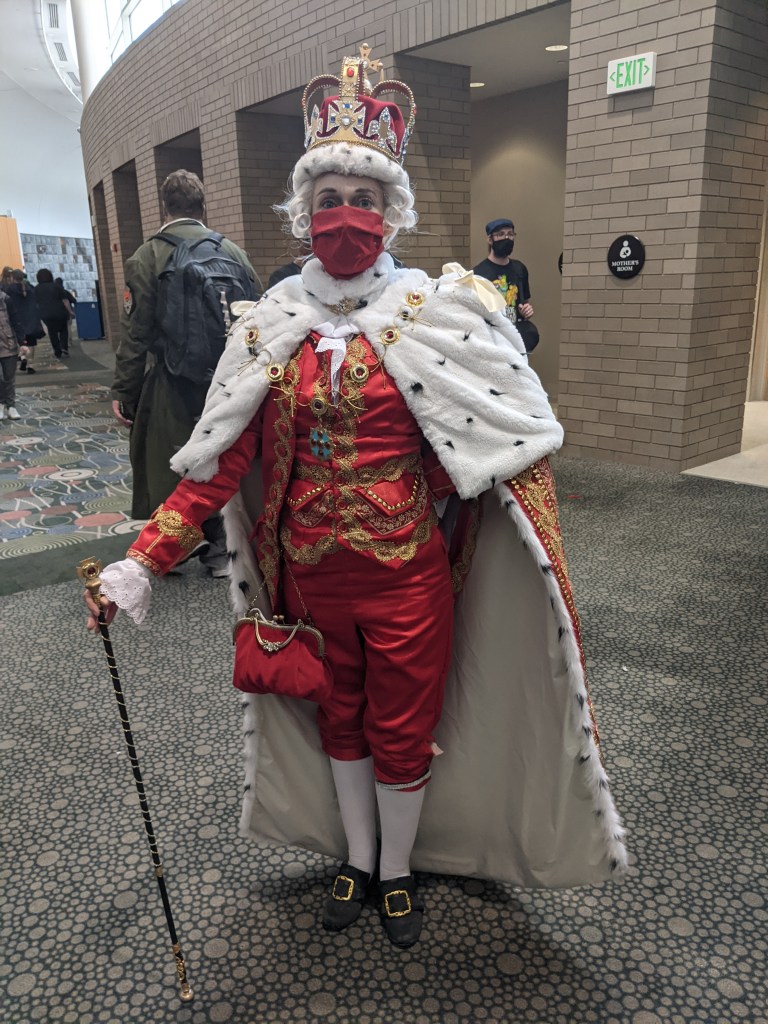
Emperor’s New Groove was a huge departure in style for a Disney animated film, but it’s one of the best movies they ever made.

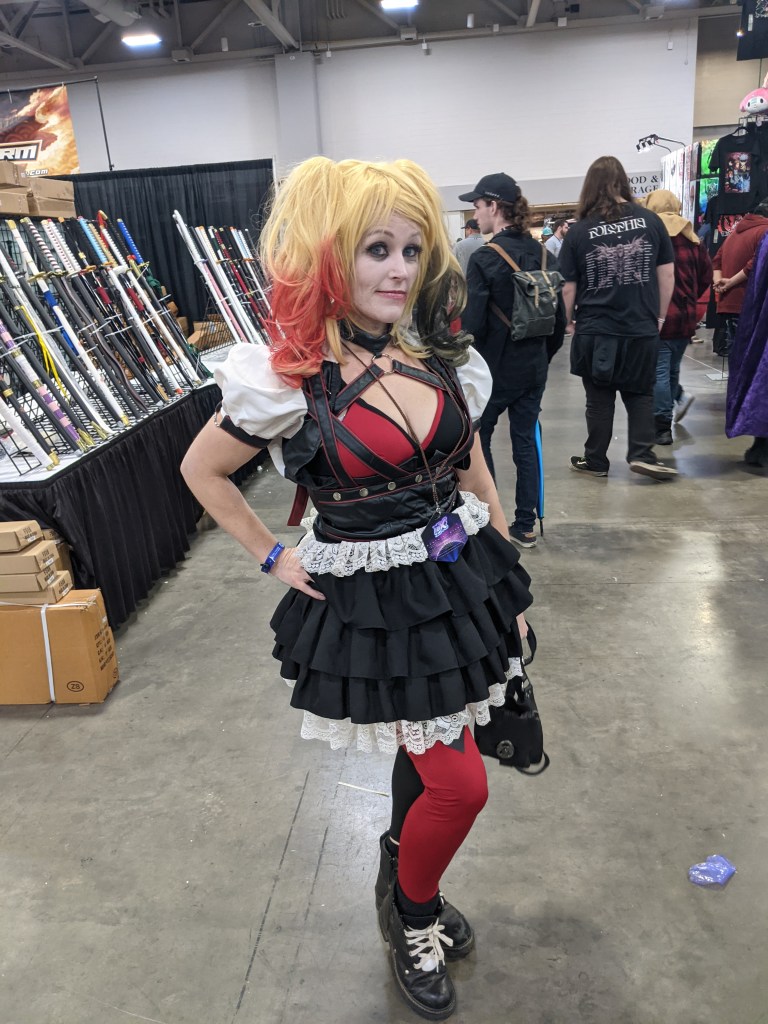
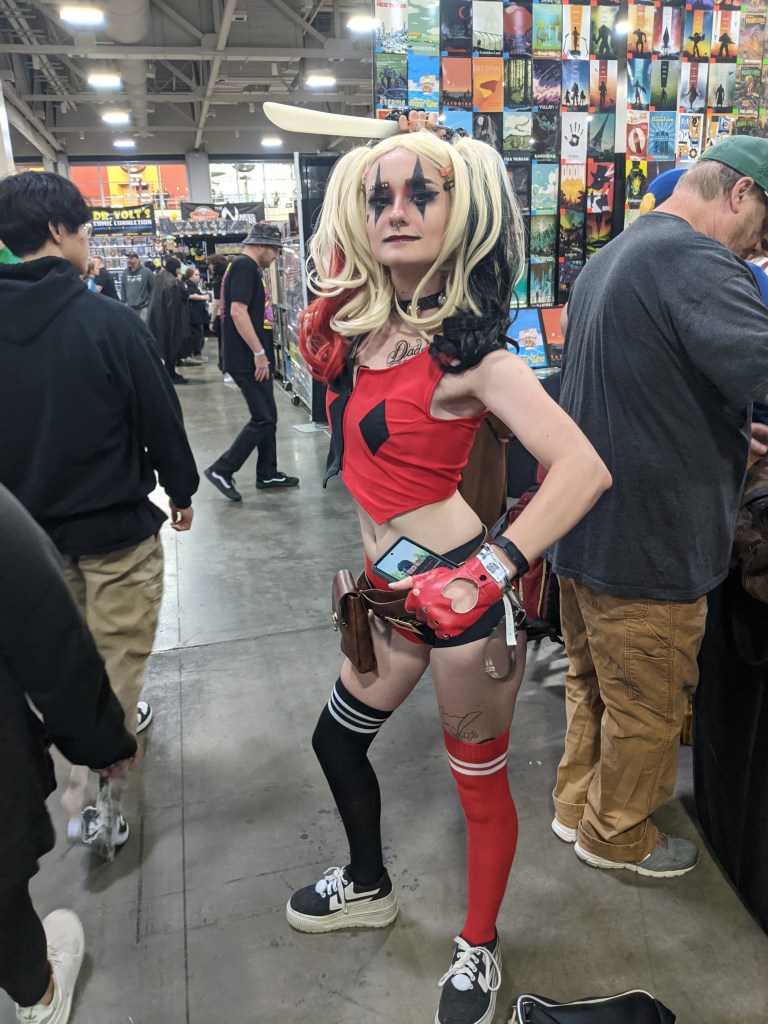
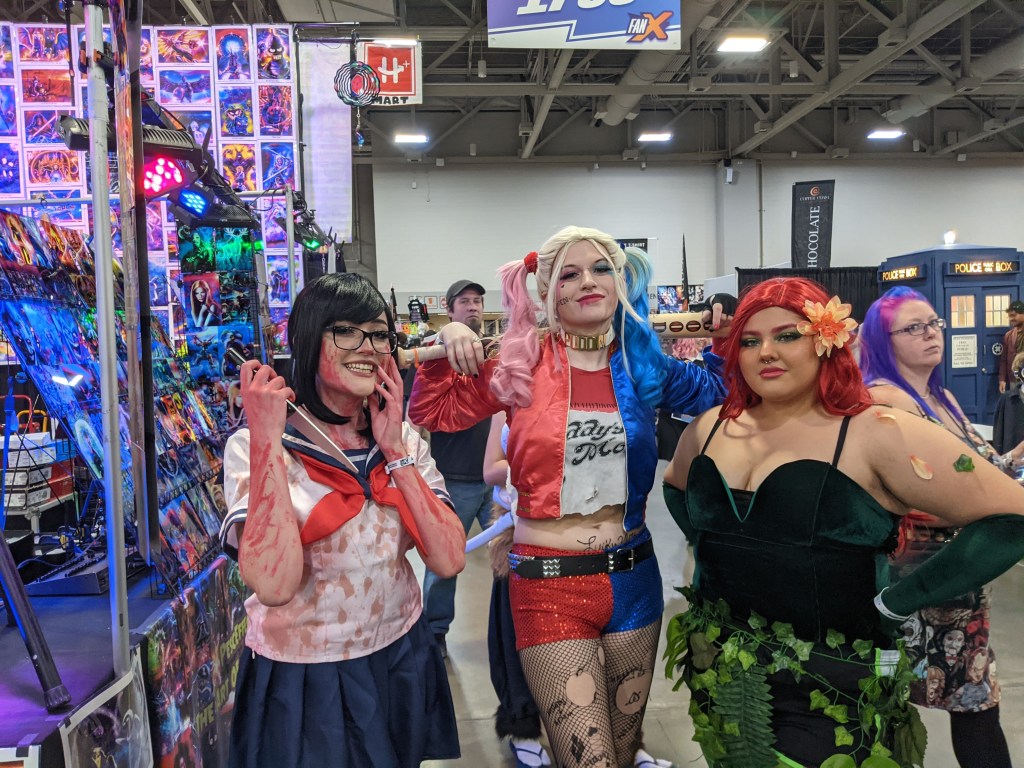
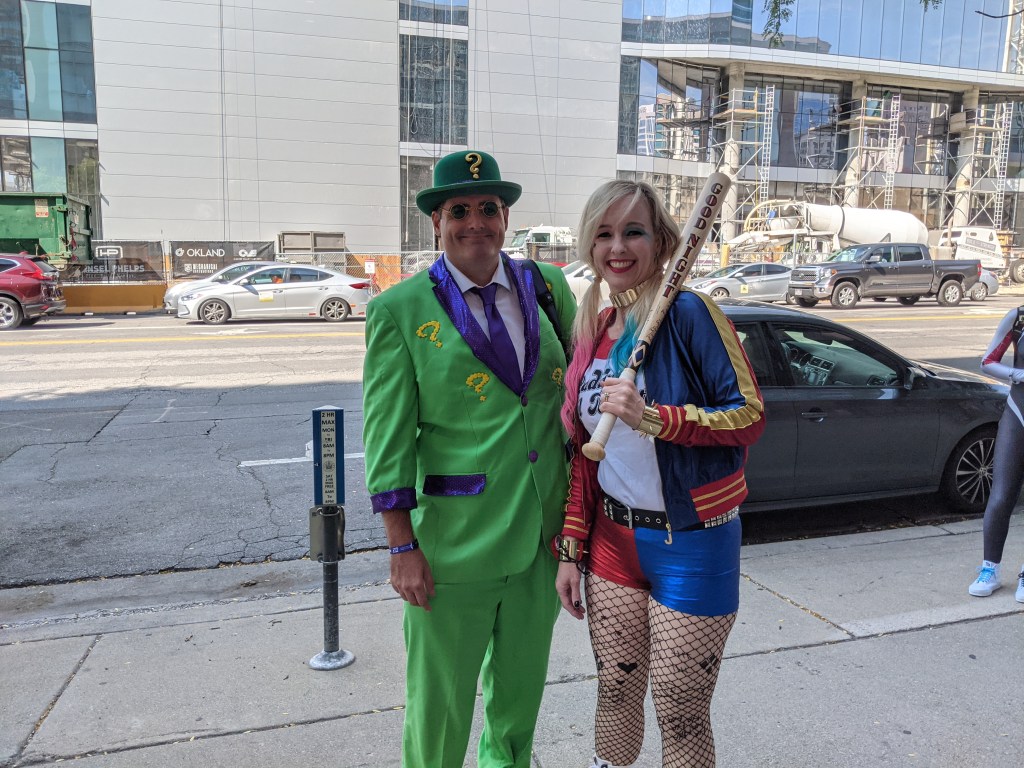
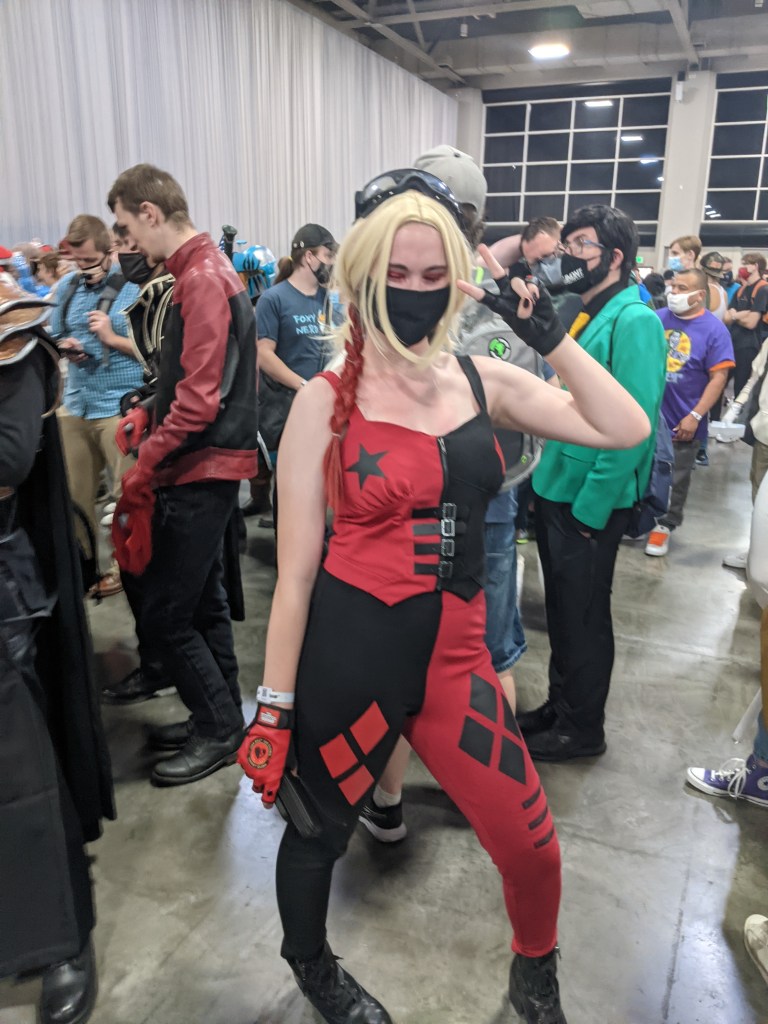
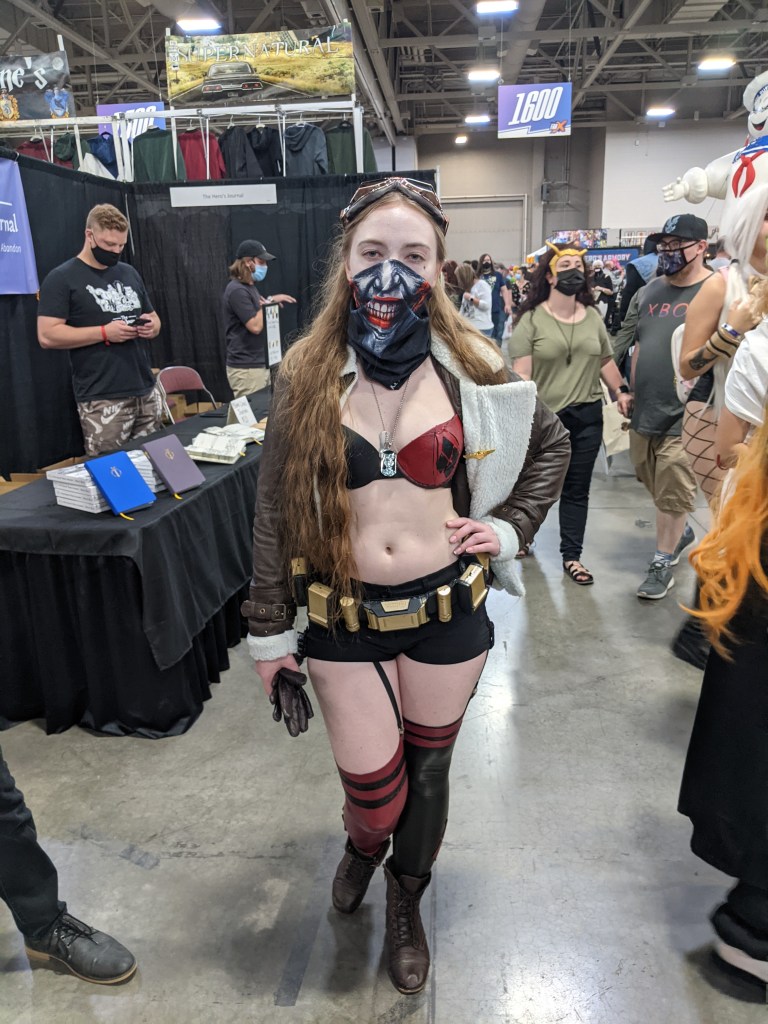
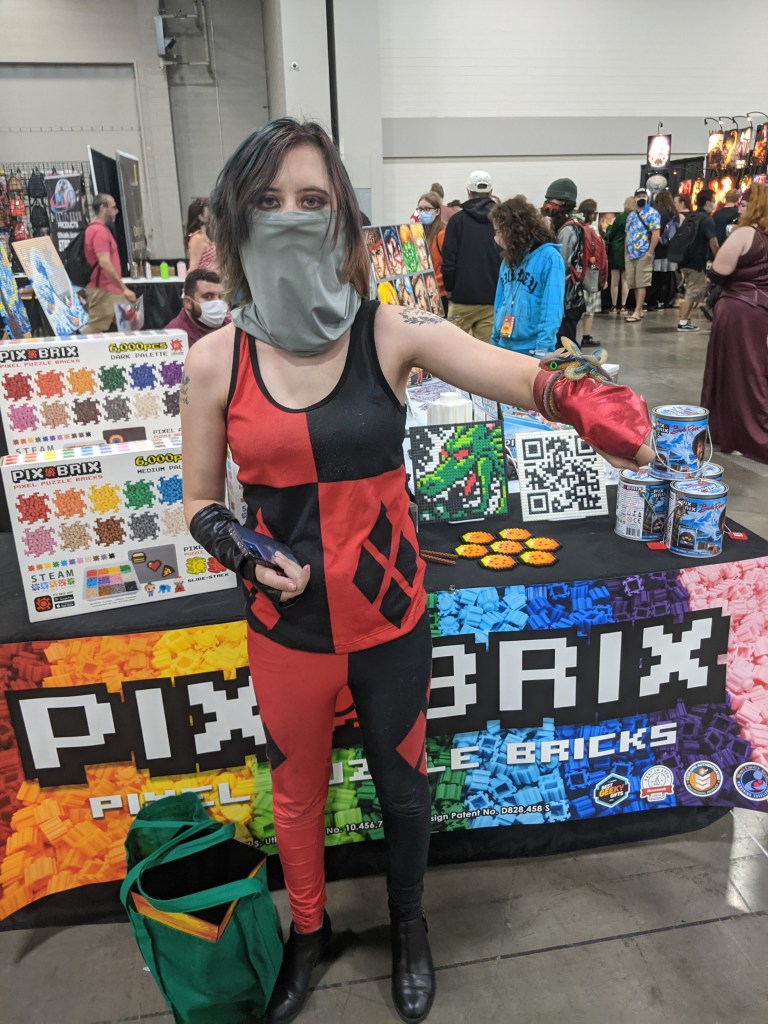
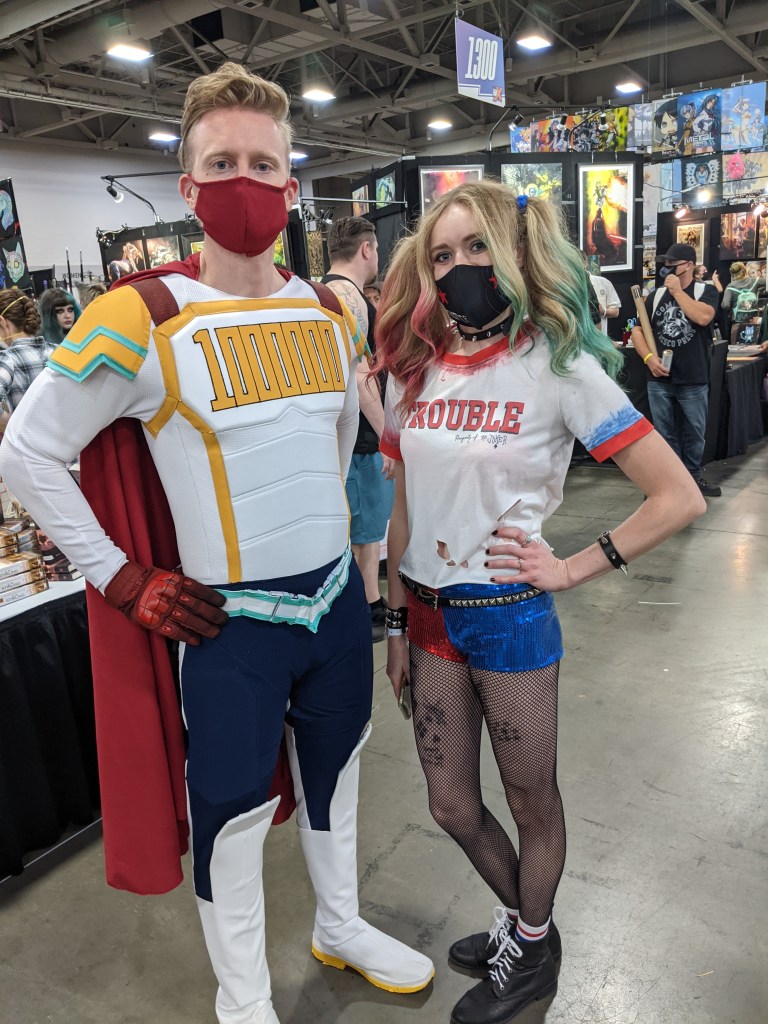
I was more worn out and less zealous about chasing down Harleys this year, which is part of the reason why there’s only six, but I think the costume might finally be on the way out.

Salt Lake Comic Con 2021

There was no Salt Lake Comic Con in 2020, obviously, but they booted things back up for 2021. The vaccine had come out a month ago, and everyone was cautiously creeping out of their bunkers with masked faces and little band-aids on their arms from the booster shots. It’s still not really clear to me whether or not this kind of thing was a good idea for society, but I had firmly secured a fulltime job making D&D books for Kickstarter at that point, which meant it was very easy for me to quarantine for two weeks both before and after these kinds of events, so any covid that bodyhopped into me hoping to jump into a new host later on was in for a rude surprise even if my shiny new antibodies turned out to be asleep at the wheel.

I didn’t end up posting any pictures, though, so let’s drop them here to get us caught up before I move on to 2022.

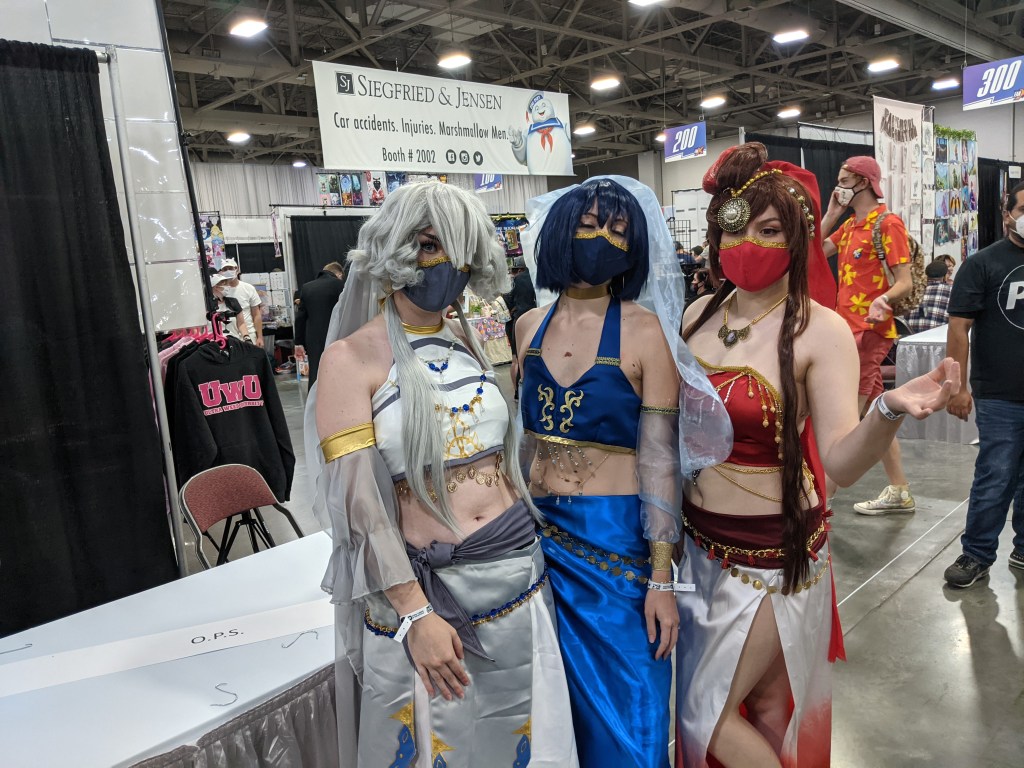
A lot of people just slapped their everyday mask onto whatever costume they were wearing, but some made costumes that had masks built in, like these three. No idea who they’re cosplaying as, but I respect the commitment to incorporating the pandemic safety measures into the costume.
Praise be.
Helluva Boss had a lot of really good episodes, but it keeps setting up long-running plots and not following up on them, when it could’ve tied those plots off in their debut episode and avoided created expectations. Fizzbot here is still an awesome character and costume, though.
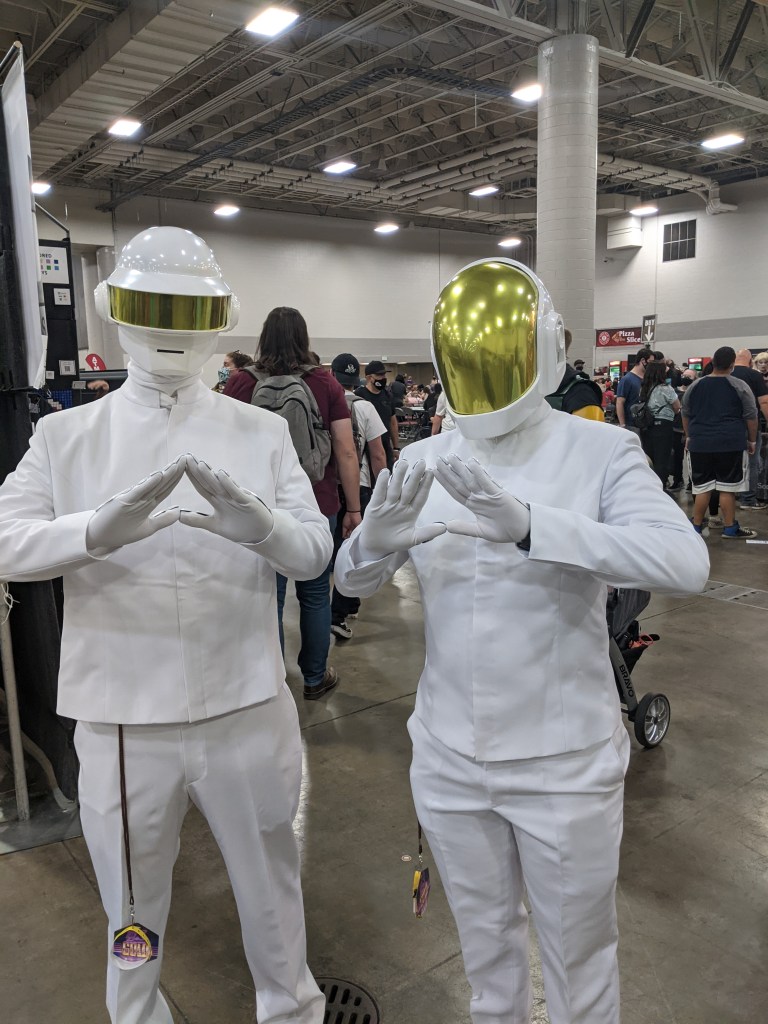
Another costume that I think may have been selected specifically due to pandemic concerns. The only way to get more protected would be with a fully functional spacesuit carrying an independent oxygen supply.
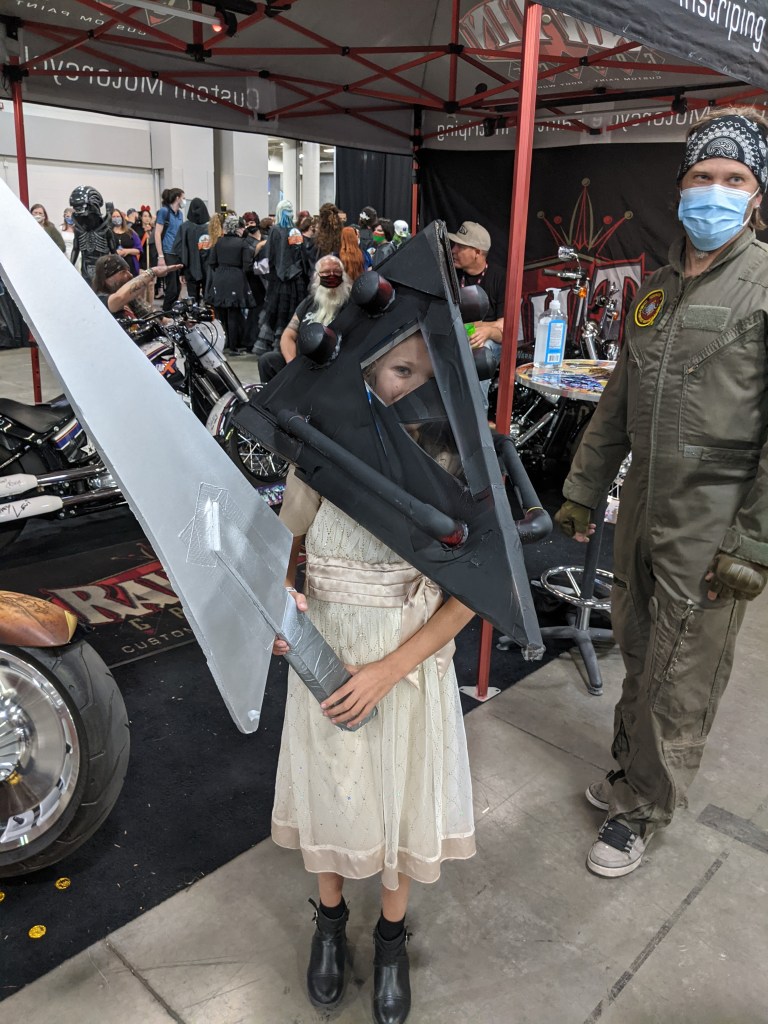
Pyramid Head has been coming up at Comic-Con a lot, lately. Silent Hill is well and truly dead, so I’m not sure what’s causing the uptick. I like the pint-size take on the costume, but no points for pandemic safety. It doesn’t count as a mask if you’ve punched giant fucking holes in it at mouth level.

Continuing our trend of people not taking the pandemic seriously. Avatar is always a reliable source of good group costumes.

Even with the Con being cancelled in 2020, this has my Waldos-per-year quota covered through the end of Biden’s (first?) term.
Da da da da da daaaaaaaa da da da di ya da da da da di ya da
The more modern the character is, the easier it is for the cosplayer’s everyday facemask to work as part of the costume. This Aeris, for example, almost looks like she could be “pandemic Aeris” the same way you might have variants like “steampunk Aeris” or “spear Aeris” or whatever. The color scheme’s off, though. And the real star of this is obviously the chocobo, but there’s less to say about that.
This game had god-tier character design.

And the Harley Quinn round-up clocks in at thirteen Harleys. Suicide Squad Harleys are no longer even a plurality of the set, with only 3 Squad Harleys compared to 4 BTAS Harleys (7 if you count a couple of bikini Harleys that use the BTAS symbols and color scheme).

Okami’s North Ryoshima Coast Was Probably A Late Addition To The Game

I frequently speculate about how certain odd things in a game may have come about due to relatively late decisions in the development process, late enough that the change might have left some detritus lying around. I strongly suspect one such change is the role the Water Dragon plays in Okami.

The second act of Okami is a cartoon political drama centered on Queen Himiko of the capital city of Sei-An, the capital’s high priestess Rao, and the underwater Dragonian people who live under the waves off the nearby Ryoshima Coast (it should be noted that while the people are mostly drawn from Japanese legends dating back millennia, the locations were made up for the game).

When you first arrive in Sei-An City, the city is crippled by plague, so all the side quests are unavailable. There’s not much to do except follow the main plot, meeting up with Priestess Rao and salvaging a ship sunk by the rampaging Water Dragon off the coast. As you leave the ship, you are pursued by the Water Dragon. It’s possible to escape the Water Dragon, but only if you’ve invested in enough magic reality-warping ink to draw enough lilypads to let you jump from pad to pad safely to shore (Okami’s protagonist is wolf-form Amaterasu, and therefore much faster jumping from pad to pad than swimming). If you’ve been spending your XP on health or wallet upgrades (and possibly even if you’ve just been blitzing the game and not getting any XP from side quests or feeding animals and stuff – I had tons of XP and lacked ink because I gave it a low priority, but I’m a fairly thorough player), or if you try a less effective escape strategy like creating one lilypad and using ink to create gusts of wind to blow you towards shore, you will be caught by the monster, whereupon you…end up safely on shore, exactly the same as if you’d successfully escaped the Water Dragon.

A number of adventures ensue. You shrink down to tiny size and have a Fantastic Voyage in the Emperor’s body (different guy from Queen Himiko, but he’s a minor character) to defeat the source of the plague, meet Queen Himiko and a friendly orca who can swim fast enough to outpace the Water Dragon so long as you’re not stupid which lets you explore the outlying islands, find one of the zodiac gods who’ve been sharing their magic reality warping ink brush powers with you, and discover the hidden whirlpool that leads down to the city of the Dragonians. There, they ask you to go on another Fantastic Voyage, except this time instead of shrinking down to fit in a human body, you are staying normal size to go into the Water Dragon and purge the corrupting spirits that have driven him mad. Plus, once you get rid of the Sei-An City plague, a bunch of side quests open up, so you might run around doing those for a while.

I bring all this up to make the point that you do a lot of stuff between your first encounter with the Water Dragon and the point where you go inside. And the method of getting inside is that there’s a chamber in the Dragonians underwater palace where the Water Dragon perpetually has his head stuck in with his mouth wide open. It’s kind of a weird way to get inside the Water Dragon, and matched with the weird part of gameplay where you get chased by the Water Dragon away from the sunken ship and have to guess the fastest way to escape on your first try or else get deposited on shore automatically and anti-climactically. I suspect that originally the dragon would swallow you as you tried to escape the wreck, and you would do the Water Dragon dungeon before you cleansed the plague in Sei-An City, and all the plot beats with the cat god’s tower and exploring the islands and the underwater palace of the Dragonians were added later, likely because Okami’s Act 2 is pretty lightweight without them.

Further evidence in support of this theory: Ryoshima Coast is split into two zones, Ryoshima Coast proper and North Ryoshima Coast. North Ryoshima Coast is where every single plot beat required to get inside the Water Dragon is located, but Ryoshima Coast proper is where the shipwreck is located and where your first encounter with the Water Dragon takes place. If you move the Water Dragon dungeon to happening after you get swallowed while escaping the shipwreck, you can very neatly excise North Ryoshima Coast with only three small edits required: First, you must move the departure point for Oni Island (the stronghold of Act 2’s main villain Ninetails, which can only be reached with the help of both Queen Himiko and the Water Dragon) from the viewing platform in North Ryoshima Coast to the nearly identical viewing platform in Ryoshima Coast proper. Second, you need to make the route from Shinshu Fields (the first region of the game) to Kamui (where Act 3 starts) accessible by double jumping, without needing the cat god’s wall climbing power, because the cat god is no longer a thing. Third, you need to edit references to thirteen zodiac gods to instead be references to twelve. You get the double jump much earlier than the cat climb (in fact, if the height of the cliff was shrunk but its shape was otherwise left alone, you could reach the top with the wall jump you have at the start of the game), but that’s no problem, because you also need the thunderbolt to get to Act 3, and you get the thunderbolt from Oni Island at the end of Act 2.

And you probably know that the Japanese zodiac only has twelve signs in it to begin with, and that Cat is not one of them. You may also know that the Cat takes the place of the Rabbit in the otherwise identical Vietnamese zodiac, and that Japanese/Chinese legend has stories explaining why Cat didn’t get to be part of their zodiac (short version: Because Rat is a bastard). Cat’s inclusion as a thirteenth zodiac god makes perfect sense, but it would have made just as much sense to exclude Cat, so I find it noteworthy that it is Cat who is found in North Ryoshima Coast, the one zodiac god who could plausibly have been added near the end of development rather than planned from the start.

And the cat climb power is used almost nowhere in the game except North Ryoshima Coast. While the internet has no encyclopedic listing of all cat climb points, the Okami wiki does note that the cat climb power is one of the least used in the whole game (the wiki uses the power’s official name of “cat walk” – I have switched to “cat climb” to make its use more intuitive to people who have not played the game, but it’s the same power). The only three cat climb points I remember in the entire game outside of North Ryoshima Coast is one in a dungeon in Agata Forest, the one you use to reach Act 3 in Shinshu Fields, and once in an Act 3 dungeon (although, in fairness, the last one actually would’ve required redesigning a small section of the dungeon to add, rather than just adjusting the height of a cliff and adding a cat statue). Contrariwise, the super-dig power you unlock that lets you dig up hidden objects which are buried in solid stone has a couple of dig points at every map in the game, even though you unlock it at around the same time as cat climb (it’s in Ryoshima Coast proper).

Here’s a bonus speculation, although I’m much less sure about this one: I think Act 2 was originally meant to either come before the confrontation with Orochi at the end of Act 1, or else its antagonists Ninetails and Blight were originally supposed to be unrelated to Orochi. In the game as it is, these two emerged from Orochi’s slain body as two out of four dark spirits who fled to cause mischief far away from Shinshu Field where half of Act 1 takes place. But Act 1 also takes you to Taka Pass, and Taka Pass borders Ryoshima Coast, and the reason why you can’t go to Ryoshima Coast and start Act 2 early is because the city checkpoint is closed due to the mysterious plague fog that’s descended on the city (you have to use the inferno power you get from the end of Act 1 to blow up a cannon and knock the bridge back down). But Orochi’s not dead yet, so Blight and Ninetails shouldn’t be doing anything! If Blight and Ninetails are just other, lesser demons, like the Spider Queen and Crimson Helm you fight in Act 1, then this makes perfect sense, but if they spawn when Orochi dies, then who’s causing the plague fog? Was Orochi doing it personally and then Blight took over after Orochi is defeated? If that’s the case, then what did defeating Orochi even accomplish?

There’s a lot of explanations for this early Blight problem. Maybe it was decided late in development that Act 1 should be completely self-contained, which required bumping the defeat of Orochi up to much sooner in the plot, so that Susano’s arc could be tied off there. Maybe the whole plot of Act 2 was always supposed to come after Act 1, but was originally disconnected and episodic from Act 1, with Blight and Ninetails getting up to shenanigans totally separate from what Orochi was doing further north, and they decided that this made the game seem aimless (which is still a problem even after Act 2’s villains are tied to Orochi’s defeat – the first time I tried to play Okami some 5 years ago, I drifted away early on in Act 2 because it felt like Orochi was the climax and I was playing the world’s longest post-game section). Maybe it’s just an oversight, because Act 2 was built after Act 1, and the reason why Ryoshima Coast is closed to regular foot traffic was made up by someone who was thinking of the story as it was during Act 2, without stopping to think that players would first come here while exploring the boundaries of Act 1. Maybe it’s just a bug, and the guy who talks about why the bridge is closed is supposed to talk about how they’re trying to keep the cursed zones out during Act 1, and switch to talking about trying to keep the plague in during Act 2, but the flags weren’t made correctly so the guard talks about the plague fog during Act 1.

North Ryoshima Coast, though, I’m pretty confident that was added in after the game was already well into production in order to put some more meat on the bones of Act 2.

Far Cry 2 Has A Dumb Ending

At the end of Far Cry 2, the Jackal, the arms dealer who equipped both sides of the civil war that tore apart the fictitious central African nation you’ve been murdering your way through, turns out to be working on a plan to evacuate the entire civilian population of the nation and then trap the militia and mercenaries inside to kill each other to a man. The player character helps this plan at the very end, presumably including the part where both the Jackal and the player character kill themselves at the end, because the Jackal seems to think that war is a literal infectious disease and that you can’t just decide to stop fighting wars, you have to actually die or else other people might become infected by war-fighting just by proximity to you.

There’s so many dumb things in this plan. The idea that you can evacuate the entire population of a nation except for the combatants, when combatants make up maybe 20% of the population at an absolute extreme level of hyper-mobilization (5-10% is way more likely even for a civil war where logistics are relatively easy). The idea that war is an infectious disease and that the people who fight it have to literally die instead of retiring. The idea that the two opposed factions will keep fighting until all of them, every last one, are dead, when they’re already starting to come to a truce and are thus presumably both close to exhausted, which will not change even after the existing leadership of the two sides is totally annihilated.

There’s also the part where all your buddies turn on you for vague reasons. I can imagine a perfectly good reason: At the end of Act 1, one of the two factions (it changes based on your playthrough and makes no difference) has the other on the brink of total defeat and are trying to consolidate their rule by killing a ton of people, including all the mercenaries who kept the war going. You have a choice to either help your mercenary buddies defend the bar where you’ve been hanging out together for the whole act, or help a bunch of civilians escape the country. I chose the latter. The buddies who showed up to fight me were mostly the Act 1 buddies, with only one exception. That one exception tried to talk the Act 1 buddies out of starting a fight with me, although he does side with them when this inevitably failed. So the Act 1 buddies try to kill me because I abandoned them to try and save the civilians, and my one Act 2 buddy joins them because he’d already cut a deal with them to flee the country, probably because the Act 1 buddies showed up first and put a gun to his head.

They don’t actually say that, though. Act 2 Buddy (mine was Xianyong Bai) says his escape plan is still on, then the lead Act 1 Buddy (mine was Marty Alencar) comes out and says the deal was to leave me on my own and wants Act 2 Buddy to shoot, Act 2 Buddy tries to defuse the situation, and Act 1 Buddy starts shooting. Act 2 Buddy sides with Act 1 Buddy. My understanding is this plays out pretty much the same regardless of who you try to help at the end of Act 1, so it’s only coincidence that any of my buddies have any reason to dislike me. An equally supported but much stupider interpretation would be that the buddies have been infected by the war virus that the Jackal thinks exists and are killing people at random. It comes across like someone thought it would be cool to have your buddies turn on you in the game’s finale, but apparently didn’t follow that thought far enough to write some dialogue where they actually say why they’re doing it.

I wonder if there were originally supposed to be multiple endings? Towards the end, you have several missions where you’re assigned to kill a high-ranking member of the UFLL/APR by another high-ranking member of the UFLL/APR as they struggle for control of their respective factions, but can instead decide to kill the person who assigned the mission. By the end, you’ve whittled each faction down to exactly one named character, who are meeting at a jungle bivouac to discuss a unified government. Part of the Jackal’s plan is to kill them both in order to throw the factions back into chaos (this part, at least, makes sense – after the total massacre of the leadership of both factions, the remaining troops will scramble to re-establish a chain-of-command, and given the militia-and-mercenaries-duct-taped-together nature of the armies, it probably won’t be straightforward or bloodless). Another part of the Jackal’s plan is to collect the diamonds to bribe the border guards, which is where you fight your buddies. So it’s straightforward to have three endings: One where you go to the Bivouac and join the new government, killing your buddies and the Jackal to eliminate anyone who can destabilize the new regime, one where you go to your buddies and plan an escape together, killing the faction leaders and the Jackal so you can cut your way out of the country, and the game’s existing ending where you help the Jackal with his stupid plan. This still would’ve had the problem that the “good” ending is the stupidest one, but at least I could’ve helped my buddies flee the country instead. Honestly, it would’ve been much more in keeping with the game’s themes if the ending was to realize that we can’t do anything in this country except make things worse, so probably we should just leave.

Far Cry 2 Tried And Failed To Be Realistic

Half-Life is a 1998 first-person shooter that pushed the realism of the genre forward by having guns lie on the ground like regular objects instead of glowing red and spinning in the air. Its graphics have not aged well – it’s on the wrong end of the Half-Life gap, which is no surprise since the Half-Life gap is named after the way that Half-Life 2’s graphics, while clearly aged, look about as close to modern games released almost twenty years later as they do to the first Half-Life’s graphics, released just six years before. Despite this, I found that its atmosphere and immersion still worked even though I first played it fifteen years after its release, past the age when nostalgia is usually able to get its hooks in.

Far Cry 2 is a 2008 first-person shooter that tried to push the realism of the genre forward by portraying a civil war in a fictitious African nation somewhere in the blood diamond region, where two rebel factions with armies comprised as much of foreign mercenaries as of local insurgents fought over the remains of a country that everyone was fleeing as fast as they could. Healing animations involved digging bullets out of your flesh with a knife or setting horribly bent and twisted limbs, enemies with a sliver of health left limp around or fire at you from the ground while bleeding out, and you have to keep your anti-malaria meds topped off or you might find yourself weakened or even incapacitated by the disease in the middle of a firefight.

You can tell from the phrasing that I don’t think Far Cry 2 was as successful in its immersion as Half-Life. Far Cry 2 has a lot more horsepower behind it than Half-Life, so where did it go wrong? Certainly not in its environmental design. Far Cry 2 depicts central Africa with a variety of different biomes and settlements, although it does lack any major cities, which is a disappointment but not an immersion problem, and in fairness to the devs I can see why representing something on the scale of Kinshasa or Luanda while also making the surrounding countryside the focus would’ve been difficult. Luanda, capital of Angola, is a major, modern port city, and Kinshasa, capital of the DRC, is the third largest city on the continent of Africa. But also it would have to look big while also being dwarfed on the map by the surrounding countryside, which means the surrounding countryside would also have to be bigger, and it’s kind of inconvenient to traverse as it is. Mercenaries tried to have major cities on a map that focused on the countryside, and the end result is that Pyongyang feels puny. Far Cry 2 has the advantage of taking place in a fictional country, though, so it might just be a small country with no major cities.

So despite one minor disappointment, environment design isn’t the reason why Far Cry 2 is less immersive than Half-Life. And neither is weapon design. Far Cry 2 covers all the standard bases: Pistols, shotguns, assault rifles, LMGs, rocket launchers. It does lack a bit of Half-Life’s variety in weird things like the gluon gun, but that’s not an immersion problem. It’s the opposite: Half-Life had to earn things like the gluon gun with its commitment to its atmosphere, making these things seem like plausible bleeding edge tech from a laboratory working at the outer frontiers of science, when they would’ve come across as goofy hyper-tech if they were dropped in right from the start (and goofy hyper-tech would be fine in certain contexts, but not Half-Life, which takes place in something approximating the real world). Far Cry 2’s gritty setting of a country worn down by years (decades?) of civil war with secondhand weapons precludes that kind of tech, so it’s not a surprise or a problem that it’s limited to your more standard military armaments.

And it’s not Far Cry 2’s enemy AI that’s the problem, either. The AI have the aforementioned limping around and firing from the ground when nearly dead, which makes them much less predictable than your standard FPS enemies, including those from Half-Life. They’re also much more willing to flank and surround the player, and the absence of any red dots on a minimap means you can get surprised by a straggler in an area you thought you had cleared, and that finding a sniper can be a challenge. And they’ll happily run you over if they can, which is an anti-climactic but not unrealistic way to die (if you want to play FC2, learn to dive for cover when you hear an engine revving). Far Cry 2 is better than perhaps any other video game at getting across the chaos and tension of a modern battlefield, where there’s never any clear signal as to whether or not you’re safe or when you’re in danger (although the game’s AI is, of course, oversimplified compared to real battlefields, and you can eventually pick up on patterns for where enemies are located and when they bring in reinforcements – still, Far Cry 2 puts a lot more effort into mitigating the limitations of AI when emulating battlefield chaos, and it pays off).

No, the problem with Far Cry 2’s immersion is its ambition. Half-Life simulated an underground laboratory under attack from aliens. You see a lot of friendly scientists and security guards early on, but they thin out as the crisis goes on, as everyone is either killed or holed up in a secure location. Far Cry 2, on the other hand, aims to simulate an entire country. The map, even combining both north and south together, is all of 6×3 kilometers, but that’s enough to feel like a wide expanse of rural countryside. No, the problem is that, outside of the in-engine opening cut scene and a couple of mission-specific spawns, there are no civilians. If you see a car approaching, you can and should unload your LMG on it or shoot it with a rocket launcher or whatever, because it is always an enemy.

Despite the fact that you look pretty indistinguishable from the mercenaries employed by both sides, both factions attack you on sight even when they’re on patrol on the roads, even early on when (as tracked by the game’s reputation system) you are a total unknown. You should be indistinguishable from allied mercs of either faction, but somehow everyone knows to attack you immediately. Even guard posts shouldn’t necessarily be able to suss out that you’re an enemy right away. Plus, while you have to take jobs from both factions to complete the story, you can support one over the other exclusively until they run out of missions, then switch to the other. At minimum, during the first half of this process, you’d think the one faction would stop shooting at you. The briefings given before missions do make it clear that you’re valuable because you’re a deniable asset, one which their own troops don’t know is (for now) on their side, but that suggests that both rebel militias are shooting at everyone they don’t personally recognize. Unless these armies are both 200 or fewer troops, that should result in tons of friendly fire.

And, perhaps most important of all, the game’s immersion is broken by its irritating and frustrating mechanics added, most likely, out of a misguided obsession with realism. I mentioned earlier that enemies can run you over, but this is a very not-fun way to be forced to reload a save. Being overrun by enemies who get on all sides of you makes a lot of sense, you’re supposed to be just a regular mercenary so really it’s kind of weird that it takes like five or six people to overrun your position instead of just three (a consequence of the deep reserve of health you get from being Player One). But also, realistically speaking, why would you ever send one person by themselves to storm positions held by eight enemies? Realistic drawbacks are only immersive if you provide realistic solutions, but the realistic solution to the problem of being outflanked is to bring more guys with you. The best you get in Far Cry 2 is a single buddy, you can only get them on the field by almost dying, and they won’t follow you to your next objective, just hang out at the spot where they bailed you out that one time (which they won’t do again until you reach a new safehouse to refresh the buddy rescue).

Plus, as is often the case with these kinds of things, realistic features that make fights easier are ignored. The enemy retreats under only the most extreme of circumstnaces, only if you’ve killed the vast majority of their allies and you’ve completed enough missions to have a strong reputation as a deadly enemy (and it still happens so rarely that I wonder if the times I’ve seen enemy remnants running away is actually a bug). Given these are rebel militias and mercenaries, you would expect them to start running away much more easily.

It’s hard to tell exactly how much of the problem is that Far Cry 2 was overly ambitious and ran out of development time on which to deliver on their ambitions, and how much Far Cry 2’s devs thought of “realism” as synonymous with “hardcore” and ignored parts of reality which make things easy or pleasant. It’s true that reality is generally more gruesome and difficult than video games, so being realistic will move things in that direction, but there are in fact nice things in the real world that video games have failed to emulate, and leaving them out is immersion-breaking. For example, unlike in video games, the real world is primarily made up of people who aren’t murderers and don’t mean you any harm. Even in warzones where people who want to kill you are common enough that you bump into them frequently, they still make up a maximum of like 10% of the total population, often less.

The malaria attacks were considered the most annoying part of Far Cry 2, but for my money I think the way enemies instantly recognize you even at very low reputation is worse, especially when combined with how quickly they respawn. Regardless of exactly what feature was the most aggravating, there were lots of gameplay elements intended to make Far Cry 2 more gritty and realistic, and which might’ve worked if the game had been realistic in general, but unfortunately it uses realism exclusively to disempower the player.