Sew You Want To Be A Hero: Power Gaming

Chapter 6

The party is sifting through the ruins of the toy shop, and the conversation drifts towards Dark Threadbare’s time with the raccants.

“Yes. They gave me to their children to play with, at first. They played rough! It was very dangerous. But when they saw I could move things and carry things they took me from the children and made me work for them. Then I got attacked by those big hatted cloud things one time and beat them up with my spade. That’s when their Chief, the great Hoomin decided I should be in his dungeon. Then you saved me from that. And then some of them were dead out front and I don’t know why.”

So Dark Threadbare was endangered by the raccants, then enslaved by them, and finally abducted – to the point where she refers to Threadbare as unambiguously having “saved [her] from that.” This does not sound like a fun time.

Threadbare twitched. Zuula’s words rang through his mind. Friends don’t lie to friends, mostly. He pondered it for a second, and decided that it would be bad to lie, here. “They were dead because I killed them.[“]

Okay, if this was going to be a character moment, then probably Zuula shouldn’t have reminded us of her total amorality in the same breath she provided what’s meant to be this scene’s moral guidance. This is the kind of minor nitpick that I probably wouldn’t notice if it weren’t reminding me of how atrocious Zuula is, though. Like, if she had a coherent philosophy in which she actually considers some things to be dishonest or dishonorable, then it’d make sense that she’s the one propping up the virtue of honesty. But she was totally on board with using deception to kill her enemies – to the point that the orc culture she draws her “wisdom” from has actual sayings and traditions about it. You could have a culture where “friends don’t lie to friends” is the moral and lying to enemies is fine, but Zuula has already explicitly disclaimed the idea that she attacks enemies because of their actual wrongdoing, and is instead motivated solely by taking what she wants from anyone too weak to stop her. The only definition of “friendship” here appears to be “people you don’t particularly want to hurt,” which means this “moral” is “only lie to people you want to lie to.”

Continue reading “Sew You Want To Be A Hero: Power Gaming”

Writing Dark Stories

Terrible Writing Advice has a video about writing grimdark stories. As the name implies, it is a sarcastic lampooning of bad trends in fiction, especially written fiction. I link to it because it’s a pretty good summary of the problems that exist with how people talk about dark stories. It’s short on solutions, though, aside from the occasional “multiply this advice by negative one” bits.

I think perhaps the most important thing about writing a dark story, though, is to have some kind of actually dark theme that you’re building to, and that lacking this theme is why most of these “then the puppy died” stories don’t work. The substance of a dark story is to explore a depressing aspect of the human condition. Dead puppies is just style – copy the style without the substance and people will notice the writer’s a poseur.

It’s not hard to think of dark themes that could support a dark story. Here’s a freebie: Most people adhere to a set of morals because society punishes deviation from them, and would abandon those morals in the heartbeat it takes to come up with a dumb excuse if doing so ever became the easy path. Here’s another: Powerful societies concentrate resources in one place, which leads both to scientific and philosophical progress and to terrible abuse of those in the outgroup of that society, and thus human progress is eternally locked to human suffering not because one is a product of the other, but because they’re both side effects of the same process. Here’s a third: Nepotistic favoritism is a natural result of the principles of loyalty and friendship that we consider praiseworthy in every other context, and the lack of which most people would consider a warning flag for an untrustworthy leader – despite also considering the inevitable results of their presence to be corrupt.

These are depressing themes. If you write a book about how nepotism is the inevitable result of giving power to someone who believes in sticking with their friends, you will write a dark book that makes people feel the way early seasons of House of Cards did. Probably not as much unless you’re really good at writing, but same basic concept and being unfavorably compared to the first few seasons of House of Cards is praising with faint damnation. If you write a book full of dead puppies, then your writing is just dull. Happy Halloween.

Sew You Want To Be A Hero: Dark Side

Cecelia’s Quest 1

And now for something completely different.

Cecelia is Celia. Threadbare has had some obvious twists – Anise being Amelia was the one that was really easy to guess and also really wanted me to be surprised by it anyway – but I’m pretty confident that “Cecelia = Celia” is too obvious even for this story to think it’s a “reveal.” Like, King Melos is her father, and hopefully this book doesn’t hold its audience’s intelligence in such contempt that it thinks adding one extra syllable to a name is enough to get readers thinking “I guess he must have a different child that we don’t know about.”

So, Cecelia’s sparring with some knight. She’s got a bunch of skills at levels like 57 and 48, which makes her significantly stronger than Threadbare, who’s still muscling through the 20s even on his best skills.

Continue reading “Sew You Want To Be A Hero: Dark Side”

Sew You Want To Be A Hero: Spooktacular Free-For-All

Chapter 5

We start with a perspective switch to Madeline, where she recaps the plot of chapter 4 to Garon. This takes several pages. Towards the end, a note arrives, in which Threadbare says he’s got the dungeon core but is injured and needs backup before the cat queen comes to claim it. Naturally, the cat queen gets the same note. Both show up, but when the cat queen arrives, she notices something amiss about the stuffing left lying around from Threadbare’s battle with Zuula’s skeletons:

The Cat Queen stood in the clearing, looking up at the fluff scattered around the wrecked hut. Then her eyes narrowed. “Puffweed fluff?” She said, peering at it more closely. And it was. Here in the mountains it bloomed far earlier than it did elsewhere, and someone had wadded great masses of it together, wetted it down to look like stuffing.

But, hang on, that battle actually happened. Zuula was power leveling Threadbare by actually attacking him with skeletons. Since Threadbare has the skills to mend himself and they had the better part of a full day before the undead would be out and about, why not just actually injure Threadbare enough to leave some stuffing around during the fights they were already having? It would’ve prevented the cat queen from catching on and would probably have taken no more time than gathering up puffweed fluff anyway.

Continue reading “Sew You Want To Be A Hero: Spooktacular Free-For-All”

Sew You Want To Be A Hero: Undead

Completely forgot to have a Threadbare post on Monday, so instead we’ll have three for today, and I’ll stick the usual Tuesday article on Wednesday instead.

Chapter 4

Threadbare plays cards with the vampires, some kind of heavily luck based game that helps get Fluffbear’s stats higher. While there, the subject of Threadbare’s mission to save Celia from King Melos comes up, and from there, how much the vampires dislike Melos.

“S’aw right. Ya good company, ya know?” Madeline sighed. “Knew it was coming. Soon as the north folded, and Balmoran fell, all the little revolutionaries and resistance fightahs that had gathered heah were next. But nobody listens to the vampaiah, huh? Now Balmoran’s gone, the dwarves are next on the chawpin’ blahk, and only the ranjahs up in Jericho’s Reach ah keepin’ them alive. They’ll be gone too soon, and tha King’ll have total control. Of what’s left ah this land, anyway.”

So apparently Balmoran isn’t the last pocket of resistance? Earlier it sounded like King Melos was already the king of everywhere reachable, but now there were two, maybe three different entities outside his control? Depending on whether these Jericho’s Reach guys are their own polity or just an organization within the territory of either the dwarves or Melos. Why did Caradon hide out within Melos’ borders when he could’ve been in dwarf territory? If Melos knew Taylor’s Delve was full of rebels all along, why did he wait ’till Balmoran fell to torch the place, especially when Balmoran is apparently not even the last formal resistance? If the dwarves and Jericho’s Reach capitulate, is there going to be another rebel territory that turns out to have been resisting Melos all along? That last question is the really important one, the one that all these little questions add up to: Is the Rebel Alliance going to be able to just keep pulling out new allies as the plot demands? Because it’s starting to feel that way, and it’s hard to care whether the dwarves bite it when they’re completely interchangeable with whoever the next final bastion of anti-Melos resistance turns out to be.

Continue reading “Sew You Want To Be A Hero: Undead”

Sew You Want To Be A Hero: Halloween Wars

When I said that I might not be posting daily for a while, I’ll admit that I was thinking “I might miss a day or two here and there,” not “there will almost immediately be a nearly week-long dark period split up only by reassurances that I haven’t wandered away, I’m just really busy.” The .pdf text for Petals and Thorns is now locked in, though, and I don’t have any more deadlines to hit except to get the Pathfinder conversion done by the end of December so I can get it presentable by the end of January. That’s not a trivial task, but the deadline is generous enough that I will hopefully not be busy for several days straight anytime soon.

Now that we’ve taken care of the explanatory paragraph that people reading through the complete series in the future don’t care about, it’s time for…

Chapter 3

Threadbare and Dark Threadbare are burying the raccants while Pulsivar hangs out. The soap thing from earlier comes up again: The familiar scent from when Pulsivar was a well-cared for pet and not a wild animal fighting for survival has a calming effect on him, so rubbing some on Dark Theadbare convinces Pulsivar to trust her (it also came up when Threadbare first reunited with him, but I couldn’t find a good place to mention it).

Continue reading “Sew You Want To Be A Hero: Halloween Wars”

Sew You Want To Be A Hero: The Novelization Of A Dungeon Crawl Is Still Boring

Chapter 2

Threadbare and Pulsivar enter the raccant dungeon in search of Dark Threadbare, and soon come across…

The little bear thought that maybe there was something hiding under the junk, but no, nothing was under there. The mob of trash had moved on its own and just slunk up and whacked him a good one.

An animate mob of trash. A trash mob, if you will.

And not much deeper in, Threadbare finds the heart of the raccant operation:

Threadbare gazed upon a large cave, with multiple seats and benches made from stalagmites, free-standing and in rows. Ropes and chains of lanterns hung from the ceiling, flashing with odd colors, and at least three dozen raccants sat on them or jumped up and down, dancing to the music.

Garbage piled high around the cavern shook to the beat, piles of trash and even cans of the stuff shaking as the beat thumped on. Occasionally a can would boil over, and a new trash mob would rattle out, then head toward one of the corridors leading out of the cavern.

And up on stage, was a Raccant wearing a pair of baggy black pants, a gold chain, and some odd contraption over his eyes that Threadbare had never seen before. Though for once that wasn’t due to his ignorance. After all, very few people in Cylvania would have recognized a pair of sunglasses.

Didn’t Caradon have regular glasses? Maybe I just imagined that. Either way, “glasses that are dark” doesn’t seem like it’d be that hard to puzzle out. Nitpick aside, though, I like this setup.

Threadbare is able to dispose of the raccant mooks by animating their own masks to attack them and then using his Wolverine claws to tear up what’s left, with some support from his animated high chair minion that he salvaged from the camp outside. That’s when the boss attacks with a hurricane of puns…

Then in a flash, the raccant was there, bashing the high chair to bits with a heavy hammer that he’d pulled out of literally nowhere.

He’d stopped because it was hammer time, and broken it down, just like that.

Threadbare popped claws and laid into him- or tried to, anyway. The bard could dodge like nobody’s business, thanks to his Raccant Touch This skill.

…which then retreats into a particularly abbreviated example of detached summary.

The fight went on for a bit, and Threadbare switched from trying to shred the guy to just trying to survive, letting Pulsivar do the real work. Fortunately that was a good strategy, and in the end, after three dodge skill ups and two more bodyguard skill ups later, the raccant fell, glasses shattering. Threadbare sagged into Pulsivar, hugging his wounds away with what remained of his sanity.

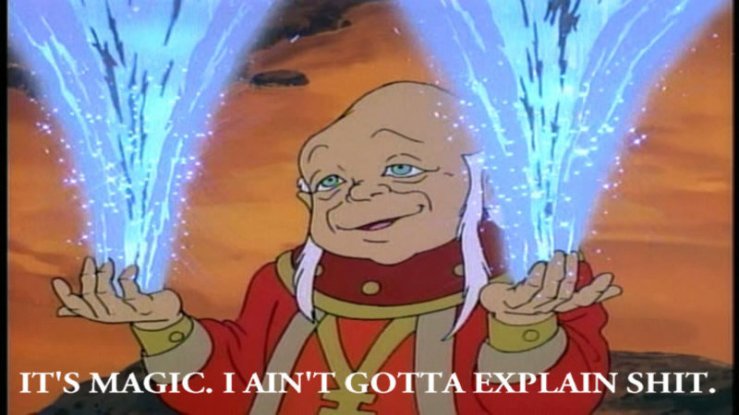
Survival Quest had this problem, too, where what makes for a good MMO fight doesn’t really make for a good book fight, and instead of having the MMO be weirdly high-lethality in order to pace the fights for a book, it retreats into detached summary. Survival Quest at least had the excuse that it was an actual MMORPG and it would actually be weird from a worldbuilding standpoint for the fights to be balanced around high lethality that allows them to be portrayed beginning to end in just two or three pages of book space (and also allows players to win with a strong alpha strike or even just some lucky crits rather than demanding an effective long term strategy – that’s bad for gameplay). Threadbare has a built-in excuse for having fights balanced for pace rather than strategy:

It's Magic 2

Continue reading “Sew You Want To Be A Hero: The Novelization Of A Dungeon Crawl Is Still Boring”

Sew You Want To Be A Hero: Threadbare Returns

We’re back, baby! One successful Kickstarter later and we are looking at Threadbare’s sequel, Sew You Want To Be A Hero. Like all of these reviews (so far) I’m reading this blind, with no idea whether it’s going to be great or terrible. Unlike the previous ones, this is book two of a series. The previous installment, Stuff and Nonsense, was a rollercoaster of really good and really terrible chapters. We’ll see if the sequel keeps ricocheting around or if it breaks one way or another.

When last we left our hero, the animate teddy bear Threadbare, he had just emerged from the overgrown remains of his home after spending five years regenerating from an otherwise fatal wound. He picked up that wound in a short-lived attempt to protect Celia, his little girl, from the nefarious evil king Melos. In a shocking reveal that has no impact whatsoever on the stakes, context, or balance of the conflict, Melos turns out to be Celia’s father, and his sinister demonic ally Anise was Celia’s mother all along (she used to be human – you can turn corpses into demons in this setting).

According to the status screen Threadbare popped up after finishing his regeneration, that was five years ago. Celia was abducted by Melos at the age of eleven, so by now is quite possibly some kind of evil Sith apprentice. As much as Threadbare’s middle dragged on without a plot, that ending was actually a fairly compelling inciting incident (which isn’t supposed to go at the end of a book, but better late than never), and I’m excited to see what happens next – although admittedly, also nervous that we’re going to have to wait until the end of the book for a single significant plot development.

Continue reading “Sew You Want To Be A Hero: Threadbare Returns”

Let’s Read LitRPG: The First Five

I’m not only trying to get a Kickstarter off the ground, but will also be attending the Salt Lake Comic Con (officially redubbed “FanX” due to an unfavorable legal battle with San Diego Comic Con and a judge who is apparently unaware that the ship on Comic Con as a term unique to one convention sailed like twenty years ago), plus maintaining the schedule on games that people have paid for remains a much higher priority than blog posts which are free. All of this to say that for this particularly busy weekend I am going to post an article that is just gathering some content I already produced and then ruminating on it. Here are all the LitRPG novels I have reviewed to date, ranked in order of how much I liked them:

  1. Way of the Shaman: Survival Quest
  2. Threadbare: Stuff and Nonsense
  3. Awaken Online: Catharsis
  4. Divine Dungeon: Dungeon Born
  5. Succubus

At some point I’d like to build up a big enough library of LitRPG reviews (or at least book reviews in general) that Awaken Online doesn’t get to hold onto its deceptive middle-of-the-pack status. That book is actually really sloppy, and beats out Dungeon Born largely by virtue of the fact of having sporadic clever moments and good fight scenes spiking up from the baseline of mediocrity, whereas Dungeon Born was almost incessantly boring. It did get a little better towards the end, but so did Awaken Online, except that Awaken Online was recovering from “Mary Sue is lauded as most brilliant strategist ever for overcoming trivial opposition” instead of “100+ pages of nothing happening.” I’d rather roll my eyes than feel them glaze over.

Other than that, the list doesn’t hold a whole lot of surprises. Survival Quest was fun to read and did a lot of things right, with most of the hiccups in my readthrough being the fault of the translation, and even then it all pretty much clicked when I started subvocalizing the first person narrator speaking with a Russian accent, so of course it comes out on top. It was picked on recommendation from a friend specifically because I was hoping for (and got) a book that I could be pretty unreservedly a fan of. Stuff and Nonsense is dragged down a lot by Zuula and has severe pacing issues, but is also littered with plenty of great scenes and has both a strong start and finish. Its flawed brilliance would even have competed with Survival Quest’s consistent competence were it not for that one atrocious character. And no one who’s even skimmed the later Succubus posts will be surprised to see Nice Guy: The LitRPG coming in dead last, a position it will likely continue to occupy even as the list of books reviewed grows.

Dungeon Born Is Dungeon Boring

Part 1: Rocky Start
Part 2: Tutorial
Part 3: Mushrooms Aren’t Plants
Part 4: Black and White
Part 5: Why Is The Dungeon Heart More Mobile Than His Minions?
Part 6: A Stoppable Force Meets A Movable Object
Part 7: Ongoing Tutorials And Video Game Morals
Part 8: Dale Strikes Back
Part 9: Late Explanations
Part 10: That Rabbit’s Not Dynamite
Part 11: Foreshadowing Of Five Armies
Part 12: End Of The Tutorial
Part 13: I Am Beginning To Suspect The Economics Of This Book Were Not Thought Through
Part 14: Religious Dispute
Part 15: Elemental Bunnies
Part 16: Dungeon Renovations
Part 17: Stumbling Forward
Part 18: Spooky Dagger
Part 19: Skipping Nothing
Part 20: The Finale, Such That It Is

At twenty posts, Dungeon Born is nearly double the length of any previous review I’ve done, but not because it’s particularly good or particularly bad, just because I happened to get very busy right as I was first reading Dungeon Born, which made me gravitate more towards getting one post done for the day and then immediately refocusing to something else. Whereas with previous books I would quickly realize when I was repeating myself because I would write several posts at a time, with Dungeon Born it took me until Part 19 and 60% of the way through the book to realize this, and then I had the whole thing wrapped up by Part 20 (which was undersized!). As such, the long form review of this book contains a lot of me making slight variations on the same nitpick over and over again instead of imposing and at least mostly respecting a moratorium on them once it becomes clear they’re going to mar the whole book.

So here’s the tl;dr: Dungeon Born doesn’t suffer from any stand-out crippling flaws like Succubus’ nice guy moralizing, Awaken Online’s blatant Mary Sue indulgence, or Threadbare having fucking Zuula in it. What it instead has is a ton of minor annoyances and not really anything interesting to recommend it. Half the book revolves almost exclusively around Dani teaching Cal how to dungeon (and in the back half, Cal figuring out how to dungeon for himself with mad science experiments, which is significantly less dull), and Cal and Dani’s dialogue is flat and uninteresting.

In the other half, we get the disjointed and aimless narrative of a town growing up around the dungeon as raiders come streaming in, under the direction of Dale, some random shepherd or something who happened to discover the dungeon along with a few others, and wound up being the only survivor of the first raid. This has a much wider cast of characters, but is still pretty much devoid of actual character arcs. The narrative occasionally talks about how Dale is getting more confident and forceful, but he killed a guy to secure the dungeon’s profits in the first chapter he appeared in. The character growth doesn’t actually happen because Dale has always been willing to take extreme measures to secure what he considers his fair share. Instead, it feels like reading the fantasies of someone mild-mannered and put-upon pretending to shock everyone by suddenly revealing they have far more power and resources than anyone thought, which is not a terrible scene to have once, but it becomes masturbatory when it starts happening over and over again, treated as though it’s a moment of growth each time.

The narrative is so lacking in actual plot structure or character arcs that at one point I realized I could (and did) skip entire chapters without anything being lost. Sure, things happen in those chapters, but not things which affect future chapters, except occasionally in a purely strategic way. AARs aren’t an inherently awful format or anything, so even that could work if there was some high level play going on (not that there’s an actual game to master, but I enjoy reading AARs that demonstrate a thorough grasp of games I haven’t actually played and have no understanding of, so a well-written book could produce a facsimile indistinguishable from the real thing by making up a sufficiently deep system to be exploited). Unfortunately, each dungeon raid is basically just the novelization of someone playing Torchlight for a couple of hours. There’s very little strategy involved, just a consistent arms race between Dale and his group getting stronger while Cal makes the dungeon stronger to try and kill them.

Then there’s the constant moral weirdness. The narrative repeatedly takes moral stances that are blatantly repugnant and either just lets them pass without comment, or even worse, tries to make excuses for them and fails. People talk about causing floods to wash away the homeless and beggars and how this isn’t really a big deal because they’re lazy and unproductive, and despite being a straw capitalist argument, that’s left to stand as the presumptive truth. Not only that, but the rulers hoard life extension magic for themselves, which is said to be what’s best for the world, because it prevents overpopulation (the possibility of using birth control is not discussed) and allows for greater stability. This, again, sounds like a philosophy meant to be understood to be blatantly villainous, here being stated by a character who I think is supposed to be sympathetic and then left unchallenged.

Worse than that, Cal is constantly murdering people for personal gain, and the only justification given is “well, they knew they were taking a risk.” So the lives of people who take risks are inherently worthless? It’s perfectly moral to shoot a soldier in the battlefield in the back and rifle through their pockets, because hey, they knew the job could be risky? It’s completely moral to go to a lumberjack barracks, bar the doors, and set the whole place on fire just to test out your new flamethrower and that’s fine, because hey, they all knew going into this that lumberjacking was a dangerous job? Getting people to risk their lives so that society can benefit is both important and not an easy thing to convince someone to do, so the deleterious effects on society of considering anyone who takes risks to be less worthwhile as a person than someone who doesn’t should be obvious.

“He knew the risks” is typically used to mean “he might not have deserved to die, but the stakes are high enough that a few human deaths are an acceptable price to pay, and his being the specific life paid was a result of his own fully informed decisions. It might not be right, but it’s not like he just got murdered out of nowhere.” This book uses the same basic phraseology, but is totally devoid of any understanding of what it means, and instead uses it to justify murdering people out of nowhere.

The whole thing comes across like the author doesn’t have any morals is too self-righteous to just own that and instead keeps trying to persuade you that it’s totally okay when he murders people for profit because he worked for what he has (this is almost verbatim from an argument presented by Dale and reaffirmed as “well-reasoned” by the narrative). I don’t know if the author actually believes that (for all I know, there’s a reversal in book three where the emptiness of the rhetoric used to justify all the unrestricted, murderous greed in this book is exposed and made into a plot point), but that’s the vibe that gets communicated by the book, and that’s a problem, because not only is it a shallow theme to have, it’s not even actually core to the theme. It has no impact on the plot or character arc because there’s not much of a plot or character arc to impact. There’s just occasionally these really poorly thought out justifications for obviously wrong actions, sometimes inserted for apparently no other reason except to establish that characters hold these poorly thought out opinions. No one’s decisions are actually driven by the belief that only select elites should be allowed to have extended lifespans. It just gets brought up and then dropped.

I may have spent half this summary review ranting about these bizarre, straw conservative morals being dropped into the book for no apparent reason, but they only come up once every few chapters and are mostly irrelevant. You may be wondering, then, why I spent so much time on them. The answer is because the book is so interminably dull, so incapable of building up a plot that amounts to anything other than an AAR of perfectly typical ARPG gameplay, that there’s nothing else to talk about. Even though this one flaw mars only maybe 10% of the book, the other 90% is just events strung together, building to nothing. And it’s boring. The only point or purpose is that our two viewpoint characters steadily gain more power, without being seriously opposed by anything, including one another. Cal tries to kill Dale, but pretty much just for the Hell of it, not because of some kind of clash of motivation. Cal could just as easily decide to intentionally avoid killing Dale and the plot would be unaltered. Dale kills Cal’s minions over and over again, but never has any intention of harming Cal himself.

Now we’re at the end of the book, let’s see how many of the Longes predictions wound up coming true:

Predictions about Dungeon Born based purely on it drawing from Xianxia:
1) Protagonist will find a variety of gimmicks and/or single innate gimmick that will help them skip massive chunks of Cultivation
Both Cal and Dale do this. I skipped over Dale doing it completely because it had no impact on anything else (like much of the events of this story), but he does indeed perform some ritual that jumps him ahead several ranks. Cal is a human soul rather than an animal soul, which means he gets to learn way faster, and has a silvertree that just so happens to be located nearby, and he can cultivate all essences types at once, and he can quickly and easily remove corruption allowing him to cultivate faster, and, and, and…
2) There will be a bunch of time skips because Cultivation takes forever
The narrative regularly timeskips weeks or months, though never years or centuries.
3) Protagonist will level up to kill and replace God
In fairness to Longes, this is clearly something that would happen towards the end of the trilogy and not in the first book, so it’s still very much on the table.
4) Different levels of Cultivation equate to MASSIVE power differences and absolute curbstomping
At one point it’s explicitly stated that each rank is about an order of magnitude more powerful than the one below (i.e. one C rank can defeat ten D ranks). This isn’t consistent, though. Sometimes people treat others who are only a single rank below them as a legitimate threat.
5) Protagonist may find a gimmick that helps them fight people on higher Cultivation level
It’s not really clear if the protagonists are able to do this because of special gimmicks or if the narrative just doesn’t understand the implications of a C-rank being an order of magnitude more powerful than a D-rank, but I’m guessing the latter. In any case, there’s no direct confrontation between the protagonist and a higher-ranked opponent.
6) Being the very best like no one ever was is the protagonist’s primary motivation
With a side order of sociopathy too spineless to admit to its own amorality.
7) There’ll be a bizarre economy and people will interact with it in a very bizarre way
Arguably true just on the basis that the main source of income for the entire town that starts growing up around the dungeon is raiding the dungeon for coins produced by that dungeon (the economic implications of a bottomless reserve of coins under the control of no governing entity is not explored). The narrative inherited this from its ARPG roots, though, not xanxia, so, half a point?
8) Skills or their equivalent (minions?) will be bought and sold via bizarre economy
Skills can be stored in special memory stones and rapidly passed on in this manner.
9) Protagonist will find a way to completely skullfuck said economy
This one hasn’t come true yet, although there’s a lot of elements that look like it might be building in that direction for later books (especially the silvertree).
10) Cultivation requires or is greatly sped up by some magic potions or eating monster parts or something like that
Silvertree. Check.
11) Protagonist will subvert that, skullfucking the economy in the process
It’s not really subverted so much as just the protagonist has one and most people don’t.