Conan Of Venarium Is Aimlessly Meandering

I don’t want to leave the first two posts unattached until I have enough Conan reviews to do a collected post like I have for LitRPG, especially since it’s entirely possible that I’ll wander away from Conan to review something else entirely after the next book. Honestly, the only reason I’m not doing that after this book is because Harry Turtledove only wrote the one, so there’s good reason to hold out hope that the next might be better. Anyway, this means that there’s two posts in this table of contents that have nothing to do with Conan of Venarium specifically.

Part -1: Conan the Introduction
Part 0: Let’s Get The Conversation About Racism Out Of The Way
Part 1: Parenting the Conan Way
Part 2: The Battle Adjacent to Venarium
Part 3: Double Villain
Part 4: Disconnected Vignettes
Part 5: Reruns
Part 6: Fourteen Year Olds In Frank Frazetta
Part 7: The Battle at Venarium

There was actually a thirteenth chapter I didn’t include in the review, in which Conan goes south into Aquilonia, becomes a raider with several other Cimmerians after the main force withdraws, and then once his band gets whittled down to nothing, becomes a thief headed south past Aquilonia, setting up the thief-era stories. Which, in my chronology, means that immediately after this Conan about-faces and begins heading north to Asgard and Vanaheim to become a mercenary instead.

That’s not why I didn’t include a review, though. I didn’t include a review because it doesn’t matter. It isn’t the climax to anything. Conan of Venarium has no arc. It’s just a string of vignettes related only in that they follow the same character in chronological order. Conan’s confrontation with the primary antagonist happens 75%-ish of the way into the book, with the rest of its length then dedicated to a battle at Venarium against rando Aquilonians. The presence of Aquilonian viewpoints could’ve made that work, with Conan’s final battle being against sympathetic characters, but this fails on two counts, first that both the Aquilonian viewpoints characters are defeated (one killed, the other routed) in a skirmish at the outskirts of Venarium, before the final battle at Venarium itself, and second that the viewpoint characters are all defeated with basically no fanfare at all. Conan doesn’t have a moment where he embraces his barbarism and strikes down someone he knew for being an invader, nor does he have a moment where he declines to strike down someone he knew and becomes disgusted and cynical with the whole bloody mess of war. He loves killing Aquilonians, except for the small handful he knows personally, which is exactly where he was when he started.

The final battle has Conan fighting with a sword and later an axe, relying on proper melee weapons of war where previously he’d been using bows and javelins as a hunter, but this isn’t the “Conan the barbarian has arrived” moment the narrative seems to want it to be, because Conan was always here, he just didn’t fight in melee until just now due to entirely mundane circumstances. It’s a symbol that’s forgotten its meaning.

We could’ve had a story about, say, Conan becoming disillusioned with Cimmeria and striking out on his own because there’s no goddamn difference between Cimmeria and Aquilonia anyway, so from now on he’s in it for himself. Or a story whose early acts focused heavily on Conan’s relationship with his Tarla and Wirp and his relationship with his parents, so that we really would’ve felt like the climactic battles of the book had completely burned down what everything else had built up, leading to us really feeling how there’s nothing left for Conan in Cimmeria. His parents in particular are frequently mentioned, but only ever a burden or an obstacle, which makes it hard to care when they die because, sure, children love their parents by default and all, but they aren’t my parents so I don’t.

Without either of these emotional arcs or any other you might think up, Conan of Venarium relies on the quality of individual vignettes to survive, so it’s a problem that half of them suck. Every time Harry Turtledove tries to write mass, classical/medieval combat, he fails. He makes basic research failures like getting what a pike is and how fortresses work wrong to a degree that makes the fights hard to parse (it took a while to figure out that Gunderman “pikes” are like six feet long, maximum) or hard to follow (the Battle Adjacent to Venarium had no stakes because the mishandling of the fort made it inescapable that the course of the battle would be dictated by authorial whim). He depicts in gory detail the first few individual fights in a greater melee, then gets bored and wanders off into detached summary for its climactic moments towards the end.

His smaller scale skirmishes work better. When it’s just Conan versus one man or monster, the fights work pretty well, which means that at least his fight with the main villain Stercus mostly works. Other than that, however, it’s difficult to find anything to praise about Conan of Venarium other than “at least it could’ve fucked up harder.” It victim blames its female characters for being targeted by rapists, but at least it lets the women join the fray towards the end. It’s got a lot of meandering vignettes, but at least it’s mostly able to stay on-theme regarding the Aquilonian invasion, so even though nearly all events in the story are totally unnecessary to its climax, they are at least loosely related.

And, of course, there’s the way that the villain is ham-handedly sign-posted by being a rapist pedophile. It was hard to even get all that worked up about it because of my total apathy towards Tarla as a character, plus its use of gratuitous rape as a plot point is pretty tame compared to Succubus, so I guess that’s the standard my subconscious operates on now. Like, Stercus is at least a believably depicted predator, although also the book engages in a fair amount of sexualization of Tarla, his underage victim, which is super weird when Tarla being too young for people of the author’s (and large portions of the audience’s) age to be looking at her like that is a plot point used to vilify the primary antagonist.

In the end, Conan of Venarium is an aimless jumble of vignettes that doesn’t build to much, botches the climax for what plot momentum it does manage to build up, and whose average quality vignette-to-vignette is mediocre.
Conan of Venarium: The Battle At Venarium

Chapter 11

If someone’s bad at depicting classical combat, you know they’re not any good for classical logistics. Fortunately, there’s rarely any call to write about the details of classical logistics. Unfortunately, Harry Turtledove has dodged directly into the path of that bullet:

And forward the Cimmerians went. No Aquilonian army could have done the like. Aquilonians, civilized men, traveled with an elaborate baggage train. The Cimmerians simply abandoned everything they could not carry with them. They had briefly paused here to gather in full force. For that, lean-tos and tents had proved desirable. Now the Cimmerians forgot them. They would eat what they carried in belt pouches and wallets. They would sleep wrapped in wool blankets, or else on bare ground.

Civilized armies didn’t give up on forage because they’re soft and delicate and cultured and need to bring many nice things with them on campaign. They gave up on forage because things like food cannot be gathered in sufficient amounts to feed an army of sufficient size. When you gather more soldiers to a single spot, the radius your foraging parties must range out to in order to feed them all eventually exceeds the range that humans can walk in a day, at which point everyone starves to death. That’s the point when you need a baggage train. The overwhelming majority of military baggage was always food.

Continue reading “Conan of Venarium: The Battle At Venarium”

Conan of Venarium: Fourteen Year Olds In Frank Frazetta

Chapter 9

That seer guy is hanging around Duthil doing odd jobs to earn his keep whenever he can’t get by selling visions. Conan asks him to look into the future of Cimmeria and see whether they’re going to win against the Aquilonians.

The seer suddenly went stiff. His eyes opened very wide, so that white showed all around their irises. “Crom!” he muttered, whether calling on the grim northern god or simply in astonishment Conan could not have said. In a voice that might have come from the other side of the grave, Rhiderch went on, “Gore and guts and grief and glory! War and woe and fire and flame! Death and doom and dire deeds! War, aye, war to the knife, war without mercy, war without pity, battle till the last falls still fighting!”

Conan shuddered. He had got more in the way of a vision than he had bargained for. Rhiderch twitched like a man in the throes of an epileptic fit. Hoarsely, Conan asked, “But who will win?” Nothing else mattered to him. “Who will win?”

Now Rhiderch’s gaze thrust through him like a sword. “War and woe!” repeated the seer. “Duthil dies a dismal death. The golden lion—” He twitched again. “Aye, the golden lion flaps above your head.”

At first, I was worried this was going to turn into another “oh, isn’t Conan so great” moment, where a fanboy oohs and ahs over his favorite fantasy hero right in the middle of a narrative. But no, this is actually just a misleading vision, in the way of prophetic visions everywhere, about Conan becoming king of Aquilonia. And also about Duthil getting razed, apparently. I don’t know how this book, specifically, will end, but my guess is that Duthil is the price Cimmeria pays for victory.

Continue reading “Conan of Venarium: Fourteen Year Olds In Frank Frazetta”

Conan of Venarium: Reruns

Chapter 7

The “disconnected vignettes” problem affects the reviewing more than the reading. It’s almost impossible to know which, if any, of the details of these stories is going to come up later. Is Conan being tested by the Three Trials of Crom which will culminate in his transforming into a Super Cimmerian with golden hair and green eyes, or are monsters just showing up because there’s a protagonist around to fight them now and it’s a good way to mark time while we wait for Conan to turn fifteen?

On the other hand, the episodic nature of the story isn’t actually bad. Individual vignettes are sometimes bad, like when Count Villainous shows up to creep on a piece of cardboard with “jail bait” painted across the front, but the episodic nature means that no matter how shoddy one vignette is, it has practically no bearing on the quality of the next. Sure, the “character arc” of the protagonist is not really an arc so much as frequent callbacks to previous stories, but if I wasn’t happy to read about Conan killing a giant snake just for the Hell of it, I wouldn’t be reading Conan at all. That’s like forty percent of Conan stories.

Continue reading “Conan of Venarium: Reruns”

Conan of Venarium: Disconnected Vignettes

Chapter 5

The timeline continues crawling forward towards Conan’s fateful fifteenth year. On the one hand, time skips suck. They play out pretty much one of two ways: Either the character is exactly the same as when we last left off, or else they’ve had a character arc we didn’t get to see and now they’re basically a different (though hopefully at least similar) character. The other hand, though, is that Conan of Venarium didn’t need to cover three years of Conan’s life. We didn’t need any details on what Conan was like before he reached barbarianing age, and having a narrative cover three years of events without coming across as disconnected vignettes marking time until the climax is hard to pull off. There’s a theme of Conan wanting to be all growed up, but so far it’s not super clear what fighting a snake in the Feywild or meeting a settler has to do with Conan’s overall arc other than being events that happened in the summer. Of course, we’re still only 32% of the way into the story, so there’s some wiggle room left for things to start coming together later.

Now in chapter 5 it is winter so we’re talking about Vanaheim and Asgard coming down to raid, because apparently they are ice people and only move south when the weather is bad, instead of doing the sensible thing and bunkering down for the winter before heading out to raid in the summer when they don’t have to trudge through three feet of snow to reach their target.

Continue reading “Conan of Venarium: Disconnected Vignettes”

Conan of Venarium: Double Villain

Chapter 3

The chapter opens with the victorious Aquilonians marching into Duthil and telling the Cimmerians that they’re in charge now, ha ha ha. Conan reluctantly admits that attacking them now is suicide and decides to stick to his father’s plan of biding their time until they can retaliate. Then there’s a bit with the Aquilonian garrison in which they stare at trees until they see Conan passing through having shot some particularly elusive birds ordinarily caught using traps, and everyone shivers at how protagonisty he is, and then we’re following Conan again on his hunt. It’s all pretty unremarkable? Like, it’s not bad. Maybe they’re absolutely botching iron age hunting the same way they botched iron age warfare in the last one, but I’m not really knowledgeable on that subject at all, so I can’t tell.

There is this one line that I’ll quote, just because it keeps coming up:

“I hope so,” said Granth. “Sometimes barbarians will kill without counting the cost. That’s what makes them barbarians.”

Daverio shrugged cynically. “That will probably happen once or twice. Then we’ll kill ten or twenty Cimmerians, or however many it takes. Before long, the ones we leave alive will say, ‘Don’t do anything to King Numedides’ men. It hurts us worse than it hurts them.’”

There’s something to be said for dumping more resources than seems immediately prudent into revenge, particularly in iron age societies, because that can deter people from trying to harm you in the future. Sticking strictly to only retaliating when such retaliation is the good move for you right now encourages bad actors to harm you whenever you’re unable to immediately profit from retaliation, and you’re usually unable to immediately profit from retaliation. Fighting powerful enemies is costly, and if you only ever look one move ahead, the “smart” thing to do is always to roll over for them. Plus, you might value a reputation for indomitability more than whatever material wealth you sacrifice acquiring it.

Continue reading “Conan of Venarium: Double Villain”

Conan of Venarium: The Battle Adjacent to Venarium

Chapter 2

We open on the Aquilonians again, this time standing guard at Venarium.

A harsh chattering came from the woods. Granth’s hand leaped to the hilt of the shortsword on his belt. “What was that?” he said.

“A bird,” said Vulth.

“What kind of bird?” asked Granth. “I’ve never heard a bird that sounded like that before.”

“Who knows?” said his cousin. “They have funny birds here, birds that won’t live where it’s warmer and sunnier. One of those.”

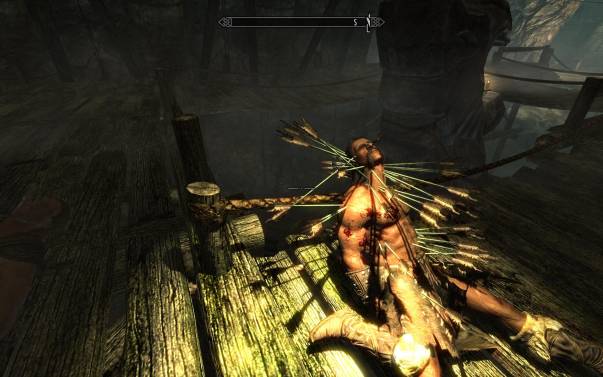
Skyrim Arrows
Must’ve just been the wind.

We flip to Mordec’s perspective as the battle begins.

Before the Bossonians and Gundermen outside the encampment were fully formed to face the Cimmerian tidal wave, it swept onto them.

Wait, why were they outside the encampment in the middle of the night? Is Venarium not big enough to hold the army that built it? Why not? There’s plenty of materials, and more soldiers means more labor to assemble it. If the fort is unfinished, I can’t find any mention of it.

The foemen in front of them gave ground. A few archers and pikemen ran for their lives, forgetting in their fear they would find no safety in flight. Most, though, put up the best fight they could. And, to take the place of the fled and fallen, more and more soldiers came forth from the camp.

Why did you even build this thing?

Continue reading “Conan of Venarium: The Battle Adjacent to Venarium”

Conan of Venarium: Parenting the Conan Way

Robert E. Howard never wrote about Conan’s origins. His earliest story chronologically was the Frost Giant’s Daughter (if, like a sane person, you place that immediately after Conan departed Cimmeria). Conan of Venarium most faithfully follows what the narrative claims in brief reference later on: That Conan came to the civilized world of Hyboria following a clash with Aquilonian forces at Venarium.

This book is brought to us in 2003 by Harry Turtledove. I haven’t cross-referenced all the books I’ve read with Harry Turtledove’s complete bibliography, but I’m pretty sure Conan of Venarium is the first of his novels I’ve read. I’ve heard of him a lot, but he writes a lot of alternative history, a genre which I tend to avoid because of how often it’s littered with historical fix fics in which a defeated army is instead victorious, thus ushering in utopia. And it’s never “Trotsky took over after Lenin and everything was great forever,” which, while not really any improvement of craft over the other style, would at least be a nice change of pace from all the “the South won the Civil War and then abolished slavery all by themselves and lived in a Libertarian paradise forever” stories.

Turtledove has written a “the South won the Civil War” alt history series, Wikipedia informs me, but I’m on too tight a deadline to even bother reading the summaries of all twelve-ish books in that series, so I have no idea how it portrays the South. I’m gonna guess that it’s not “evil empire in which sadistic aristocrats reign over an economy sustained by one of the most brutal systems of chattel slavery in all human history while using racist tensions to keep the unlanded majority of whites loyal to their cause despite their having been ghettoized in impoverished bayous.” In fairness, though, I haven’t actually read any of them, so I won’t hold that series against Turtledove here.

Also, Macmillan, the seller of this story, has offered it DRM free at the request of Tor Books, which is neat.

Continue reading “Conan of Venarium: Parenting the Conan Way”

Conan the Cimmerian: Let’s Get The Conversation About Racism Out Of The Way

As promised, today we are reading Robert E. Howard’s posthumously published essay on the history of his fictional world Hyboria, something originally written for use internally to help Howard keep his setting straight (officially – I wouldn’t be surprised if this was one of those things written mainly for the love of worldbuilding, but that’s speculation).

The following can be found in Marvel’s Conan Saga series number 50, 51, 52, 53, 54 and 56. It is an adaptation by Roy Thomas and Walt Simonson of Robert E. Howard’s immortal essay commencing with the age of Kull.

I don’t plan on quoting word-for-word the entire essay just because I no longer have to worry about copy/paste limits from Kindle. Rather, I’m quoting this section because I want to point out that this “adaptation” appears to be word-for-word identical to the original. I’m pretty sure it’s been “adapted” in that some neat illustrations have been added.

The essay proper begins in 20,000 BC, grounding us in real world history. This, I think, is an artifact of the time. By the 1930s, everyone was okay with the idea that a fictitious story could be blatantly so. Like a stage play or radio drama, it could recount exact dialogues and depict events with descriptive detail implausible for any supposedly historical narratives, and didn’t have to claim to be the compiled diaries of four guys who actually hunted a real vampire or one guy who got stranded on an island full of two-inch tall people or whatever. It had not seemed to have quite shaken, however, the need to claim connection to the real world. JRR Tolkien didn’t invent the concept of the “secondary world” which is wholly separate to our own, not just far away or long ago but a completely different reality, but the concept doesn’t seem to have caught on until his writings became popular.

Continue reading “Conan the Cimmerian: Let’s Get The Conversation About Racism Out Of The Way”

Conan the Introduction

Given the weird publication time for this article, you might think it’s an early Friday article, but no, Friday’s “article” is going to be the video we didn’t do on Sunday, and this is a late Thursday review post, because I’ve had enough scheduling troubles for the past several weeks and want to get back into my regular routine ASAP, rather than putting this post off until Saturday. My next review is going to look at Conan the Barbarian. This is mostly a bunch of short stories, and I expect we’ll manage about one of those per post, but having never done any particular commentary on Conan stories before, God only knows how that will pan out.

Before we can get started with that, though, we need to answer the question: What order are we reading these in? The order of publication is the least controversial route, and is therefore suitable only to cowards. I’ve never read Conan stories in any particular order before (and never more than one or two at a time), so maybe there’s an evolution of the character, setting, or style that I’ve always missed out on, but my estimation has always been that the basic ideas behind Conan are pretty consistent throughout. Moving past Robert E. Howard’s work, obviously the character of Conan changes in the hands of other authors, and going author-by-author would be reasonable, but for whatever reason it appeals to me more to go by in-universe chronology.

This leads to the various chronological orderings, of which Wikipedia informs me there are five. The Miller/Clark/de Camp chronology sorts Robert E. Howard’s work into the basic progression from Conan the thief to Conan the brigand/mercenary to Conan the king, the rough career clearly implied by the stories themselves, but it’s got some pretty rough edges, most notably geographically. No attention was paid to the location of the stories during the ordering, which means Conan will often traipse the continent at random and at speeds so high as to imply intent (i.e. “I’ve got an appointment in the City of Thieves to climb the Tower of the Elephant, better get moving, don’t want to be late” rather than just wandering in a general direction across the world), going hundreds of miles in one direction only to turn around and cross half those hundreds of miles back for the next.

Robert Jordan created the next chronology, which incorporated a lot of post-Howard stories. The reasoning behind the placement of events was never explained. William Galen Gray attempts to synthesize Jordan’s and the Miller/Clark/de Camp chronology while also including all Tor-produced Conan stories following Howard’s death. The Gray chronology incorporates a good chunk of the non-Howard stories and is the most complete reading order for a look at the character as a whole, not just the works of the originator. Both of these do suffer the same problem of Conan traveling very far, very quickly, as though he’s got a quest log full of his adventures in numbered order and is moving very purposefully to hit each one with large stretches of unremarkable travel as he criss-crosses the countryside, rather than wandering across Hyboria and encountering danger at every turn.

Joe Marek was the first guy to look at Conan’s list of abilities and notice that “teleportation” wasn’t on there, and reordered the stories to pay a bit more attention to how Conan was getting around the continent. Dale Rippke did a similar project, working from first principles and intentionally ignoring earlier attempts at a chronology to get a more sensible order. So, fantastic, the process has been refined over time and the newest chronologies are the best, right? By the end of that sentence, you knew the answer was “no,” because the Marek and Rippke chronologies deal only with Robert E. Howard’s original work. Using these reading orders would mean either ignoring later contributions to the character or else reading them in a separate bloc from Robert E. Howard’s stories, at which point we may as well go in order of publication anyway.

On top of that, the reorderings are sometimes a bit too zealously focused on geographic plausibility, especially for Marek. I can appreciate that the Frost Giant’s Daughter makes more sense as a very early story because it takes place right next to his homeland of Cimmeria, regardless of the fact that Conan is a mercenary, not a thief, and that little sixteen-year old Conan taking on two frost giants and winning is pretty nuts. We wouldn’t be telling stories about this guy if he wasn’t awesome. Conan was a proper barbarian warrior at Venarium when he was fifteen, so why not let him be a giant-slaying badass just one year later? But then there’s the reordering of the Black Colossus, explicitly stated to be the first time Conan led a major army and which marks a turning point in Conan’s career towards kingship. Sure, the exact timeline is vague and you could, as the Marek ordering does, say that it’s actually quite early in Conan’s career and he continues to be a brigand and a mercenary for like fifteen stories before he ever commands an army again, but it seems to fit Conan’s career much better if we treat this story as the transition point between Conan the mercenary and Conan the conqueror, moving from here to Conan as captain of a queen’s guard in A Witch Shall Be Born rather than learning to be a pirate in Queen of the Black Coast.

My general plan is to mostly follow the Marek ordering while using the Gray ordering as a guide for where to put the non-Howard writings, but also that I’ll break from that pretty much whenever I feel like it as we go along. In that spirit, I will begin on Saturday with The Hyborian Age, an essay written by Robert E. Howard to help him keep his setting straight, published posthumously and often used as an introduction to various Conan collections. You can find an illustrated version of the essay here.

Now, upon hearing that I plan on reading the non-Howard Tor-produced Conan works, you might be thinking to yourself “whoa, there, Chamomile, that’s like fifty new stories, many of them full-length novels. How long are we doing this?” And the answer is “until I get bored.” I won’t break off mid-novel, but if I decide I’ve had enough of Conan after just one or two books, I’ll go and read something else instead.