Conan the Bold: Racist Against Bossonians

Before we get rolling, I want to back up and comment on something that I’d missed in the last chapter (hazard of pushing these out on a deadline is that sometimes I don’t give them as much thought as they deserve). What Kalya’s said to bring to the party is mainly that she understands how civilization works. As a story specifically set towards the very beginning of Conan’s career, Conan has only a vague idea of how things like law enforcement and criminal networks work. Kalya’s a less fearsome fighter than Conan, but she can handle herself alright and she has a valuable understanding of civilization. Perfectly good team-up, right?

It would be, except that Conan pays basically no price for his barbaric lack of subtlety in the town where he met Kalya. Sure, he gets ambushed by Rario, but he hacks his way out with no difficulty and if losing a potential informant was a major setback to their pursuit, neither Conan nor Kalya brings it up. Kalya doesn’t even bring it up when telling Conan that she’s joining his party, and you’d think if it were actually that important, she would have: “If I’d made inquiries instead of you bullrushing into every conversation, Rario would’ve told you where our quarry is” is a lot more compelling than just “we both want the same men dead.”

Chapter 3

I find shockingly little to discuss in the front half of this chapter. We’re following Taharka and his men again as they arrive at a lawless border town between Aquilonia and Nemedia, where the local gladiator business has been gummed up by a crackdown on the slave trade by the Aquilonians. Taharka hatches a plan to kidnap people, teach them how to fight with simple weapons, then drug them up so they’re manic and vicious and set them fighting each other. So far as villainous plots go, it’s pretty well-suited to the story. It’s clearly evil, there’s obvious profit in it for the bad guys so they’re not just doing it for the evulz, and the stakes are comfortably local for something this early in Conan’s career. There’s not really anything new to comment on, though. It’s a pretty similar Taharka scene as was in the last post, and I’m kind of wondering how important these Taharka scenes are going to end up being to the narrative. The closest thing to something notable I can think of is mainly in the descriptions of the town, but, I mean, it’s a lawless border town in a Conan story. Imagine Tortuga but with more sand and scantly clad women and you’re basically there.

It’s the back half of the chapter, when the Aquilonian sorcerer guy goes poking around for the aggression-inducing drugs he’ll need for the gladiatorial scheme, that things start to get more noteworthy.

Axandrias saw a light in the dense darkness at the far end of the room. With some trepidation, he began to walk toward it. Several times he stopped and squinted upward at the serpent heads above. Always they were blank and enigmatic, but as he walked he had the uncanny sensation that they moved slightly, and from the corners of his eyes he kept half-seeing a flash of motion, as if long, forked tongues darted from scaly mouths.

He reached the source of the light, and found that it was a flame burning in a brazen bowl. The bowl stood on a tripod, and he could see no trace of fuel to feed the flame. This did not disturb him unduly. Since he was something of a conjurer, he assumed that most wizard’s feats were the same sort of trumpery.

Something disturbed him, and he looked back the way he had come. The bright rectangle of the doorway was at least fifty paces away. Yet, when he had stood before the temple, he had estimated that the city wall was no more than twenty paces away. That meant that this structure must extend through and well past the wall. It was another mystery, but he had not come here to sort out puzzles.

“What brings you here?” The voice came from behind him and Axandrias whirled, his hand darting to his sword hilt. The speaker was a tall, gaunt man dressed in a featureless black robe. He was shaven-headed, his cadaverous face as immoble as those of the stone serpents.

With a relieved sigh, Axandrias relaxed. “Your pardon, good priest. You startled me. I did not hear your approach. Are you the sole priest of this temple?”

“I am. The gods I serve are ancient beyond the dreams of men, and are all but forgotten in this decadent age.” The priest’s accent was strange. Axandrias was widely traveled but he had never heard its like. There was something odd in the man’s phrasing as well.

What with the strong snake themes, I’d assumed this was just a temple of Set, but Axandrias would presumably recognize a Stygian accent, considering he travels in the company of someone from even further south.

Feigning scholarly interest, Axandrias convinces this priest fellow to show him where they keep the magic around here. One book in particular quickly catches his eye.

“Great indeed,” intoned the priest in his sepulchral voice. He opened the cover and exposed the first page. It was an oddly thick and creamy parchment, inscribed all over in tiny characters the color of rusty iron. Axandrias touched the page and found it strangely smooth. He commented upon the fact.

“This is a book of spells written by the wizard-king Angkar, of the pre-Atlantean Empire of Walkh. To one who can read these characters are revealed the secrets of communication with beings that ruled the universe ere the earth was created. He was a sorcerer of all-embracing evil, such as is not seen in these times. He compiled this book as the masterwork of his reign. He had his fifty subject kings send him their daughters, more than nine hundred in all. These pages are made from the flayed skins of those princesses. The characters were written with the blood of royal infants. When the book was complete, he had the bones of his own face set into its cover, cut from his skull while he yet breathed. The binding is his own skin.”

Axandrias jerked his hand away as if the page was red-hot.

Oh, don’t act all surprised, Axandrias. This was clearly a standard-issue Necronomicon from the first sentence of description.

This weird snake prince guy really likes to show off his voodoo, and they end up looking at another bit of it:

“I can see,” Axandrias said, desperate to change the subject, “that I have come to the right place. To one who is privy to such secrets, the trifling things I seek must be as naught.” Idly, he raised the hinged lid of a plain, copper bowl. Inside, he saw a mind-shattering vista of the gulfs of deep space. He was looking as if from above into a monstrous whirlpool of stars. Abruptly he slammed the lid shut and tried to make his stomach return to its accustomed position. The wizard seemed not to have noticed.

This one’s more original than the bog standard Necronomicon, at least. A bowl with space in it doesn’t seem all that mind-bending and I’m not sure why you’d actually want one, but it’s a neat curiosity, anyway.

The next item on the tour is the murder steroids that Axandrias is actually here for, which need to be activated with some kind of spell to get their full effect. Axandrias leaves the temple and finds that it’s some weird space-time folding thing that’s bigger on the inside than on the outside:

When Axandrias reached the mouth of the alley, he looked back and saw the face of the temple once more. Consumed with curiosity, he hurried down a side street until he came to a stairway which mounted the city wall. With his prize tucked inside his tunic, he went up the stair and then made his way gingerly along the ruinous wall. When he saw the two warehouses which flanked the temple, he leaned over and surveyed the view. As he had estimated below, the flat, featureless roof of the temple extended about twenty paces from the paved alley until it disappeared into the wall.

He turned and crossed the thickness of the wall, a distance of less than four paces. He leaned over the parapet, expecting to see the greater bulk of the temple extending beyond. There was nothing. Just a featureless face of rough stone wall and beyond that, a grassy field where oxen placidly cropped the vegetation. His scalp crawled and his mind reeled. Where was the rest of the temple?

And…that is the chapter? I’m really not sure what we accomplished, here, but it’s still early enough in the story that this could be going somewhere.

Chapter 4

Conan and Kalya have lost the trail of our villains when they check into a small roadside inn, who warns Conan that he shouldn’t be traveling with just a girl for a companion in these parts, because there’s been a spate of slave raids targeting healthy, strong men, specifically. You might think this justifies the previous chapter, in which the reason for these slave raids is set up, but I think it’s the reverse. Here, in these first two pages, we’ve set up all we need to know about the slave raiding operation in this part of the country. As an audience, we can guess that it’s not a coincidence that there’s mysterious raiders, and we don’t need to know the details of Taharka’s plan in order to follow Conan’s story, so long as we know everything that Conan knows, including why Conan cares. Indeed, Kalya figures out where this is going just a few paragraphs later:

When the woman had returned to the hut and the others were engaged in their conversations, Conan leaned across the table. “What think you of this? Might it have aught to do with Taharka and the others?”

“I cannot say, but I feel that there is some connection. The man is full of plots and schemes, and this may well be one of them. What its nature is I cannot yet tell, but it must be something crafty and devious.”

“Yet the slavers are said to be Nemedians,” Conan said.

“Nemedian clothes are as easy to put on as any. Raiders of any kind know how to use false colors. I think this is a good area in which to concentrate our search. If there is any new villainy being done, we can be fairly sure that Taharka and Axandrias are at the center of it.”

Of course, we’re still early on in the story, and there’s plenty of time for that spooky temple that got set up to be paid off later. We’ll see whether or not that actually happens.

Conan speaks to Kalya about his past:

“I am not like my countrymen,” Conan agreed. “Before I was old enough to hold a man’s sword I was always at odds with any who would rule me or order my life. My father, the village elders, the chieftain of my clan, they all had a go at thrashing me until I grew too large for such treatment. When I earned my warrior’s standing at Vanarium, they gave up trying.”

This makes him different from most Cimmerians? I thought refusing to bend the knee was a whole thing for not just Cimmerians, but Hyborian Age barbarians in general. In any case, this explicitly sets the novel after the events of Venarium. It’s even consistent, if vague, with how Second Venarium went for Conan, specifically:

“You were at Vanarium?” she said. The news of that battle had been all over Aquilonia and the borders a few seasons before; The Aquilonians had pushed across their borders onto ancestral Cimmerian lands and had built the city of Vanarium, manning it with Gunder and Bossonian frontiersmen. The Cimmerians had annihilated the settlement in a day and night of screaming slaughter. All three races were warlike in the extreme and fought without mercy.

Conan’s face twisted, as if this had turned his thoughts down paths he did not wish to follow. “That is past,” he said shortly. “Let us see what is to be found in this town of rogues.”

Conan lost everything at Venarium, so it makes sense he wouldn’t want to talk in detail. It’s really Conan of Venarium’s final chapter alone that’s fucking with the placement in the timeline. Without that, these two stories don’t have to be alternate origins at all. Personally, I have no difficulty just ignoring that final chapter and assuming Conan returned to Cimmeria after raiding Aquilonia for a while, and that this story is then a sequel.

Their investigation quickly brings them to the inn where Taharka has been selling his gladiators:

“A fighting-pit,” Kalya murmured. “Have you ever seen such?”

“Aye,” Conan said. “In Vanaheim and Hyperborea.”

So not only does this post-date Venarium, it probably post-dates quite a few stories taking place in Conan’s viking mercenary days (including the Frost Giant’s Daughter and a few post-Howard stories I have’t read). I didn’t expect the Chamomile Chronology I’m piecing together to stand superior to others, but now that I’m seeing such obvious cracks in the existing chronologies, I’m beginning to have my doubts.

Conan and Kalya observe a gladiator battle.

Although the swords had clipped, upturned points, they were better designed for cutting than for the thrust.

What do you mean “although?” The word you’re looking for is “because.”

There’s a whole thing here where Conan and Kalya are trying to figure out what’s going on. I know I’ve knocked points off Threadbare for hanging its entire plot on “what’s going on” instead of “what will happen next,” but that doesn’t mean that a book like this, where we have to watch our heroes figure out what’s going on even though we already know, is much better (although it is better). Threadbare gave us a mystery but neglected to give us any reason to care about the answers besides “ooooh, it’s mysterious,” but here in Conan the Bold the story has given us a reason to care about the answers (Conan’s personal grudge with Taharka is really dumb, but accepting that he has a personal grudge, we want to know what Taharka’s up to) but then gives us all those answers way ahead of Conan.

They do eventually start closing in, though.

“There,” he said, pointing, “against the far wall, between a Kordavan poleax and a silver-headed staff. Two Bossonian longbows. We are far from the Marches to see two such weapons.”

Kalya smiled, and the demented gleam returned to her eye. “There are two men nearby with whom we should have some words.”

Conan leaned on his elbow, chin cupped in a hard palm. He did not take his eyes from the bows, lest the weapons should be retrieved while he and his companion were not looking. “How should we go about this? Should we slay them, or take them aside and question them, or follow them to where the others are?”

“I recommend we take them to some private spot and find out what they know. If you slay them out of hand, part of your vengeance will be done, but I will be no closer to mine.” She sipped at her ale meditatively. “It may be that the others have ridden on and these two have stayed behind. If so, we must know of it. As for following them,” she thought for a moment, “it is tempting but dangerous. If they have separated, we might trail them for days accomplishing naught while the others draw farther away. Even should they lead us to the band this very evening, we might find ourselves facing six hard men. And it is likely that the band has grown. Your business is only with the six you were tracking. Mine is only with Axandrias. We do not want to take on perhaps ten or twenty at once.”

And shortly thereafter, they spot their quarry on the balconies with some whores:

There was no mistaking their nationality. Both were stocky men of medium height, strongly made. The hair of both was brown and square-cut. They closely resembled one another save the eyes of one were gray, those of the other, brown.

I’m not racist, I’m just saying all Bossonians kind of look the same to me.

The two ambush the Bossonians.

“Speak!” Conan barked. “You can die easy or die hard, but die you shall! Where are the rest of those who raided the Cimmerian steading? I want Taharka and the two Gundermen and the Aquilonian, Axandrias. Are they all still with you?”

Murtan shrugged, eyes still on his weapon-belt. “What are they to us? Aye, the wily Keshanian is still our leader. The Gunder brothers do this bidding as well.”

Okay, sure, no honor among thieves, but you aren’t exactly being offered a lucrative reward, here. For that matter, you’re not in a super compromised position. I’ve skipped the ambush, but they’re just being held at swordpoint in some alleyway. Odds of getting away alive are very slim, so if Conan and Kalya were offering to let them go, that’d mainly be a question of whether or not the Bossonians believe them. But it’s not like they’re strapped to a chair or deep in enemy territory. Odds of being able to force captors to either kill them or let them go are pretty solid. Just go for the swords at your necks and if they slit your throats, they were gonna do that anyway, and if they don’t slit your throats, you’re now in a position to run away.

“We have learned what we needed from them.”

Conan said to the woman. “Have you any further use for them?”

“Nay.” She dropped her point from Ballan’s throat. “These two are nothing to me. It is Axandrias I want. Do as you will with them.”

As she stepped back Conan snatched the weapon-belts from her hand and cast them at the feet of their owners. “There are your swords,” Conan said. “Use them!”

Or just run away. Granted, you do have him two-to-one (he asks Kalya not to get involved, and her vengeance is only with the Aquilonian), but he’s also got a proper length arming or maybe long sword, and you’ve got a pair of short swords used as archer sidearms. Plus, you’ve been making bank off of this slave trade thing, you could probably get a whole lot of reinforcements if you run into a heavily populated area and promise money to whoever brings you the Cimmerian’s head. It’s doubly weird that the Bossonians settled for “die quickly” when – as they confirm – they were confident that Conan would let them fight for their lives and were only afraid of immediate execution from Kalya. They could’ve just demanded that Kalya back off in exchange for the information and promised to give Conan the honorable(?) vengeance he was seeking.

But, no, the Bossonians attack head-on like idiots and get chopped to pieces. Kalya even confirms that they’ve got tons of money on their person while looting the bodies in the aftermath.

Also, Kalya’s musing on the fight in its aftermath just makes me dislike Conan:

A fight that consisted of three blows, two of them mortal. All of them struck by one man before his foes could strike effectively. Her swordmasters had told her that the ascending backhand blow was the weakest possible stroke, as the descending oblique was the strongest. The latter had the full weight and most of the muscle power of the body behind it, while the former utilized only the muscles of one shoulder. They had taught her that certain very skilled fighters could use the muscles of the flank and the leading leg as well. She had seen that blow tear through leather, bone and flesh as through so much smoke. The man’s art was minimal, but his speed, strength, timing, and coordination were little short of supernatural.

Conan isn’t actually good at anything, he’s apparently just arbitrarily granted perfect reflexes and super strength. Of course, in reality, using specific moves and stances is how amateurs fight. It’s a foundation that you build general situational awareness and familiarity with your own body’s capabilities on top of. And if you want to be super strong, you have to actually work for that, it doesn’t just happen. Sure, some people are more pre-disposed towards it than others and natural talent can disqualify you from being competitive in certain fields (including melee combat) no matter how hard you try, but nobody gets to peak performance without even trying.
Conan the Bold: Chainmail Bikini

Chapter 2

Conan is pursuing the people who killed that one woman he knew for like three weeks, Hellbent on revenge. He comes across an abandoned Nemedian slaver, slowly dying from a wound he received in the battle with the Cimmerians. Conan interrogates the Nemedian to find out who his companions are, and the answer is two Bossonians, two Gundermen, an Aquilonian who allegedly has sorcerous powers, and their Keshanite leader. Notably, everyone but their leader is from somewhere in greater Aquilonia, so why on Earth were they set up as this bizarre international band? Why not have one guy very far from home, and everyone else is locally sourced?

Perspective changes to our villain, whose second in command (the Aquilonian wizard) is speaking to him about the morale problems caused by their 80% losses.

“Ah, but these fellows have the wrong attitude,” said Taharka. “You see, we lost many men back there, but that is no matter. In all the world, nothing is so easily replaceable as men. Each likes to believe himself unique and irreplaceable, but this is sheer self-deception. If you would ever be a leader of men, my friend Axandrias, you must understand that men, whether they be slave or free, few in numbers or in the tens of thousands, are nothing. Their death, if it serve your purpose, is acceptable. Their life, if it is inconvenient to you, is intolerable.”

“Wise words, my lord,” said the Aquilonian.

This isn’t terrible villain dialogue. It’s extremely on the nose, but it comes across as not too cartoonish for a Conan story. Provided the narrative manages to avoid running this into the ground, this guy could be a pretty effective villain.

Continue reading “Conan the Bold: Chainmail Bikini”

Conan the Bold: At Least They Know How Forts Work

Chapter 1

Conan the Bold is an origin story written either (optimistically) by someone who thought that the Venarium story referred to in Robert E. Howard’s work wouldn’t be as good as what he could come up with or (pessimistically) someone who’s only vaguely familiar with Conan and didn’t even know that the Venarium story was referred to at all. We’ll see if this origin story fairs better than the last, and how mutually exclusive they are (my estimate: Not particularly, and very, respectively, but you never know).

The steading was set in a small clearing, surrounded by low hills dense with a cover of hardwood forest. The householder, a graying man named Halga, leaned on his spear as he watched his three sons driving his cattle to pasture. He felt a deep satisfaction, for the winter had been mild and the herd had increased significantly. Now the trees were in full leaf, the streams were full of fish, and the rigors of past months had given way to a time of plenty.

This is the opening paragraph, attaching us to the perspective of this Halga fellow, whose family recovered Conan after he staggered out of the Pictish wilderness badly injured.

The object of Halga’s thoughts was confused in his own mind as he left the steading, passing through the gate in the timber wall that still seemed alien to him. The Highlanders did not use such fortifications. The southwestern Cimmerians, living so near enemy peoples, needed more protection than those who faced little but neighborly feuding.

And here we’re flipping to Conan’s perspective, just a handful of paragraphs later. This kind of casual perspective shift is never a good sign for the quality of a story, especially when all that Halga’s perspective told us are things that Conan either already knew or could easily have suspected on his own, unless it is, for some reason, a plot point that Conan doesn’t know that Halga is hoping to match Conan up with his daughter.

But now there was another urge pulling at his heart, causing him to doubt the wisdom of the wandering life. The source of that urge was Halga’s daughter, Naefa. who was making no secret of the fact that she wanted Conan for her husband.

So, no, the entire first page or so of this story from Halga’s perspective could’ve been traded out for one paragraph from Conan’s.

Continue reading “Conan the Bold: At Least They Know How Forts Work”

Conan Of Venarium Is Aimlessly Meandering

I don’t want to leave the first two posts unattached until I have enough Conan reviews to do a collected post like I have for LitRPG, especially since it’s entirely possible that I’ll wander away from Conan to review something else entirely after the next book. Honestly, the only reason I’m not doing that after this book is because Harry Turtledove only wrote the one, so there’s good reason to hold out hope that the next might be better. Anyway, this means that there’s two posts in this table of contents that have nothing to do with Conan of Venarium specifically.

Part -1: Conan the Introduction
Part 0: Let’s Get The Conversation About Racism Out Of The Way
Part 1: Parenting the Conan Way
Part 2: The Battle Adjacent to Venarium
Part 3: Double Villain
Part 4: Disconnected Vignettes
Part 5: Reruns
Part 6: Fourteen Year Olds In Frank Frazetta
Part 7: The Battle at Venarium

There was actually a thirteenth chapter I didn’t include in the review, in which Conan goes south into Aquilonia, becomes a raider with several other Cimmerians after the main force withdraws, and then once his band gets whittled down to nothing, becomes a thief headed south past Aquilonia, setting up the thief-era stories. Which, in my chronology, means that immediately after this Conan about-faces and begins heading north to Asgard and Vanaheim to become a mercenary instead.

That’s not why I didn’t include a review, though. I didn’t include a review because it doesn’t matter. It isn’t the climax to anything. Conan of Venarium has no arc. It’s just a string of vignettes related only in that they follow the same character in chronological order. Conan’s confrontation with the primary antagonist happens 75%-ish of the way into the book, with the rest of its length then dedicated to a battle at Venarium against rando Aquilonians. The presence of Aquilonian viewpoints could’ve made that work, with Conan’s final battle being against sympathetic characters, but this fails on two counts, first that both the Aquilonian viewpoints characters are defeated (one killed, the other routed) in a skirmish at the outskirts of Venarium, before the final battle at Venarium itself, and second that the viewpoint characters are all defeated with basically no fanfare at all. Conan doesn’t have a moment where he embraces his barbarism and strikes down someone he knew for being an invader, nor does he have a moment where he declines to strike down someone he knew and becomes disgusted and cynical with the whole bloody mess of war. He loves killing Aquilonians, except for the small handful he knows personally, which is exactly where he was when he started.

The final battle has Conan fighting with a sword and later an axe, relying on proper melee weapons of war where previously he’d been using bows and javelins as a hunter, but this isn’t the “Conan the barbarian has arrived” moment the narrative seems to want it to be, because Conan was always here, he just didn’t fight in melee until just now due to entirely mundane circumstances. It’s a symbol that’s forgotten its meaning.

We could’ve had a story about, say, Conan becoming disillusioned with Cimmeria and striking out on his own because there’s no goddamn difference between Cimmeria and Aquilonia anyway, so from now on he’s in it for himself. Or a story whose early acts focused heavily on Conan’s relationship with his Tarla and Wirp and his relationship with his parents, so that we really would’ve felt like the climactic battles of the book had completely burned down what everything else had built up, leading to us really feeling how there’s nothing left for Conan in Cimmeria. His parents in particular are frequently mentioned, but only ever a burden or an obstacle, which makes it hard to care when they die because, sure, children love their parents by default and all, but they aren’t my parents so I don’t.

Without either of these emotional arcs or any other you might think up, Conan of Venarium relies on the quality of individual vignettes to survive, so it’s a problem that half of them suck. Every time Harry Turtledove tries to write mass, classical/medieval combat, he fails. He makes basic research failures like getting what a pike is and how fortresses work wrong to a degree that makes the fights hard to parse (it took a while to figure out that Gunderman “pikes” are like six feet long, maximum) or hard to follow (the Battle Adjacent to Venarium had no stakes because the mishandling of the fort made it inescapable that the course of the battle would be dictated by authorial whim). He depicts in gory detail the first few individual fights in a greater melee, then gets bored and wanders off into detached summary for its climactic moments towards the end.

His smaller scale skirmishes work better. When it’s just Conan versus one man or monster, the fights work pretty well, which means that at least his fight with the main villain Stercus mostly works. Other than that, however, it’s difficult to find anything to praise about Conan of Venarium other than “at least it could’ve fucked up harder.” It victim blames its female characters for being targeted by rapists, but at least it lets the women join the fray towards the end. It’s got a lot of meandering vignettes, but at least it’s mostly able to stay on-theme regarding the Aquilonian invasion, so even though nearly all events in the story are totally unnecessary to its climax, they are at least loosely related.

And, of course, there’s the way that the villain is ham-handedly sign-posted by being a rapist pedophile. It was hard to even get all that worked up about it because of my total apathy towards Tarla as a character, plus its use of gratuitous rape as a plot point is pretty tame compared to Succubus, so I guess that’s the standard my subconscious operates on now. Like, Stercus is at least a believably depicted predator, although also the book engages in a fair amount of sexualization of Tarla, his underage victim, which is super weird when Tarla being too young for people of the author’s (and large portions of the audience’s) age to be looking at her like that is a plot point used to vilify the primary antagonist.

In the end, Conan of Venarium is an aimless jumble of vignettes that doesn’t build to much, botches the climax for what plot momentum it does manage to build up, and whose average quality vignette-to-vignette is mediocre.

Conan of Venarium: The Battle At Venarium

Chapter 11

If someone’s bad at depicting classical combat, you know they’re not any good for classical logistics. Fortunately, there’s rarely any call to write about the details of classical logistics. Unfortunately, Harry Turtledove has dodged directly into the path of that bullet:

And forward the Cimmerians went. No Aquilonian army could have done the like. Aquilonians, civilized men, traveled with an elaborate baggage train. The Cimmerians simply abandoned everything they could not carry with them. They had briefly paused here to gather in full force. For that, lean-tos and tents had proved desirable. Now the Cimmerians forgot them. They would eat what they carried in belt pouches and wallets. They would sleep wrapped in wool blankets, or else on bare ground.

Civilized armies didn’t give up on forage because they’re soft and delicate and cultured and need to bring many nice things with them on campaign. They gave up on forage because things like food cannot be gathered in sufficient amounts to feed an army of sufficient size. When you gather more soldiers to a single spot, the radius your foraging parties must range out to in order to feed them all eventually exceeds the range that humans can walk in a day, at which point everyone starves to death. That’s the point when you need a baggage train. The overwhelming majority of military baggage was always food.

Continue reading “Conan of Venarium: The Battle At Venarium”

Conan of Venarium: Fourteen Year Olds In Frank Frazetta

Chapter 9

That seer guy is hanging around Duthil doing odd jobs to earn his keep whenever he can’t get by selling visions. Conan asks him to look into the future of Cimmeria and see whether they’re going to win against the Aquilonians.

The seer suddenly went stiff. His eyes opened very wide, so that white showed all around their irises. “Crom!” he muttered, whether calling on the grim northern god or simply in astonishment Conan could not have said. In a voice that might have come from the other side of the grave, Rhiderch went on, “Gore and guts and grief and glory! War and woe and fire and flame! Death and doom and dire deeds! War, aye, war to the knife, war without mercy, war without pity, battle till the last falls still fighting!”

Conan shuddered. He had got more in the way of a vision than he had bargained for. Rhiderch twitched like a man in the throes of an epileptic fit. Hoarsely, Conan asked, “But who will win?” Nothing else mattered to him. “Who will win?”

Now Rhiderch’s gaze thrust through him like a sword. “War and woe!” repeated the seer. “Duthil dies a dismal death. The golden lion—” He twitched again. “Aye, the golden lion flaps above your head.”

At first, I was worried this was going to turn into another “oh, isn’t Conan so great” moment, where a fanboy oohs and ahs over his favorite fantasy hero right in the middle of a narrative. But no, this is actually just a misleading vision, in the way of prophetic visions everywhere, about Conan becoming king of Aquilonia. And also about Duthil getting razed, apparently. I don’t know how this book, specifically, will end, but my guess is that Duthil is the price Cimmeria pays for victory.

Continue reading “Conan of Venarium: Fourteen Year Olds In Frank Frazetta”

Conan of Venarium: Reruns

Chapter 7

The “disconnected vignettes” problem affects the reviewing more than the reading. It’s almost impossible to know which, if any, of the details of these stories is going to come up later. Is Conan being tested by the Three Trials of Crom which will culminate in his transforming into a Super Cimmerian with golden hair and green eyes, or are monsters just showing up because there’s a protagonist around to fight them now and it’s a good way to mark time while we wait for Conan to turn fifteen?

On the other hand, the episodic nature of the story isn’t actually bad. Individual vignettes are sometimes bad, like when Count Villainous shows up to creep on a piece of cardboard with “jail bait” painted across the front, but the episodic nature means that no matter how shoddy one vignette is, it has practically no bearing on the quality of the next. Sure, the “character arc” of the protagonist is not really an arc so much as frequent callbacks to previous stories, but if I wasn’t happy to read about Conan killing a giant snake just for the Hell of it, I wouldn’t be reading Conan at all. That’s like forty percent of Conan stories.

Continue reading “Conan of Venarium: Reruns”

Conan of Venarium: Disconnected Vignettes

Chapter 5

The timeline continues crawling forward towards Conan’s fateful fifteenth year. On the one hand, time skips suck. They play out pretty much one of two ways: Either the character is exactly the same as when we last left off, or else they’ve had a character arc we didn’t get to see and now they’re basically a different (though hopefully at least similar) character. The other hand, though, is that Conan of Venarium didn’t need to cover three years of Conan’s life. We didn’t need any details on what Conan was like before he reached barbarianing age, and having a narrative cover three years of events without coming across as disconnected vignettes marking time until the climax is hard to pull off. There’s a theme of Conan wanting to be all growed up, but so far it’s not super clear what fighting a snake in the Feywild or meeting a settler has to do with Conan’s overall arc other than being events that happened in the summer. Of course, we’re still only 32% of the way into the story, so there’s some wiggle room left for things to start coming together later.

Now in chapter 5 it is winter so we’re talking about Vanaheim and Asgard coming down to raid, because apparently they are ice people and only move south when the weather is bad, instead of doing the sensible thing and bunkering down for the winter before heading out to raid in the summer when they don’t have to trudge through three feet of snow to reach their target.

Continue reading “Conan of Venarium: Disconnected Vignettes”

Conan of Venarium: Double Villain

Chapter 3

The chapter opens with the victorious Aquilonians marching into Duthil and telling the Cimmerians that they’re in charge now, ha ha ha. Conan reluctantly admits that attacking them now is suicide and decides to stick to his father’s plan of biding their time until they can retaliate. Then there’s a bit with the Aquilonian garrison in which they stare at trees until they see Conan passing through having shot some particularly elusive birds ordinarily caught using traps, and everyone shivers at how protagonisty he is, and then we’re following Conan again on his hunt. It’s all pretty unremarkable? Like, it’s not bad. Maybe they’re absolutely botching iron age hunting the same way they botched iron age warfare in the last one, but I’m not really knowledgeable on that subject at all, so I can’t tell.

There is this one line that I’ll quote, just because it keeps coming up:

“I hope so,” said Granth. “Sometimes barbarians will kill without counting the cost. That’s what makes them barbarians.”

Daverio shrugged cynically. “That will probably happen once or twice. Then we’ll kill ten or twenty Cimmerians, or however many it takes. Before long, the ones we leave alive will say, ‘Don’t do anything to King Numedides’ men. It hurts us worse than it hurts them.’”

There’s something to be said for dumping more resources than seems immediately prudent into revenge, particularly in iron age societies, because that can deter people from trying to harm you in the future. Sticking strictly to only retaliating when such retaliation is the good move for you right now encourages bad actors to harm you whenever you’re unable to immediately profit from retaliation, and you’re usually unable to immediately profit from retaliation. Fighting powerful enemies is costly, and if you only ever look one move ahead, the “smart” thing to do is always to roll over for them. Plus, you might value a reputation for indomitability more than whatever material wealth you sacrifice acquiring it.

Continue reading “Conan of Venarium: Double Villain”

Conan of Venarium: The Battle Adjacent to Venarium

Chapter 2

We open on the Aquilonians again, this time standing guard at Venarium.

A harsh chattering came from the woods. Granth’s hand leaped to the hilt of the shortsword on his belt. “What was that?” he said.

“A bird,” said Vulth.

“What kind of bird?” asked Granth. “I’ve never heard a bird that sounded like that before.”

“Who knows?” said his cousin. “They have funny birds here, birds that won’t live where it’s warmer and sunnier. One of those.”

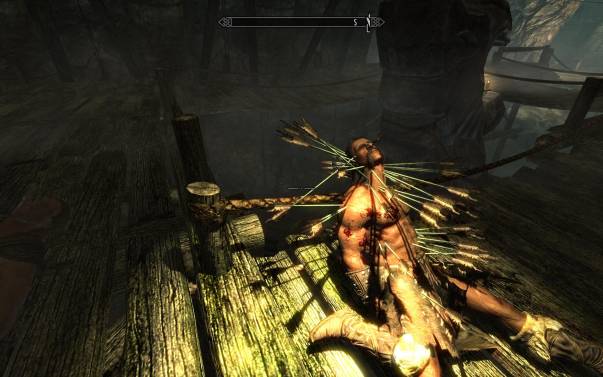
Skyrim Arrows
Must’ve just been the wind.

We flip to Mordec’s perspective as the battle begins.

Before the Bossonians and Gundermen outside the encampment were fully formed to face the Cimmerian tidal wave, it swept onto them.

Wait, why were they outside the encampment in the middle of the night? Is Venarium not big enough to hold the army that built it? Why not? There’s plenty of materials, and more soldiers means more labor to assemble it. If the fort is unfinished, I can’t find any mention of it.

The foemen in front of them gave ground. A few archers and pikemen ran for their lives, forgetting in their fear they would find no safety in flight. Most, though, put up the best fight they could. And, to take the place of the fled and fallen, more and more soldiers came forth from the camp.

Why did you even build this thing?

Continue reading “Conan of Venarium: The Battle Adjacent to Venarium”