September Humble Choice

The first Tuesday of September is here. What’s in the box?

Tiny Tina’s Wonderlands is probably great for someone, I dunno. I like Borderlands gameplay reasonably well but I also really like its aesthetic, and the existing set of four games (counting the Pre-Sequel) is already enough to mostly exhaust my interest in the mechanics, so I don’t need a fifth game that does away with the aesthetic. Also, Tiny Tina’s not that great? I don’t know why this character is so beloved. There’s nothing wrong with her, she’s one of the better Borderlands side characters, but nothing about her leapt out as needing an entire game of her shouting about dragons.

Deceive Inc. is a multiplayer game about being a spy trying to steal a thing before any of the other spies can steal it. This is a cool concept and I might give it a whirl, but it can’t be meaningfully completed so it’s not going on the backlog, and I’d be surprised if my hours of play broke double digits by the end of the year. This is one of those games that would probably be really fun if I had a group of 4-5 people who played these kinds of things regularly with each other, but I don’t.

The Forgotten City is a “mystery and adventure game” set in a faithful recreation of an Ancient Roman city. It seems like one of those things where someone really just wanted to recreate an Ancient Roman city and then realized if they wanted to sell the thing, some kind of gameplay would be required. Fair enough, and I might explore the city on a lark, but it’s also not going into the backlog because I definitely don’t care about completing it. If there’s a blogpost about it, expect one of the highest criteria for whether it’s any good to be how easy it is to ignore the main plot completely and just walk around.

Aces&Adventures is a “poker-powered deckbuilding adventure.” That sounds like a perfectly good basis for a game, but what few scraps of plot it advertises are very generic. It seems like it’s trying to sell itself entirely on its mechanics, and there it runs into the problem that I already quite like Slay the Spire and don’t really see what this game brings to the table over just replaying that. The obvious niche here is people who really love deckbuilding games the way I like Metroidvanias, but I am not those people.

Patch Quest is a Pokemon game except it’s also Bullet Hell, a Metroidvania, and a Roguelike. I went back and forth on this a bit, partly I just don’t like the art style very much, but also it’s a Roguelike, and I am extremely over those, and ultimately I decided not to put it on the list. My general policy is getting to be that if I’m on the fence, give it a pass, but I think that’s a good policy – when I’ve already got so many good games in front of me, avoiding wasting time with a dud becomes more valuable than one more good game on the pile.

Fore Tales is another card-based game, but this one sells itself a good deal on its story. It’s got that Redwall “anthropomorphic animals in a medieval setting” vibe and seems light-hearted and pulpy without being childish, which is a pretty good tone to strike for me. At 20 hours, it’s pushing it for a “try it out and see” game, but that is main story+, while main story only is less than 10 hours, so I can always just skip some side content if I decide it’s not working.

Who Pressed Mute On Uncle Marcus is an FMV game made during the pandemic lockdown. I appreciate the need to keep a career on life support during the lockdown, but it’s unfortunately true that basically every pandemic project a live-action actor participated in turned out to be strictly worse than live action content you can find on Netflix. Having not played Uncle Marcus at all, it’s possible this one’s the exception, but I’m not gonna spend two or three hours finding out. As short as that is compared to an entire month’s worth of playing games, it’s still time I could spend playing Grime.

Autonauts vs. Piratebots is some kind of economy-automating game except the end goal is to produce an army with which to destroy the piratebots. I’ve always liked the idea of an RTS game that focuses heavily on the base building while putting minimal pressure on unit micro to the point where it plays more like a city-builder where the end goal is to mass troops and send them out to crush an enemy, and this seems like it’s trying to be that, so I will definitely give it a try. It’s a sequel to Autonauts, so I’m slightly worried that it’s not going to stand alone well, but will rather expect all players to be veterans of the original, when as far as I’m concerned the original only exists so the devs could get some initial returns on the basic systems on the way to making the real game. We’ll see how that turns out.

This gets me up to 162 in the backlog, despite having spent an embarrassing amount of time on Dungeons III DLCs. They’d completely run out of ideas for the last two, but by that point I was so close to done I decided to enable to cheat console just so I could say I’d gotten them all. I’ve also got Cook Serve Delicious 2 nearly finished off, been picking at that one for ages now.

Merchant of the Skies

Merchant of the Skies is one of those games where you sail/fly around a map to buy things where they’re cheap to sell them where they’re expensive in order to buy bigger ships and reach more distant locations. As the name suggests, it takes place in a floating archipelago and you have an airship to huck your goods around in. Its distinguishing feature is that it has significant base-building elements. As you explore the (randomly generated) map, you can find the standard collection of cities selling goods, but also several uninhabited islands that have some kind of resource on them: Wheat, wood, stone, whatever. You can build a little base to harvest the resource, and other buildings to process that resource, turning sand into glass into bottles and then supplying an alchemist with both bottles and apples to make apple cider or else with both bottles, tea leaves, and flowers to make medicine. Once you’ve rebuilt the lighthouse and figured out how to build your own recharging towers (all the airships are powered by electricity, even though they’ve got propellors and balloons and stuff) you can buy boats and program them to run routes to do things like ferry your glass bottles from the sand pit where they’re created to the apple orchard where you’ve built an alchemist to turn them into cider, then have the same ship pick up the finished cider to deliver to an inn for profit.

This is a cool idea, although the execution leaves something to be desired. Almost no one sells any resources above the first tier. You can buy and sell sand and wood, but not glass or lumber. If you want to make a killing from your base-building, you have to find a gem island and set up a mine, because gems are a tier 1 resource that regular towns buy but also super valuable. Some higher-tier resources remain useful for the whole game because of how common they’re used for base building, chiefly lumber and bricks, and there’s a set of four (depending on difficulty setting) inns on the map that you can keep supplied with bread (baked from flour that’s ground up from wheat, making it a tier 3 resource) and apple cider (made from glass bottles and apples, making it a tier 4 resource).

Others, however, are useful exclusively for a specific side quest that calls for them: Iron gears are used to repair a lighthouse, which means you need exactly 20 of them ever in the whole game and can pretty much shut down your whole iron gear production facility after you get them. There’s a side quest to deliver two bottles of medicine early-ish in the game, but it hints that you should track down the wise men on their giant flying turtle and buy it from them rather than try to manufacture it for yourself, and medicine will never be useful again, despite being probably the single hardest resource to create in the game. The game really would’ve benefited from somewhere to send your iron gears and medicine (and maybe also bricks and lumber) in the endgame, the way inns take bread and apple cider at a steady rate forever. This is especially true since you can’t just sell these high-tier resources at regular towns, so there’s absolutely no point in making them outside of satisfying quest requirements.

The game also has no combat, which I am pretty confident was an intentional choice on the part of the developer. That’s not a criticism, just something I found worth pointing out, since if I didn’t, someone might reasonably assume there’s some kind of simple system for fighting off pirates and engaging in piracy yourself, because that’s the standard for these games. Closest thing is that there’s a giant octopus who will show up and challenge you to a game of musical Mastermind and mug you if you lose.

If you want one of these ship-trade-y kinds of games with base building and resource harvesting elements, then Merchant of the Skies is the entire genre so there’s nowhere else to go. It does ultimately deliver on both flying around buying and selling stuff and on building up little resource colonies and production chains, and it ties those two gameplay elements together seamlessly, so despite its flaws I do recommend it to anyone who thinks that sounds like fun.

July Humble Choice

I’m in a weird place where it actually kind of stings now to open up a bunch of new video games from the Humble Choice if I haven’t been playing very many. Like, oh, shit, this might get me back over 170 because I didn’t really play much. Partly I’ve been busy, partly I’ve been moving (mostly my father but also some of my stuff) and my PS3 controller has been packed up for a while, which means I’ve hardly been playing anything.

But I’m not going to let myself pass on good games just to make a number move in the direction I want it to, so I’m definitely grabbing The Outer Worlds. It’s kind of surprising I don’t already have this one. While I’ve heard that it isn’t as good as the pitch of “the guys behind KotOR 2 and Fallout New Vegas finally have enough clout to make their own thing from scratch” would imply, I’ve still heard pretty good things overall and I like RPGs.

TemTem is another one of those games that looked at the stagnation of Pokemon and smelled opportunity, in this case making that Pokemon MMO that everyone always said they wanted. I don’t actually want that, although I can see why people who like competitive battling would. Instead of fighting a bunch of mono-type gym leaders in a game that’s basically 20 hours of tutorial and then you fight the Elite Four, the Champion and Elite Four can be the five actual best players on the leaderboard and the gyms can be special battlegrounds with specific restrictions on what kind of types, moves, items, etc. etc. are allowed in the battle and gym leaders can be whoever’s on top of the leaderboard for that specific set of restrictions. Then you can focus the PvE mode on battling Team Dildo or whatever, assuming you don’t want to ditch PvE content completely, which would not be unreasonable. Battles against a criminal organization Hellbent on world domination make sense as a situation where 2-8 trainers would team up, though.

I have no idea if TemTem actually does any of this, though, because I don’t actually care. While I enjoy the design challenge of sketching out a concept for PvP focused Pokemon game, I just don’t like PvP very much and it especially doesn’t play well with my desire to finish games and move on. Worth noting that TemTem doesn’t even advertise itself as PvP focused (its gyms are PvE, although it does feature competitive battling at all), which kind of leaves me wondering…why, then? Why else would you make your Pokemon game an MMO? The premise is all about competitive battling! The draw of a fantasy PvE MMO is that it’s a setting where a bunch of adventurers teaming up to raid a dungeon is, like, a thing that happens, and connecting you to a bunch of other players means that you can have that experience (or else consciously choose not to). What’re you teaming up for in TemTem? When in the Pokemon setting do 2-8 trainers team up to take on a gym?

In fairness, it’s totally possible the game has answers to these questions and I’m just not looking close enough to see them. Their description of their competitive battling does suggest their design has more intelligence to it than “people say Pokemon would be a cool MMO so let’s make something that is exactly that with no further elaboration.” I’ve got too many games in my backlog already to roll those dice, though.

I don’t have Yakuza 4 Remastered yet, and that’s a neat get since I’m picking at the series right now. This definitely falls into the category of “you already know whether or not you want a Yakuza game and don’t need me to tell you about it,” though.

Roadwarden seems like something I should enjoy, but something about the pure brown desaturated look is really off-putting to me. It’s a text-with-illustrations RPG about exploring a mysterious peninsula in a dark fantasy setting. This should be my jam, and I’m forcing myself to add it to the backlog, but also making note that I have a weird unsettling feeling about it. When I get around to actually playing it, I’ll ditch it if the feeling persists in play, even if I can’t figure out why. I’ll be disappointed if my blogpost on Roadwarden ends up being as uninteresting as “this game gives me bad vibes for no reason,” but if it does in fact give me bad vibes for no reason, then I’m not going to play it to the end out of some deluded obligation.

Kraken Academy‘s pitch is all about its setting and says nothing about its gameplay, which says “adventure game” to me. It’s only five hours, but I already picked up a bunch of games this month, I really don’t need to bog myself down with a genre I dislike even if the writing could hypothetically save it.

Merchant of the Skies is one of those trading type games where you have a boat of some kind and fill it up with stuff that’s cheap to take it to somewhere it’s expensive to sell it up and use the money to buy a bigger boat until you have the biggest boat of all and enough money to retire to a private island or buy China or something. This one is set apart by two things: First, your boat flies, and second, you get to buy little buildings at different locations. I like this genre, it doesn’t get a whole lot of love (or at least it doesn’t cross my radar much), and I like both of those new twists on the standard concept, so this is a get for sure.

Ozymandias: Bronze Age Empire Sim is a 4X game, and those are a huge time commitment. It’s also not really something you can play to completion, since there’s no particular campaign (and a campaign for a 4X game would be pretty unwise anyway). I’m going to get it for my collection, but I won’t add it to the backlog, since it can’t really be meaningfully completed.

I already have Shotgun King: The Final Checkmate. It’s a fun time-waster that only takes like 15-30 minutes. I think it might be possible to complete, but I definitely haven’t bothered and am not going to. It’s a game where you are a Chess king and have to defeat all the enemies alone, but luckily you have a shotgun, and also that shotgun converts killed enemies into cards that allow you to move like that enemy for one move. So, if you use your shotgun to kill a knight, you can get on that knight’s square to pick up a knight card, which you can play to make a knight move. You can only have two cards in your inventory at once, so you usually want to fill them up with queens, but gameplay being what it is, sometimes you shove a bishop in there because it’s nearby and it’s better than nothing. You can only fire your shotgun twice before you have to reload and if you get checkmated, you lose. Also your opponent is a fucking cheater who will sometimes move like five pieces at once, but in fairness you do have a shotgun, and you can tell which pieces are about to move because they’ll wiggle a little in advance.

This does indeed bring my total backlog over 170 to 171, although a lot of the new games are short enough that I should be able to get things back below 170 provided I actually play any video games in the month of July.

Moving Is Hard

My father needed help moving lately, and between that and the sibling gatherings that have resulted, I have basically lost four full days out of my schedule, at the same time as this blog’s buffer was starting to run empty. I’m wringing a bit of extra space in the buffer out of this very brief explanatory update, but mostly if this blog goes quiet for a bit, then that is why.

Borderlands 3’s Visual Upgrade Did Nothing

The first three Borderlands games (including the Pre-Sequel) looked so similar to one another that I’m pretty sure they were made in the same engine. Characters got design updates occasionally and the entire weapon inventory seems to have redesigned between 1 and 2, but anything that didn’t specifically get a redesign looks exactly the same. Borderlands 3, released five years after the Pre-Sequel, is the series’ first major graphical upgrade.

They may as well not have bothered.

Because of the weird min-maxing of my processor and graphics card, I can only play Borderlands 3 on the lowest settings, while the Pre-Sequel and earlier games run no problem. This does bias me against the visual upgrade, but look, Borderlands isn’t a photorealistic series. Not being that is one of the things that set it apart. The graphics don’t necessarily benefit from being better because there’s no real world standard that everyone knows about and can compare it to and which even our strongest graphics engines can’t yet mimic. Borderlands 1 already looked exactly like a Borderlands game, so the only room for improvement is in new character designs, weapon designs, monster designs, and so on, to keep things from getting too stale and repetitive.

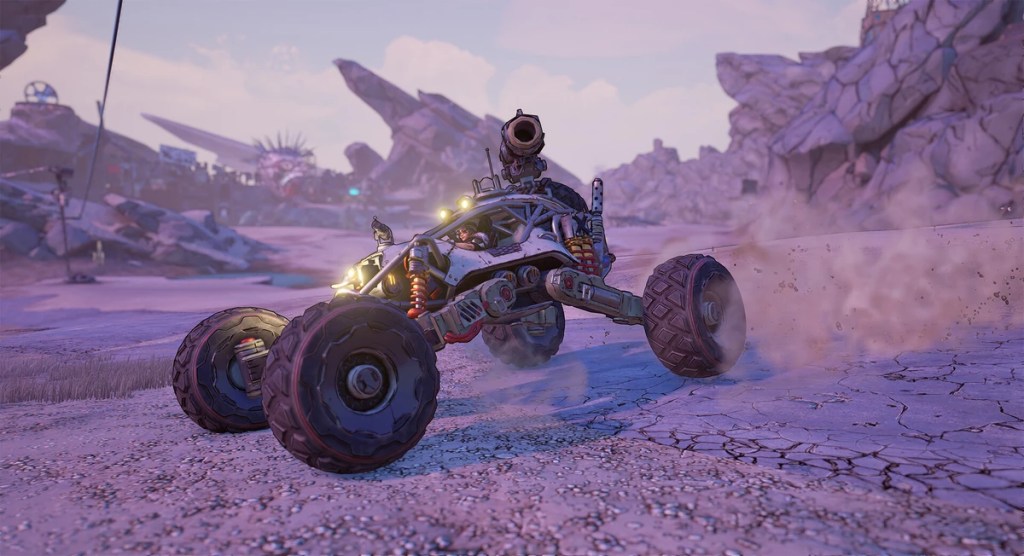
Borderlands 3 also has some redesigns, although the problem here is that I mostly don’t like them. For example, here is the Borderlands 2 light runner:

And here’s the Borderlands 3 outrunner:

Borderlands 1 had a vehicle called outrunner but which looks basically identical to the BL2 light runner, so I’m going to refer to the BL1/2 design as the light runner and the BL3 design as the outrunner. There’s nothing about the outrunner design that seems like it would be bad for general audiences, but I personally dislike how it’s now much more lightly armored and has lots of shock absorbers and thin struts exposed. The light runner had a rugged look that helped make Pandora seem like a place where roads and garages were rare and bandit ambushes were common. The outrunner more looks like a dune buggy you’d take for a spin on vacation – an off-road vehicle, for sure, but not one built to keep going in spite of a light sprinkling of small arms fire.

I’ve talked about the three pillars of Star Wars before, and other than the fact that Star Wars hates wheels (everything is either treaded or hovers), the light runner fits right in with the space western scoundrel pillar (I call it “smuggler pillar” in that article because I only later realized that “scoundrel pillar” is a much better name for it), while the outrunner does not. Personally, I really like Star Wars and the biggest appeal of Borderlands for me has always been that it feels a lot like that scoundrel pillar of Star Wars but with guns that make the dakka dakka noises, which is basically the only change I have ever wanted to that aesthetic. Borderlands 3 leaving that behind to do something else is really disappointing to me, although I’m not sure how general audiences would take it.

Also it’s really dumb that in 2019 they’re still so shy about saying the word “fuck” in an M-rated video game full of blood and giblets and dismembered body parts used as scenery doodads, and their heavy use of “slap” as a replacement really draws attention to it.

D&D Half-Races

WotC is getting rid of half-elves and half-orcs. This is good. They claim they’re doing so to fight racism. This is bad.

Mixed race characters are a cool idea and one that makes a ton of sense in the ever-more metropolitan world of D&D. Back in the mists of the 1970s, being an elf or a dwarf could be a character’s defining trait. That was a sufficiently cool defining trait, and one with enough support in foundational work like Lord of the Rings, that it became common. By the 80s, elf and dwarf had moved from being character classes to the new category of race and could have classes of their own. Gary Gygax hated Lord of the Rings and wanted to play Conan and Elric instead, so he added a bunch of passive aggressive restrictions on so-called demi-human characters to try and discourage them, but it didn’t work.

It was perfectly common for humans, elves, and dwarves to be in the same adventuring party as one another, and because players generally assume that adventurers have a normal experience of the world (which is barking mad, but also comes up with regards to things like the value of money and how many class levels a random bartender has), the assumption was that humans, elves, and dwarves hung out together all the time. Elf-only and dwarf-only kingdoms were still a thing, but major cities were assumed to barely have a human majority with significant demi-human populations. Half-elves, originally added because Elrond is a half-elf and D&D nerds were the kinds of people who knew and cared about this kind of deep Tolkien lore, took on new connotations of not being the result of some rare contact between opposite worlds, but of being a naturally common occurrence anywhere human and elf territories (usually allies in the first place) bordered one another. Half-orcs got added in as a half-measure towards people who thought orcs were cool and wanted to be one without actually adding orcs to the adventurer coalition.

By the 90s, when Drizz’t was rising to fame, rogue members of traditionally evil races started gaining traction, and the popularity of WarCraft II and especially III mainstreamed (within the context of fantasy nerd culture, at least) the idea of shades of grey in your standard elves vs. orcs conflict. This made fewer inroads towards actually adding orcs to the adventurer coalition, probably because the source material still depicted orcs as consistently opposed to humans, just also that their own coalition was an equally valid perspective. It’s probably not a coincidence that this coincided with 3e’s explosion of poorly balanced monster races, with the goal of making just about anything sapient playable.

It didn’t catch on, but considering how well the return to that well went in future editions (especially 5e), it’s probably because the weirdest and hardest to balance races were also given the least attention, seen as an afterthought. Trolls were technically playable, but the balance on them was a nightmare. Their abilities were massively overpowered, and they were smacked hard with level adjustments, which totally failed to solve the problem because while the troll’s natural abilities might make them equivalent to a 6th-level Fighter, a troll with one level of Fighter is not equivalent to a 7th-level Fighter. The abilities you get at 7th level are worth way more than the abilities you get at 1st level. The exact breakpoints for when this monster with that class was hideously under- vs. overpowered varied for every single monster and class, but in general, playing a monster with a level adjustment was a sucker’s game. This prevented the population of the generic D&D city from getting any weirder, but only temporarily. People clearly wanted bizarre races, 3e just failed to deliver.

5e remained as reluctant as ever to include orcs in the player coalition, reserving them for expansion content and giving them otherwise unheard of stat penalties, but petulantly holding out on orcs, specifically, didn’t change the fact that dark elves had fully migrated into the player coalition, along with dragonborn and tieflings, mostly breaking down what few barriers remained to what might be considered a “standard” adventurer race. The infrequent nature of expansion material in 5e also led to the general assumption that it was all core. Whereas earlier editions had new books coming out so frequently that to declare that all of them would be allowed was to invite chaos (which is not necessarily a bad idea because some groups like chaos, but most GMs like to worldbuild and don’t like having the party consist exclusively of expansion races from obscure sourcebooks they don’t own, haven’t read, and never even thought about while building the setting), the slow release of 5e books led to the attitude that books like Xanathar’s Guide to Everything and Tasha’s Cauldron of Everything are effectively core – including Volo’s Guide to Monsters and its drastically expanded list of options for player races.

At this point, it’s assumed that most major D&D cities not only have significant populations of elves, dwarves, dragonborn, and tieflings, but that obscure races like tabaxi and tortles are considered unremarkable even if they’re few enough in number to not show up in demographic breakdowns. So-called “monster races” like goblins and orcs are regarded with, at worst, mild suspicion, and are frequently treated as uncommon-but-unremarkable just like the tortles. Major cities are jampacked with all kinds of bizarre creatures. So it’s becoming simultaneously much harder not to notice that elves and orcs are, for some reason, the only races that breed with humans (and non-human races never breed with one another), and also much, much harder to write stat blocks to change that. The solution of cutting the half-elf and half-orc is the best one – the alternative is to write a system for combining any two races that is begging to be powergamed to death. Add a sidebar saying that mixed characters can pick the stats of one ancestry or the other. This is completely reasonable if you want to keep normal sexual reproduction as a trait of most creatures (personally I favor the “humans have babies, everyone else does something weird” approach, but that’s probably never going to be popular).

But this perfectly reasonable ditching of a legacy mechanic that’s long outdated in the modern hyper-cosmopolitan world of the D&D default is not striking a blow agianst racism. In fact, if it’s a purely narrative decision rather than a mechanical one, it’s actually pro-racist. Not Nazi-grade or anything, but removing mixed-race characters as a mechanical option does add slightly more friction to playing them, and while there are no real half-elves to worry about, there are people who use half-elves to evoke the experience of being, like, half-American half-Mexican or something. You can have a D&D backstory that evokes that same experience while mechanically being either a human or an elf, and you could also have a D&D backstory that evokes that experience by being mixed between two human ethnicities, which obviously provides a better parallel, but in fairness it is a fantasy story and sometimes you want to add an element of the fantastical to the experience.

All this to say that removing half-elves and half-orcs isn’t at all a pro-segregation move if you’re doing it for mechanical reasons, that’s just an acknowledgement that you can’t keep up with the number of potential mixes you’ve introduced with all these new ancestries so you’re giving up and people will just have to fluff stuff. But drawing attention to banning mixed races as a culture war move actually does come across as pro-segregation.

Like, OSR projects are sometimes run by normal people and are sometimes run by racists. If I heard about some obscure OSR project but all I knew about it was some mostly-generic title like “Monsters Down Below” or something, I wouldn’t assume they were racists based on that. And if I heard they weren’t including half-elves and half-orcs, I would default to the charitable assumption that it’s because of the mechanical issues that these imply half-dwarves and half-halflings and half-dwarf/half-elves and so forth, and they didn’t want their race section to sprawl with all these fiddly pairings. But if I heard they made a point of banning half-elves and half-orcs to make a statement on real world race issues, I would at that point guess that yeah, these guys are racists who don’t like having mixed-race characters as part of the default good guy coalition.

The only reason this move comes across as racist is because they went out of their way to frame it as a race thing.

Far Cry 4 Is Two Really Good Games Combined Into One Pretty Okay Game

Far Cry 4 is mainly something to give the visual and hands-controlling part of my brain something to focus on while I listen to podcasts and audiobooks. This is something I really like to do, and I’m having a pretty good time with Far Cry 4, although I suspect it would be much less so if I’d played Far Cry 3 on PC. Because I played Far Cry 3 on console, Far Cry 4 is my first time experiencing the full potential of these game mechanics. But Far Cry 4 could’ve been a great game even despite the looming shadow of its predecessor, if it had picked one of the two games it’s trying to be and committed to it.

Continue reading “Far Cry 4 Is Two Really Good Games Combined Into One Pretty Okay Game”

My House Was On Fire

Even having switched to one post weekly, my queue has run empty so I need to write something up. Problem is, I’ve been extremely busy in January trying to pivot away from 5e as fast as possible, so I haven’t played that many video games. Turns out I needn’t have bothered, everything just kinda worked out, but I did bother so now my blogging queue is empty.

I’m less than halfway through Far Cry 3, I’ve played a little bit of Moonlighter but not quite gotten past the first dungeon of five, and I still haven’t quite wrapped up the last side quest I want to bag in Hades before calling it finished. And when I have been playing video games, it’s usually been in a state of absolute exhaustion, a point where I realize I can’t do any more work so the smart thing to do is recover so that I can work at a reasonable pace later – and that’s not a great place to be in when trying to figure out if Moonlighter is any good. I’m kind of generous on games in the first place, but in that state of mind any game will hold my attention for 1-2 hours and then immediately lose it as I feel able to get back to writing and panicky about reaching my deadline.

So these blog updates might end up being a 2022 thing? I dunno, we’ll see how things go.

Glass Onion Was Disappointing

“Maybe Elon Musk is dumb actually” is an idea that is certainly having a moment, as Musk has been live-tweeting his mid-life crisis for the past several years. I wonder when Glass Onion was written, that it happened to come out just as that wave seems to be cresting (but hey, maybe Musk has even more spectacular failures in the queue). Certainly, the fact that “the Elon Musk-alike is very stupid” is meant to be the movie’s twist ending has been kinda spoiled by the fact that this is now a common opinion and one you would expect Rian Johnson in particular to have.

Very early on they set up “maybe the Elon Musk-alike is the killer” and then dismiss it with “no, his motive is too obvious and whoever the killer was struck in-person, and he’s too smart to take such a bone-headed risk.” And the problem is that I immediately realize this is not a thing Rian Johnson believes and so right off the bat I know that yeah, of course he’s the killer, he is absolutely stupid enough to have done it, doubly so since, with him ruled out, the entire middle of the movie is spent detective-ing four other potential culprits instead. I don’t even consider it worth being a spoiler alert. If you saw Glass Onion and you didn’t instantly realize the Musk-alike is the killer as soon as the line dismissing him was spoken, then you weren’t here for the mystery anyway. Two years ago we all might’ve bought that Rian Johnson was actually going for “Musk-alike as corrupt genius,” but not in 2022 (or very early 2023, when I saw it).

But then it falls apart in the ending, because Benoit Blanc is supposed to have this takedown at the end where he lays out how stupid the Musk-alike’s murders were…and, uh, they actually reveal a strong ability to improvise, poisoning his second victim with his own glass by using their pineapple allergy, thus creating a drink that he can drink from with impunity but which the target will die from, thus making it seem like he was the one being targeted and removing himself from suspicion as the culprit. We don’t see his first murder clearly (it’s the inciting incident, already accomplished as the story begins), but apparently he managed to poison the victim’s drink without her noticing. His third murder was simple, straightforward, and except for a stroke of pure dumb luck, effective. Benoit Blanc even praises it as having “panache” before he realizes that the killer was riffing off of an idea that Blanc himself had planted in his head – but if turning off the lights and shooting the target works, it works, regardless of who gave him the idea. If the third victim didn’t happen to have her sister’s diary in her coat pocket to intercept the bullet, the Musk-alike would’ve just won.

The method of his downfall is pretty dumb, anyway. His whole getaway mansion is powered by some new energy source that floods the place with hydrogen gas. It’s supposed to be a “billionaire self-proclaimed genius inventor’s idea is actually disastrously stupid” thing, but it takes serious effort to get the place to catch on fire. Firearms are discharged, a crucial piece of evidence is lit on fire, the lighter used to do it is playfully flicked on and off a couple of different times throughout the movie, and the protagonist (Andy/Helen, not Blanc – he ties the series together, but as a recurring supporting character, not the protagonist) has to get a bonfire going pretty high indoors to set off the chain reaction. Which then fails to inflict meaningful harm on any of the people at ground zero for the explosion. While making homes hyper-vulnerable to arson is certainly a drawback of the technology, it demonstrably isn’t turning homes into deathtraps, because the trap gets sprung and no death ensues. You definitely wouldn’t want this energy powering urban centers where a fire in one building could cause an explosion that chains into other buildings and causes a city-spanning blaze, but vastly reduced energy prices at the tradeoff that someone intentionally setting your house on fire will be able to get the whole house burning in thirty seconds sounds like a pretty good deal to me, on account of the scarcity of mad arsonists.

Not to mention the ending relies on the protagonist engaging in the exact same kind of improvised crime that Blanc just finished calling the Musk-alike an idiot for. There’s definitely a moral distinction to be drawn between arson for the sake of avenging your murdered sister versus murder for the sake of personal gain, but intellectually speaking, “use the materials at hand to accomplish a crime” is pretty much the same.

The “billionaire ‘genius’ is actually stupid” theme gets carried really well earlier. Early on in the movie, the Musk-alike sets up a murder mystery themed party, and brags to Blanc, a professional detective considered the best in the world, that it’s going to be “next level.” Blanc solves it before the “murder” scene even happens, and we later learn that 1) the mystery was written by someone else who 2) did not know Blanc would be at the party, expecting only the Musk-alike’s other “disruptor” friends, none of whom have any kind of background in solving puzzles or mysteries. So, y’know, this mystery writer set up a mystery for some randos and of course Blance walks right through it effortlessly, he’s a professional at the top of his field tackling a mystery designed to be solvable by ordinary people. If the Musk-alike had designed these puzzles and mysteries himself, he would know how hideously mismatched the difficulty of the puzzle was to Blanc’s skills, but since he’s just taking credit for other people’s work, he blithely assumes that since he got a renowned person to design the mystery, it’s probably a fair match for the renowned person who’s showed up to solve it (not to mention, a renowned mystery writer is not the same thing as a highly effective actual criminal, although it’s not clear to me whether or not Rian Johnson, a renowned mystery writer, is copping to this).

The parlor scene for the fake murder was pretty enjoyable, but the parlor scene at the end is a flop. Maybe this could’ve worked, if the Musk-alike had been set up with a sense of real menace, a sense of being an evil genius looming over the gathering with the power to snuff out anyone at any time he chooses, someone removed from suspicion because he projects an aura of such power that if he were the killer, things would surely be much, much worse. When he confronts Benoit Blanc in the glass onion after his murder mystery is ruined, the audience should feel like Blanc is in danger. When he positions Blanc between himself and his “friends” after Duke’s death, it should come across as an act of ruthless calculation, unconcerned with the lives of others, not panicky cowardice. Give Blanc lines about how the Musk-alike has been living here for months, in a building he built, on an island he owns. He could’ve had an entire platoon of security on site if he wanted, could’ve filled the place with cameras, could’ve rigged it up with death traps if he wanted to, using the same design skills that went into the puzzle boxes. The only reason, Blanc muses early on, to have left the island so unsecured is if he knew that none of the guests would dare to try and kill him. After the Musk-alike is seemingly targeted, Blanc starts trying to figure out why the Musk-alike’s predictions were wrong, what information he didn’t know about could’ve changed the situation.

Then he can be revealed at the end to be a moderately clever improviser who stumbled into power by blind luck. The reason why the island isn’t a fortress ready to protect him from a murderer isn’t because he assessed no such precautions were necessary, but because he was too stupid to realize he was in danger until it was too late. I can imagine a version of the ending scene where the big reveal is that, if you ignore his aura of menace and self-aggrandizing narrative, the thing he holds over everyone’s heads to keep them in line isn’t genius. It’s money. He didn’t design his own puzzle boxes or his own mystery, and his murders are accomplished not with elaborate traps or brilliant misdirection, but slightly clever improvisation with a glass of pineapple juice. The “he just used pineapple juice” reveal is supposed to be obviously stupid, but the problem is that it’s cleverer than most people could come up with on short notice. But if it’s bringing him down from “sinister criminal mastermind” to “exactly one clever idea” then it works.

You could even do a thing with the puzzle box where the Chess puzzle is presented as more important than the others, getting an entire layer of the box to itself, the “final boss” puzzle before getting to the invitation. And on the surface the Musk-alike can sell that as “Chess puzzles were always my favorites, I’m a Chess master, bwahaha,” but the actual puzzle (as it is in the movie we get) is mate-in-one. An earlygame mate-in-one where you can recognize which piece is your queen and which is the opponent’s king even though they’re unlabeled. It might even literally be the Scholar’s Mate, I didn’t look closely enough to check. It’s Chess, a game where you famously have to think more moves ahead than your opponent to get an advantage, and the Musk-alike thinks the best way to show off his genius is a mate-in-one puzzle. He didn’t even design the box, of course, so really all he did was say “oh, and make the final puzzle a Chess puzzle because that’s my brand” to the guy who actually made them.

Instead, the movie is a glass onion. An illusion of complexity, sure, but you can see the center clearly from the beginning. And I think Rian Johnson was too busy taking potshots at his Musk-alike character to sell that illusion.

Console Shooters Are Bad

The hottest take of twenty years ago.

I bring it up, though, because Far Cry 3 is one of those games released in the early 2010s that won’t run on my computer even though games both newer and older will. This is probably at least in part due to the bizarre processor/graphics card min/maxing I’ve done, where I bought a really garbage graphics card because I was buying my current PC before the blockchain crash so graphics cards were expensive, and balanced it out with a really beastly processor. That processor has been able to carry quite a few games (for example, Far Cry 2 runs fine, and that’s also a PS3 game), but for some reason it struggles with 2012’s Far Cry 3 where it doesn’t with 2015’s Assassin’s Creed: Syndicate. I suspect multicore processors are involved somehow, like, sufficiently old games can run on just one core of my processor, sufficiently new games are optimized for multicore, but at just the right age we get games that one core of my processor can’t handle without backup from a better graphics card, but which can’t use multicore properly. That’s a blind guess, though, I have no idea if Far Cry 3 does or doesn’t take advantage of multicore processors.

Anyway, I solved this problem by finding a used copy of Far Cry 3&4 collection for PS3 and dusting off my console. And man, putting first person shooters on a console is really not a good idea. I’ll still probably get through it, but unfortunately my opinion of the series’ star title will undoubtedly be affected by the fact that I am playing it on a vastly inferior platform. I don’t generally buy into the whole “PC master race” thing, but for first person shooters there really is no competition, here.