
Why is it a different country each time? Why are half their views just refreshing the main page a whole bunch? What the Hell is going on?
Category: Uncategorized
Attention Norway
Now it’s you giving me 100-ish views all from one visitor. What the Hell? This feels like it has to be a bot thing, but why would a bot want to visit the same page a hundred times?
Attention Canada
So I just got like sixty pageviews today, all of them from one guy in Canada. You know this blog comes with a follow button, right, buddy? You don’t have to read it all today. It’ll still be here tomorrow. Promise.
Ace Combat Zero Has A Terrible Last Boss
EDIT: People keep finding this blog post while looking for advice on how to defeat Pixy, so I wrote a post that contains some actual advice for that. This post, as the title implies, is mainly about how Pixy is a much worse final boss than either of the two missions that immediately precede the confrontation with him.
After over a decade (I’m not counting mobile games until they make one that doesn’t suck), the Ace Combat series is finally coming back to Strangereal with Ace Combat 7 some time next year. I’ve been replaying a couple of old Ace Combat games I have lying around to celebrate, and have been reminded how much I hate this guy:

Just Crazy Enough To Work
“That’s just crazy enough to work!” The Hell does that mean? How can any amount of irrationality or delusion help you to accomplish something? This is a meme, and like most memes it’s stupid when applied literally, but also like most memes it’s a shorthand reference to a more complicated idea. Unlike most memes, it’s old as Hell, so you can’t track down the origination of the meme to a 4chan thread from 2008, whose context will make the meme’s meaning immediately obvious.
What I suspect the meme’s origins might be is the answer to the old story of two economists walking down the road when they see a twenty dollar bill on the street. The younger economist bends over to pick it up, but the older economist says “don’t bother. If there were money just lying on the street, someone would’ve come and picked it up already.” Although the older economist is clearly wrong in this story (that’s, y’know, the joke), he’s usually right, which is why the idea that any good idea would already be in use was dominant in economics for a while (it isn’t anymore, which is why the story is about an old and young economist, and not an economist and, like, a plumber or something). Generally speaking, if you think you see an easily exploited opportunity, you’re missing something and are wasting your time and resources when you try to jump on it. If the opportunity were really that obvious and that easy to take advantage of, everyone would already be doing it, like how everyone uses email for business purposes. People who refuse to do that are at a disadvantage because the benefits of email are so obvious and easily accessible that it’s common practice. If you see a business opportunity that’s as easy and straightforward as using email, you have to ask yourself: Why isn’t everyone already doing this? Occasionally the answer is that someone left a twenty dollar bill on the street and you’re lucky enough to be the first person to wander by, but nine times out of ten, the old economics maxim holds true: If it were a good idea, businesses would be doing it already.
Yet that’s obviously not true all the time, or else no one would ever be able to get ahead through innovation. So how can you tell that your idea is actually an untapped opportunity and not a dead end? When it’s just crazy enough to work. That means it’s not so crazy as to be obviously impossible (i.e. it’s not an Underpants Gnome business plan), but it’s still crazy enough that you might plausibly be the first person to have thought of it. Figuring out exactly how crazy an idea has to be to thread that needle is obviously not an exact science, but the meme still helpfully refers to the general idea. Or at least it used to. Maybe.
Star Wars Is A Terrible Example Of The Hero’s Journey
The Hero’s Journey is frequently illustrated using the example of Star Wars: A New Hope. A New Hope’s plot was based on the Hero’s Journey and follows the model closely, so you might think this is sensible at first glance. On closer examination, however, it turns out that this is the opposite of true. Being based so closely on the Hero’s Journey makes A New Hope a terrible example of the monomyth, and the hackneyed understanding of the Hero’s Journey that you get when you analyze Star Wars (and only Star Wars) to understand it is the reason why so many movies riffing on the Hero’s Journey are so godawful.
The important thing to understand about the Hero’s Journey is that it is an emotional journey. You can have that journey symbolized in the plot by also having a literal journey and that’s fine, but the actual heart of it is the character arc of your protagonist. Joseph Campbell names the steps of the journey after certain common symbols of it, but the symbol is not the story beat. For example, the Meeting With The Goddess is about the hero finding the thing they left home for, on the other side of the road of trials they undertook to get there, in the farthest depths of exotic otherworldliness as they will see in this particular story (sort of – that’s also kind of the Ultimate Boon, but Star Wars uses the two plot beats pretty much interchangeably, which is another reason why it’s a bad example of the Hero’s Journey). An actual goddess is not required. All that matters is that the hero is as far out of their comfort zone as they will ever get, and this meeting denotes the point from which they will begin their ascent back up to where they came from, now imbued with whatever power they derived from overcoming the trials of whatever strange circumstance they’ve been grappling with for the last quarter of the plot.
Star Wars literalizes this beat by having Luke meet Princess Leia at about the same time as he’s become a Death Star-storming space adventurer who doesn’t need Ben Kenobi’s direct guidance or Han Solo’s permission to be a hero, and that literalization is what makes it a terrible example. This strictly literal usage of Campbell’s symbolic reference to the moment of revelation is not only unnecessary, it can confuse people trying to understand the Hero’s Journey into thinking that the story beat here is literally “protagonist meets a powerful female of some sort.” So, a lot of people think that somewhere around the mid-point of the story the protagonist should have a moment with their love interest and that this should spur them on to action. That’s vaguely similar to what it actually represents, but only vaguely. And it’s not even a vital step of the journey! Campbell threw in a lot of common but not ubiquitous elements, because he was writing an anthropological work, not a storytelling guide. You don’t actually need a meeting with the goddess to tell a hero’s journey story at all.
Hogwarts Is Messed Up
Hogwarts is technically a school and from the students’ perspective it’s run like one. From the administration’s perspective, it’s a front for a vigilante counter-terrorist organization, a magical research laboratory, and a vault for containing dangerous magical artifacts. Hogwarts is the most secure place in magical Britain, which means organizations like the Order of the Phoenix use it as a stronghold and lock up their deadliest magical superweapons there to keep them out of the wrong hands while paying so little attention to the professors that Slugworth can found magical prodigy conspiracies complete with handing out powerful magical elixirs and the secrets of fucking horcruxes and Lockheart can totally abandon his students to deal with potentially injurious or even deadly magical creatures on their own, and in neither case are either of them fired. Sure, the Defense Against the Dark Arts position was literally cursed and that made teachers slim pickings, but the death eater infiltrator was a more responsible teacher than Lockheart, so they clearly had some options.
Hogwarts teachers are held to basically no standards at all for student safety and injuries requiring hospitalization are commonplace. For the love of God, each year has about eight-ish students per house for a total population well under 250, and yet they have a hospital ward with enough beds to handle one or two dozen kids. They have magical supermedicine that can heal nearly any injury overnight, and yet they’re all ready to have 5-10% of their student body incapacitated in the hospital at any given time. Hogsmeade must have a comparable population (you can hardly get much lower) and they don’t even have a clinic!
Hogwarts has recognized the threat to student health represented by using their school as a fortress/safehouse and consistently failing to discipline teachers who endanger children, and their answer was to expand the medical facilities. They do not give a fuck if students are in danger. “Professor Dumbledore, St. Mungo’s has sent another letter of complaint. They say they’ve had to dedicate an entire ward of the hospital just to Hogwarts injuries. Should we maybe stop harboring retired aurors who are secretly still pursuing unresolved cases and have dozens if not hundreds of old dark magical enemies seeking revenge?” “Nah, we’ve got some room in the south tower, just set up a medical ward there, problem solved.”
Final Fantasy XII Espers as Villains: Adrammelech, Hashmal, Belias, and Ultima
Today we are finishing our look at the connections between Final Fantasy XII espers and the main villains of every previous game in the series (including spin-off game Final Fantasy Tactics), as proposed by this chart:
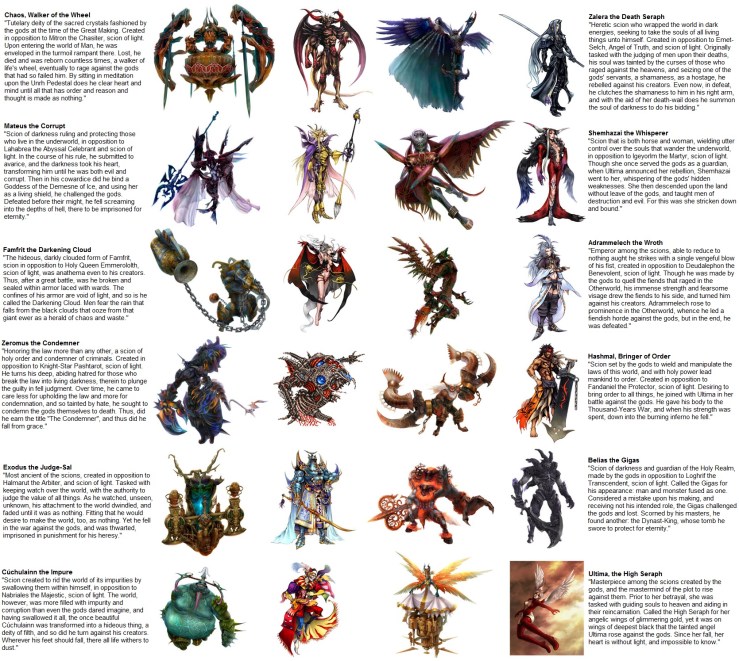
Today, we’re looking at Adrammelech, Hashmal, Belias, and Ultima, and here we’re getting into territory where nearly every esper/villain match-up is one I disagree with. I’ll note just in case here that I require all comments to be approved before appearing on the blog, however that’s not because I have any particular intention to suppress discussion, but because genuine comments are actually slightly less common than spam. If the post gets any kind of traction at all, I anticipate it’ll cause some discussion, so don’t panic if your comments aren’t showing up. If you’re not a spambot, I’ll approve you, and if a real discussion gets going on this blog, I’ll lift the requirement for approval for at least so long as that discussion lasts.
Anyways, espers and villains.
Continue reading “Final Fantasy XII Espers as Villains: Adrammelech, Hashmal, Belias, and Ultima”
Final Fantasy XII Espers as Villains: Zeromus, Exodus, Cuchulainn, Zalera, and Shemhazai
For some reason this post, specifically, gets more views wandering in off of Google than the actual first post of the series, so now there’s a link to that post right up here at the top. Have one for the third and final post, too, while we’re at it.
As established in the first post of this series, we’re looking at the espers from Final Fantasy XII and attempting to match them with the major villains of previous games in the series. This isn’t the first time this has been done, because someone already made this chart:
My premise, however, is that this chart is wrong about several of them, and in any case even for the ones about which the match is good (in some cases, even obvious), an explanation of why may be interesting to people who haven’t played every game in the series up to XII, as the original chart just offers physical comparisons, which don’t always match up well at all (compare Hashmal to Jecht, Adrammelech to Kuja, Kefka to Cuchulainn – some of these match-ups aren’t even close).
Today we’re examining the espers Zeromus, Exodus, Cuchulainn, Zalera, and Shemhazai, and we’re going to see a few disagreements with the chart in the process as well as discuss why some of these espers just don’t really match up to any of the main villains of the series at all, which won’t stop me from trying anyway.
Final Fantasy XII Espers As Villains: Chaos, Mateus, and Famfrit
The Final Fantasy series of games doesn’t take place in the same setting (outside of same vague hints that each radically different fantasy world in the series might possibly be different planets in the same galaxy, which hardly matters when nobody has any space ships). They maintain series continuity by having similar setting elements, like unique creatures, the prominence of magic crystals (especially early in the series), and similar (though steadily evolving) combat and exploration from one game to another.
So when I say that the Final Fantasy XII espers (powerful magical allies who can be summoned to help the party in difficult fights if you complete the sidequests required to unlock them in advance) are secretly the main villains from the previous Final Fantasy games, I’m actually advancing a theory and not just sitting down and explaining the plot of the game to people who haven’t heard of it. Hopefully anyone who is only vaguely familiar with the series is caught up now.
This theory is nothing new. Final Fantasy XII came out over a decade ago. The idea that many Final Fantasy XII espers are based on bosses from previous games is immediately obvious to anyone who’s played those previous games, and several of the others fit in fairly easily if you look closely. Someone took that close look, then plugged in the gaps with any unused bosses from the remaining games, and made this chart:

This chart is wrong. I mean, obviously. If this chart were correct I’d just be saying “hey guys, look at this cool chart.” That wouldn’t be much of a blog post. Mostly this chart is wrong because upon careful examination, there are a few espers that just don’t neatly line up with any bosses and vice-versa, and ultimately the idea that each previous game in the series was intentionally represented by an esper was probably unintentional. Rather, the FFXII dev team probably just used the side quest unlockable espers as an opportunity to make lots of references back to earlier games without bogging down the main plot with callbacks. It’s like the Gilgamesh side quest is a reference to FFV overall and also has references to III (sort of), VII, VIII, IX, X, and XII itself. That’s simultaneously overflowing with references to earlier games in the series while not being anything close to exhaustive.
The espers to bosses lineup is still close enough that you can make a pretty good fit, though, so I’m going to go boss by boss and look at what I think the chart got right, what I think fits poorly, and occasionally lament how the chart’s fit is poor but there’s not actually any better options amongst the espers in the game.
Continue reading “Final Fantasy XII Espers As Villains: Chaos, Mateus, and Famfrit”
 Chamomile Has A Blog