
My father needed help moving lately, and between that and the sibling gatherings that have resulted, I have basically lost four full days out of my schedule, at the same time as this blog’s buffer was starting to run empty. I’m wringing a bit of extra space in the buffer out of this very brief explanatory update, but mostly if this blog goes quiet for a bit, then that is why.
Month: June 2023
Dungeons: Why Didn’t You Just Make An ARPG?
Dungeons is allegedly a Dungeon Heart strategy game in the mold of Dungeon Keeper: You build a dungeon and repel attacking heroes, inverting the usual Diablo-style dungeon crawling action RPG. It’s really clear that what they actually wanted to make was a regular ARPG, though. The main plot is about descending down through three different tilesets of dungeons and confronting three dungeon bosses. It’s full of references to almost entirely Blizzard RPGs like Diablo and World of WarCraft (although in fairness Arthas was also a character in WarCraft III, an RTS), bringing up Dungeon Keeper only to explain how Dungeons works differently.
So how does Dungeons work differently? Well, your dungeon lord is at least 50% of your influence over the map. Monsters don’t venture far from the pentagrams used to summon them, and you can’t move those pentagrams after placing them. The pentagrams do expand your area of influence, so you use pentagrams to push out the borders of your control. You can’t tunnel very far past your area of influence, so pushing borders like this is, to some extent, important.
Dungeons’ big change from Dungeon Keeper is that your primary resource is now soul energy. Heroes come into your dungeon with zero soul energy, but as they fulfill needs like treasure, defeating monsters, finding equipment, or finding knowledge, they fill up soul energy. Once they’re maxed out, they’ll try to leave. You get a chunk of their soul energy when you defeat them and can get more by imprisoning them in a dungeon to slowly extract the rest.
Regular old gold mined out from veins in your underground lair is still used to place minion-spawning pentagrams, but every other function of gold is in helping you extract soul energy, either by placing loot or libraries or armories or other things that give heroes soul energy or else dungeons that help you extract it from defeated heroes. Soul energy is the currency you use to increase your dungeon level and place prestige items. The former makes all your minions stronger while the latter makes your dungeon lord stronger.
Your dungeon lord is the only unit you can move around with regular right clicks. Since all of your other units are tied to pentagrams which must be placed within your area of influence, your dungeon lord is the only one who can venture into enemy dungeon lords’ territory and is the only unit you can use for various scenario-specific objectives to do with ruining the heroes’ day, like intercepting a thieves’ guild smuggling cash through the underground or wrecking the cellars of various townsfolk (which spawns heroes in response). Your dungeon lord has an ability tree retained throughout the campaign, and while some of the abilities on that tree increase the power of your defensive minions, most of them increase the power of your dungeon lord either passively or through spells you can equip to your hotbar.
Additionally, at the end of each of the game’s three acts (not explicitly defined as such, but there’s three major antagonists in three different dungeon tilesets confronted in sequence), you must send your dungeon lord to fight the enemy boss alone. The more you’ve invested your skill points into dungeon management, the less effective you’ll be in these boss fights where your dungeon lord is the only usable unit.
What it all adds up to is an ARPG with a dungeon heart backdrop that mainly serves to distract from the ARPG elements. The strength of your character is pretty directly tied to the prestige items you can build for your dungeon, but those are bought with soul energy, and the system for accumulating soul energy involves a lot of babysitting heroes into taking a bunch of gold before dropping your dungeon lord on them (who is, remember, the only mobile unit, even in sections of the dungeon under your control), then waiting for more heroes to show up. The rate at which soul energy comes in is pathetic compared to how much you need to buy big-ticket prestige items that can significantly increase your power (or dozens of smaller ones that add up to the same cost for slightly lesser effect).
Focusing the dungeon management on being half dungeon lord and half game master made the dungeon heart gameplay less fun than games which focus purely on defeating heroes, and the rate at which heroes come in is far too slow when they’re the only source of the game’s most vital resource, and all of your offensive actions (which are the conclusion to basically every scenario – less than a quarter of the game’s sixteen stages are defensive) are carried out by playing the action RPG that they clearly wanted to be making instead.
The game also performs poorly on my machine, and while I normally chalk this up to my weird powerful processor + weak graphics card combo caused by the pressure crypto has been putting on the graphics card market, Dungeons is a 2011 game, so this seems like it’s more likely the thing where games from the 2010-2012-ish era run worse than games both before and after and upgrading the machine doesn’t help.
I took a quick look at the next game in the series and it does look like you can actually move your units plus you can venture forth to the surface world instead of always wrecking people’s cellars, so I’m not taking Dungeons II and III out of the backlog, but they’re definitely on notice to actually work, both in terms of performance and gameplay.
Miles Morales Is A Vital Part Of The Spider-Man Myth Cycle
Super heroes are mythical figures. Their stories get told and a canon of their exploits and adventures gets built up from the stories that people like enough to bother retelling. Sometimes a definitive work is written that incorporates basically all of a mythical cycle in one text, like Le Morte d’Arthur, and sometimes the myths never get collected in one place but the overall life story of a character still emerges from all the different stories, like the Trojan War (of which the Iliad recounts only the crucial turning point, not the entire story).
For example, here’s the rough life story of Batman that has emerged from 100 years of stories:
Bruce Wayne’s parents, Thomas and Martha Wayne, are killed by a mugger in front of his eyes as a child. When he grows up, he dedicates himself to martial training, physical and mental discipline, and leveraging his wealth towards becoming the crimefighting vigilante Batman. Early on he’s angry and brutal, and his butler Alfred is his only confidant. His foes are organized crime gangsters like the Falcone Family, Penguin, and the Black Mask. As his career goes on he forges relationships with allies like Jim Gordon and Harvey Dent, and begins training an expanded roster of sidekicks who graduate into hero allies: Batgirl, Robin, Nightwing, Huntress, the Bat-family. Batman’s growing roster of allies allows him to finally start healing from seeing his parents die as a child, as he begins raising a family of his own, of sorts.
The relatively ordinary criminals who were his nemeses fall to the wayside under his caped crusade, but the power vacuum gives rise to a menagerie of more bizarre foes: Scarecrow, Mr. Freeze, the Riddler, Twoface (after a tragic accident disfigures Harvey Dent and pushes him over the edge), and most iconically, the Joker. Batman and the Joker fight for the soul of Gotham for at least a decade, long enough for Jason Todd to go from Robin to Red Hood. During this era, Batman joins the Justice League, becomes friends with other heroes but especially Superman.
At some point, Joker dies. The myths vary as to how, exactly. Sometimes Batman finally breaks and kills him, sometimes he gets himself killed in one of his fits of reckless showmanship. Regardless, once Joker’s gone, the fight for Gotham is basically over. Other supervillains continue on, but by this point defectors are starting to line up for Batman’s side. Catwoman, initially a wild card, is firmly on Batman’s side (though not a reliable ally). Red Hood, initially sided firmly with the rogues gallery, is now more or less on the Bat-family’s side. Talia al-Ghul flips sides completely and mothers the youngest of the Robins with Bruce Wayne.
Batman Beyond may or may not fit into the mythic cycle. It’s a specific work written with only the Animated Series in mind, skipping over the entire Death-of-Joker era (which the Animated Series didn’t have) to set up its post-Batman setting. Batman Beyond is well-regarded so the motive is there to try and incorporate it into the cycle, but it’s also hard to reconcile the state of Gotham City in Beyond with the unambiguous fact that late stage Batman has a huge reserve of sidekicks and hero allies most of whom are younger than him. What happened to Nightwing? What happened to Talia? What happened to Damian Wayne? Terry McGuinness is a really good Batman but it’s weird that he’s on his own with just an aging, physically incapacitated Bruce instead of playing Robin to Nightwing or Damian.
Anyway, the somewhat confused state of the end of the Batman cycle is both totally normal for mythic cycles and also doesn’t detract from the greater point. Nobody ever set out to gather all the Batman stories into one collected narrative, but people have told stories of young Batman and old Batman and a rough outline of Batman’s life has emerged from it all.
So what does all this have to do with Spider-Man? Well, Spider-Man’s been a more soap operatic character for a long time. The core of Spider-Man is the coming-of-age story, of learning how to wield the power he’s been given. Spider-Man can never seem to get past, at maximum, the age of about twenty-eight or so, and he’s noticeably falling behind his peers in standard life milestones by then, with no children and not even married. And it’s not because he doesn’t want these things. Black Cat offers very much to lead Peter into a life that rejects the standard social norms, and while he dabbles with the idea, he never actually does it. In the end, Peter Parker’s love interest is Mary Jane, not Black Cat, and the usual vibe of a Black Cat arc is that Black Cat misunderstands who Spidey is and why he is where he’s at. She assumes that Spider-Man is failing to marry Mary Jane because he doesn’t really want to, that he’s being pressured into pursuing it by societal expectation, but the course of the arc reveals that Peter Parker very much does want to be a regular boring member of society, he’s just crushed by the dual-burden of also using his superpowers to keep people safe from supervillains.
And if Peter ever gets past that angst and struggle, he won’t be Spider-Man anymore. People want Peter Parker to eventually figure things out and get to live a happy, balanced life, but there’s not really any story there, so we only ever see Peter in that 15-28 age range. Unlike Batman, there’s no phase where his rogues gallery crumbles away to leave behind a board full of allies arrayed against a shrinking number of enemies, and implicitly total victory is now imminent. Flash Thompson gets to mature from high school bully to a hero-without-powers, Eddie Brock/Venom gets to become an anti-hero who’s finally gotten over his vendetta with Peter, but Peter himself has to be tormented by angst, trapped in eternal purgatory, never able to grow past being a well-intentioned high school or college student who’s doing his best to handle the enormous responsibilities life has thrust on him.
Until Miles Morales. As originally introduced in the Ultimate comics, Miles Morales is a replacement for a dead Peter Parker. That’s a valid way to do his character, I guess, but it does mean that Miles tends to be basically just Peter Parker but again. Having no active Peter Parker to contrast against, it’s easy for Miles to gobble up all the usual Peter Parker things that people expect from a Spider-Man story.
The version of the story told by the Spider-Verse films, though, tells it differently. Sort of. It actually repeats the Ultimate plotline pretty straightforwardly for Blonde Peter Parker. But Blonde Peter Parker isn’t our Peter Parker. Our Peter Parker struggles under the burden of being both Peter Parker and Spider-Man, and frequently fails at one to pull out a win for the other, almost always sacrificing Peter Parker for the sake of saving the city as Spider-Man. He doesn’t have a high-tech spider cave, he has a shed. He’s Peter B Parker, the man who was never able to be there for Mary Jane or anyone else in his life as much as he wanted to be, because there was only one Spider-Man, and it had to be him who saved the city, every time, and usually there wasn’t any time left over to be Peter Parker after that.
Until Miles Morales. Now there is another Spider-Man. Now Peter can take the night off to be with MJ while Miles takes care of things. Finally, at long last, he gets to marry Mary Jane (yes, they did get married in the comics, but the relationship worked so poorly that even though fans utterly loathed the arc that decanonized it, they still never went back on it). He gets to raise Mayday Parker. He gets to have all those things that his myth cycle up until now has only portrayed him as wanting and not getting to have.
Like Batman Beyond, the Spider-Verse films are very hard to fit into the overall myth cycle of Spider-Man, although (also like Batman Beyond) they’re sufficiently well-received that people might damn well try anyway. That is, it’s hard to fit the events of the Spiderverse movies into the generic life and times of Peter Parker that emerges from what stories get retold over and over again. Spider-Man has the advantage that the entire second half of the protagonist’s life is basically blank, though. While the majority of Batman stories take place when he’s in his 30s, stories about Old Batman are very much a thing in a way that stories about Old Spider-Man aren’t, really, which means “what’s Peter Parker like in his 50s” or even “what’s Peter Parker like in his mid-to-late 30s” does not have an agreed-upon answer in the myth cycle so far, so although the Spiderverse answer is deeply incompatible with many, many other stories in a way that, for example, the Venom symbiote is not, the lack of competition means that Spiderverse might win anyway.
But even if the Spiderverse angle gets contained to the Spiderverse movies and gets ignored by other Spider-Man stories (like the Insomniac video games), I think Miles Morales is crucial to Spider-Man’s overall myth cycle. Spider-Man needs to be angsty, a mess, unable to keep up with all the responsibilities thrust on him by both his regular life and his superpowers. But if Miles Morales is the main character, then Peter Parker doesn’t have to be like that – he can finally get his ducks in a row, figure out his life, be Spider-Man part-time to help show Miles the ropes and provide backup for major crises but spend most of his time raising his spider-baby with Mary Jane and living a normal life.
Chrono Cross Character Quests: The Thieves of Viper Manor
Serge has been pulled from his Home World to Another World, an alternate timeline where he drowned as a child. Almost as soon as he arrived he was ambushed by government goons of the Acacia Dragoons sent to arrest him for being a ghost, on the command of a mysterious villain named Lynx. Lacking anything better to do with his weekend, he heads up to to the Acacia Dragoons’ capital city of Termina to break into Viper Manor and confront this Lynx guy to see what he knows about all this wibbly-wobbly timey-wimey bullshit.
He’s also given his talking dog a walk and scritches behind the ears, helped a sapient occult artifact resolve his identity crisis with the power of archaeological digs and fishing, and gone on a date with the alternate timeline version of his girlfriend. He also met a thief named Kid and could hypothetically have recruited her, but also maybe he didn’t, so we’re talking about her now, when he’s more likely to do so, because some criminal expertise seems relevant now. You’ve also got to recruit someone else who’s trying to get in and wouldn’t you know it but there are three options: Help a magician climb up the cliffs in the rear, chase a rock star into a haunted forest to creep up from the sewers below, or help a foppish idiot playing hero charge the front gates directly.
We first meet Kid back in the Another Arni Village episode and it’s possible to recruit her there, but she’s more thematically relevant here and it makes some amount of sense that Serge might put off recruiting her for a while, seeing as how the game opens with a dream premonition where you shank her for no apparent reason and you might reasonably want to avoid that. After Serge arrives in Another World, main villain Lynx sends some of his government allies to kidnap him, and Kid shows up to kick their asses (so hard they’ll kiss the moon) just on the principle that these guys are bullies, laws are for wimps, and she has a personal vendetta with Lynx anyway. This is before you’ve had a chance to recruit Leena or Mojo or (in this version of the game) Poshul, so if you pounce on the chance to have a cute girl in the party, she’s your first party member besides Serge. If, instead, you turn her down, she’ll try to join you again in Termina while you’re plotting to break into Viper Manor. Even if you refuse, she breaks in for her own reasons and gets poisoned, at which point Serge will agree to save her whether the player likes it or not and she’ll join the party after she’s cured even if you’ve resisted recruiting her up to that point.
This is intentionally a break from the original game’s branching story, which locks you out of content and incentivizes you to make dumb story choices but ultimately has no impact on the narrative whatsoever. In the game as it exists, you have the choice to save Kid or abandon her to die from poison, which means you can pursue thwarting your dream vision as far as letting Kid die anyway just to give destiny the finger, and she’ll still end up getting cured anyway by a random stranger and then shows up just in time to get killed on schedule despite never having even been a member of the party. If we’re going to force Kid’s presence in the party (and we have to), then let’s do it when Kid is in life-threatening danger and Serge is compelled by JRPG protagonist instincts to save her. After you cure her, the game gives you an option to try and reject her from your party, in which case Serge explains his dream to her, and Kid scoffs and says she’s going after Lynx no matter what, so unless you plan on giving up your quest completely, you’re headed to the same place at the same time and she’s coming whether you like it or not.
Regardless of exactly when and how you recruit her, she’s a thief and needs a side quest about doing freelance professional crimes. She also has a revenge plot with Lynx that forms part of the main plot, and that could carry a character by itself, but Kid is also a thief and her criminal nature is a major part of both how she is depicted and how other people treat her. She’s even a former member of a gang called the Radical Dreamers, although that’s more of a reference to a spiritual predecessor game than a significant part of her backstory, so we’ll focus on Kid as a solo act for her side quest.
That side quest is going to have basically the same gameplay as Viper Manor from the main plot: Dungeons that emphasize avoiding enemies (Chrono Cross has enemies that are visible on the map and cause random encounters when you touch them), solving puzzle locks, and avoiding traps. They don’t have to be as involved as Viper Manor, but there should be a few of them tied together by being called, like, the Three Treasures of El Nido or something. People can talk about how they’re the most famous treasures in the archipelago and they were going to be brought together for display at the Viper Festival, but they had to cancel because there was a rumor the Radical Dreamers were going to come and steal them, and now Kid feels like she’e been issued a personal challenge. Even in the game as it exists, Kid is trying to steal the Frozen Flame, although she never even gets close to accomplishing this and the only purpose of that plot thread is to introduce the Frozen Flame as a legendary treasure so that when you later on learn that it’s a fragment of Lavos from Chrono Trigger you have some context rather than being like “yeah, I guess that’s a name you could have for a piece of Lavos, sure.”
There are three characters you can recruit to break into Viper Manor. In the game as it exists, these three are mutually exclusive because they really want you to do a New Game+. In this version, recruiting one doesn’t lock you out of recruiting any of the others and you can even come back for them after Viper Manor.
Nikki is the rock star. His dancer sister Miki can’t be recruited until much later in the game, but they’re a diva duo and they can share a side quest. Miki is also recruited in act two when you’re playing as Lynx (after a body swap, but you still have a different party), which means she can hold up that side quest while you’re in Home World. In the game as it is, Nikki is integral to a side quest where you help the demihumans of Home World reclaim their ancestral home on the island of Marbule (they never lost it in Another World) with the power of rock and roll, and we’re going to make that the capstone to a series of rock performances where you play a rhythm game of some sort, with a number of different songs.
There’s one set in Another World played at Termina, which you can play by chasing Nikki into Shadow Forest where he’s trying to find his long lost sister Marcy (he’ll be doing this kind of thing a lot), then completing the Viper Manor episode of the plot (including the part where Nikki confronts Marcy – turns out she’s an elite warrior for the Acacia Dragoons and tries to kill Nikki for breaking in, family, amirite?) and returning with Nikki to his unnamed ship. The other set is in Home World, played at the SS Zelbess by bringing Miki to the ship (docked with the Zelbess) after confronting the exiled Sage of Marbule, who then agrees (without saying it outright) to teach Nikki the song of Marbule. Completing the Another World set isn’t necessary to saving Marbule (Another Nikki plays the Termina sets, but Home Nikki plays the Marbule song), but completing the Home World set is, and the Home World set is amped up versions of the Another World set, so Another World provides good practice.
You still can’t save Marbule until you get Another Fargo back in your party. After completing the Zelbess set, Nikki will say he thinks he’s ready, but Home Fargo says the Zelbess is still unable to sail and never will be. Just like in the game as it exists, if you recruit Another Fargo and bring him to the Zelbess in Home World, he’ll take over and prove Home Fargo wrong.
Pierre is the faux-hero. He sort of has a side quest, in that he’s a weakling who can become quite powerful under the right circumstances, specifically, if you get him the hero’s sword (plus the hero’s medal and hero’s shield, but hero’s medal is trivially acquired while recruiting him and hero’s shield is straightforwardly lootable in Viper Manor, the episode of the game you recruit him for). Thing is, you recruit him in Another World, lose him when you get flung into Home World alone, and regain him when you gain the power to travel between worlds. His hero sword is found in Home World and in a location that gets destroyed behind you, so his side quest must be completed without him and then you give him the results and this apparently completes his arc to grow into the hero that he always pretended to be.
We’re replacing this with a straightforward monster hunt. Pierre seeks to prove his valor by finding and slaying terrifying monsters who plague the land on behalf of a hunter’s guild in the same style as the Final Fantasy XII hunt quests (the minimum number of hunts to serve the side quest is, like, nine, bearing in mind that the first two or three are straightforward and easy and only the last handful are typical JRPG optional content challenge level, but as long as we’re dreaming let’s imagine there’s 70+ just like FF XII). After several of the hunts he complains about how the sun was in his eyes and he’s feeling sick today and so forth, but he grows into a significantly more powerful character over the course of the hunts as well as becoming less of a fop and more dedicated to the hard work needed to become a true hero.
Guile is the magician. Early on the Chrono Cross devs planned to have Guile be Magus from Chrono Trigger, but they abandoned this idea partway through when they remembered that they resent the fact that their game is a Chrono Trigger sequel in the first place and will fulfill their contractual obligation to tie their lore into the events of Trigger exclusively by way of killing beloved characters, then go back to making the standalone game they wanted to be making the whole time.
That leaves us with the first character who isn’t just gimmicky but downright incomplete. Guile is a magician and he wants to break into Viper Manor basically just to prove that no fortress is impregnable, sort of a Houdini type. Perfectly good character, but to the extent any kind of side quest makes sense for him, it’s to break into lots of heavily guarded estates – which is exactly what Kid’s side quest already is, and it’s more fun to break into a place to rob it than it is to break into it just to prove you can.
Now I do plan on doubling some of these characters’ side quests up, but only when they’re closely related themselves. Kid and Guile might have aligned goals, but only by coincidence. They don’t know each other and have no obvious character arc with one another, the way that character sets like Nikki and Miki or Glenn, Karsh, and Riddel do. One option for Guile is to pair him with the game’s other magician (as bizarre as some of these characters get, 45 is enough that their schticks end up with a lot of overlap anyway) and give him some kind of magic show, but Guile seems less like a performer and more like an analogue hacker, plus the other magician (Sneff, we’ll get to him eventually) has a whole character arc about getting out of this kind of performance, and while that’s a specific circumstance, we still potentially want to avoid “doing a magic show” as being a big part of his side content. I’ll decide for sure when I get there.
There are two ways to weasel out of this, both of which could be used together, although neither involve any real side quest, just piggybacking off of other things. The first is to lean into the role he played in Radical Dreamers, a short game produced by some of the Chrono Cross team independently in which Kid, a mysterious benefactor named Gil, and the protagonist (unrelated to Serge but a vaguely defined ageless faceless gender-netural culturally ambiguous adventurer person, so Serge’s backstory makes as much sense for them as any other) breaking into Viper Manor to steal the Frozen Flame. Guile is a master magician who steals things just to prove that no lock is unpickable and nobody is safe, and he has a mentor/benefactor relationship with the talented Kid, who’s so fiercely independent as to resist the idea of anyone else looking after her even to the limited extent of a mentor/pupil relationship, but who’s nevertheless convinced into letting Guile help because his deep reserve of experience is undeniably beneficial. In this way, Guile can piggyback off of Kid’s side content. He can also carry Kid’s side content when Kid isn’t in the party, although he’ll object.
The second way to weasel Guile into having content but not really is to reintroduce the concept of Guile as Magus in disguise. His involvement in Viper Manor is still down purely to taking the idea of an impregnable fortress as an affront and breaking into it just to prove it’s possible, and he can still be impressed by Kid’s talent and take it upon himself to guide her growth – but also Kid bears an uncanny resemblence to his missing sister Schala, because she is a clone made by Chronopolis to intervene whenever history threatens to break the Chronopolis time loop, which is a Good Ending for humanity despite the shady methods employed by Chronopolis in the process.
In act three of the game, the second time you’re playing as Serge (as opposed to act two when you play as Lynx – sort of, you’re bodyswapped), Guile is going to have a side quest that reveals that he is Magus as well as some of the information regarding what happened to his sister Schala in order to take some of the heat off of the endgame exposition dump where the devs ran out of money and throw a bunch of NPCs to literally explain the plot to you. I’m not going to bother to work out the exact plot details until someone pays me to write a complete game script (why won’t you return my phonecalls, Square?!), but the point of the side quest is to establish that Schala has merged with Lavos and to direct the player towards combining the Tear of Hate with the Tear of Love to form the Chrono Cross to reunify the timelines, destroying the Time Devourer while freeing Schala. This is the Good Ending generally, but for Guile/Magus in particular, any other ending is unacceptable. It’s also really unsatisfying how you make the Chrono Cross in the game as it exists.
You get the Tear of Hate and the Tear of Love automatically, then you walk up to the dragon sage Steena and ask what to do with them, and she says to go to a specific place to combine them into the Chrono Cross. That place is a waterfall that otherwise looks unenterable on the world map (no label shows up to indicate it’s an enterable location), but it’s empty of monsters so you can just walk in and combine the Tears into the Chrono Cross. There’s no explanation for why this has to be done here nor does the game even explain what the Chrono Cross is for. On repeat playthroughs you can figure out that the Tear of Love is from Home World and the Tear of Hate is from Another World so combining them allows you to merge the timelines, but it’s not clear on the first playthrough, and Chrono Cross spends the first 90% of its runtime being a JRPG that straightforwardly tells you a story. You can’t swerve from that into being a Dark Souls game where it’s on you to piece the lore of the main plot together from clues and fragments. Players will be completely justified in the expectation that the plot is going to be explained directly to them at some point, because that’s what the game has been doing up until now, and there’s no way for them to guess that this specific part of the game is meant to be a mystery solved before you beat it, rather than a setup to be paid off in a mandatory story scene.
This is all a long walk towards saying that Guile/Magus has an endgame side quest that directly ties into the main plot and straightforwardly explains that combining the Dragon Tears from each timeline creates an artifact that allows the timelines to be merged and which (due to wibbly-wobbly timey-wimey stuff) will also eradicate the Time Devourer’s essence, leaving Schala untouched.
This definitely means that this version of Chrono Cross is unambiguously running out the budget for the game as it exists, which I normally try to avoid, but that’s completely out the window for this thought experiment (the practical answer to “how should Chrono Cross have been made” is “with far, far fewer playable characters,” not “by tripling the size of the game to give its 45 playable characters enough content to justify their includsion”).
Oh, and while we’re making changes, the tear from Home World should be the Tear of Hate, and the tear from Another World should be the Tear of Love, because there’s a (possibly accidental?) plot twist in Chrono Cross where you are from the goatee dimension where everything went wrong, but for some reason they labeled the Dragon Tears from Serge’s perspective instead of the greater world’s perspective, even though he had nothing to do with naming them.
Chrono Cross Character Quests: Arni Villagers
I wrote an article about whether or not Final Fantasy games deliver on the promise of their characters’ and settings’ premises, where frequently the answer was “no.” The idea was that certain characters being playable party members evokes an idea that you get to do or be that character in some meaningful way, but you don’t, particularly. I think Final Fantasy VIII is the best exemplar: The premise is that you are cadets at a mercenary high school that teaches you how to fight wars and hunt monsters. This informs a small handful of early quests that set up the main plot, but once you accept an assassination contract on the main villain your mercenary high school credentials cease to be relevant, and by the 1/3rd-ish mark of the game your original motivation for going after the main villain has been swamped by personal motivations and a weird amnesia backstory. That last part is for the best (well, not the amnesia part), you want the stakes to get more personal and character-driven as the game goes on, but nowhere in the prior parts of the game is the premise of mercenary/monster hunter high school paid off.
I mentioned during the article that one reason some of the games ran into trouble, especially IV and VI, is because they shoved every cool character they could think of into the party, massively exceeding both the maximum size of the party in any given battle and the space they had to really develop those characters’ concepts, with the end result that the protagonists of your Final Fantasy game are like 60% Darkest Dungeon characters: Cool character designs with interesting mechanical functions, but a paper-thin backstory and nothing that evokes that you are playing as them in particular. That works great for Darkest Dungeon, where high turnover in party members is a key part of the premise, but in Final Fantasy games we are supposed to get to know these characters and they should have some opportunity to actually do the things they’re supposed to be about.
I also mentioned that peak character crowding came from Chrono Cross, which has 45 playable characters. Now, expecting Final Fantasy to pay off the premise of its characters was already unreasonable to ask of the developers, since the state of game development as both a technology and an art form just wasn’t that advanced and everyone understood that if you had a pirate captain in your party, that didn’t mean you would get to actually play as a pirate captain. It meant you would get to hang out with a pirate captain while doing the main plot. Not only was that still the state of the art when Chrono Cross came out, Chrono Cross also has such a flabbergastingly large cast list that you can’t plausibly do justice to most of the character premises because there are just too many.
But as a design exercise, I’m gonna try anyway. It should be a doable project when all I’m doing is giving a one-paragraph overview of what kind of side quest could be used to evoke the project, since I don’t actually have to design the damn thing. So the basic premise here is, imagine a version of Chrono Cross with way too much money and development time which creates a unique side quest for every single character’s ultimate weapon, including the ones who already had side quests for ultimate weapons, if I decide those side quests didn’t do the job properly.
We’re also going to be doing these characters in rough order of recruitment, so you can more or less follow along with the main plot along the way, although it may get kind of disjointed especially towards the end, when there’s few new characters to recruit and what ones do first become recruitable that late are usually the bizarre side characters with nothing to do with the A, B, or C plots of the game.
Continue reading “Chrono Cross Character Quests: Arni Villagers”Dragonball Musou
One video game I’ve always wanted to see is Dragonball Musou. That is, a Musou fighting game like the Dynasty Warriors series, but in Dragonball.
This is a better fit than it might seem at first glance. The Musou series emerged from fighting games, and while they’ve drifted enough that you couldn’t make a good Dragonball Musou game just by slapping a coat of Dragonball paint on the latest Dynasty Warriors release, the fundamental bones are very much amenable to Dragonball. In the Musou series, there are peons, huge swarms of generic mooks, generic officers, 100+ minor characters who all share one of 3-5 generic models and movesets between them, and face officers, each of whom has a unique moveset and character model. Officers, especially face officers, are so massively more powerful than peons that not only are they expected to take out an average of about 400 of the poor bastards in every battle, they’re not even expected to be at any significant risk when doing so. Peons can do a bit of chip damage to officers, but stand almost no chance of inflicting serious injury on them by themselves.
Instead, peons serve three combat roles: Number one, they hold the line against enemy peons in places where officers aren’t present. The battlefields are big enough that there are times when peons fight other peons with no officers around, and battlefield control has an important impact on reinforcement rate and/or morale, the latter of which makes peons more aggressive, attacking more often and more willing to attack officers instead of enemy peons and therefore dealing more chip damage against officers, as well as allowing them to win fights against other peons. Morale is determined by a combination of battlefield control, defeated officers, and peon casualties, which are mostly under the control of officers, so you can swing a battle your way as an officer by getting a morale advantage, which causes peons to attack more often for a favorable casualty ratio against enemy peons and to steadily advance to claim territory even in locations where no officers are present, which can cause the morale advantage to snowball.
Number two, peons bog down enemy officers. Some peon attacks just about bounce off of officers, but others cause the officers to flinch, which means trying to run past a peon swarm can see you getting knocked off your horse (bear in mind we’re still talking about Dynasty Warriors now, we’ll talk about adapting this to Dragonball later) and potentially surrounded by a dense enough crowd of peons that it takes you a while to get past them. Not only that, but trying to run right past the peon line without defeating them means that, whenever you arrive at your destination, you will have to fight a bunch of peons to clear it out, which is usually what you’d like to do. Ignoring the front line to charge directly to an objective is still a valid strategy because peons still aren’t much of a threat, and even if the fight at your destination will be slower if you have to do it alone instead of bringing your own peons with you, the time saved in getting there without fighting will usually make up for it. You’ll take much more chip damage but it’s still a difference of 10% of your healthbar (total, for the entire attack) the slow way versus 30% the fast way, so it’s not like you’re in great danger of dying from the peons even when surrounded behind enemy lines.
However, it’s still a high-risk strategy, because number three, an officer with peon backup is much, much stronger than an officer alone. This is due to a combination of the flinch mechanic and directional blocking. Peons almost always deliver only 1 or 2 attacks by themselves, maybe 3-4 if they’re a high-ranking NCO (Dynasty Warriors runs firmly on authority = asskicking rules). Difficulty level and morale can affect this, but peon combos are timid enough that flinching from them doesn’t make much difference when fighting other peons. Flinching does, however, prevent you from interrupting the combos of enemy officers, and it works the same way for you: Your attacks cause enemy officers to flinch, which means they cannot interrupt your combos until you’ve reached the end (which is usually at least 6, often 8-9 depending on the character’s moveset – some characters technically have like 19-hit combos but their damage is low to compensate). Some characters have mid-combo attacks that have a fairly long wind-up time, but still not quite long enough for an enemy to recover from the flinch in time to get their block up. As long as each subsequent hit of the combo hits the target officer and causes them to flinch, you will get the entire combo off on them.
Unless an enemy peon hits you mid-combo, causing you to flinch and interrupting the combo. Furthermore, because the game has directional blocking, i.e. when you block you only block attacks from about a 120 degree arc in front of you, and because flinches also interrupt blocks, it’s possible to be in the middle of blocking an enemy combo from the front only to be hit from behind, causing you to flinch, and then the back end of the enemy combo (usually including its most powerful attacks) will hit you in the face. Even though peons do very little damage, the flinches they cause mean that an officer with peon backup is considerably more dangerous than an officer alone. Blitzing right past a peon front line to attack an enemy control point is a risky play because you’ll be in a whole lot of trouble if an enemy officer shows up.
I’m not counting this as a full separate point, more like point 3B because it’s an outgrowth of peons-as-reinforcements, but if a fight with an enemy officer has reduced you to very low health, it’s entirely possible to be finished off by peons. Being scared of enemy peon masses only happens when you’re very badly damaged from an officer, but it does happen.
How do we translate all this to Dragonball?
Continue reading “Dragonball Musou”Stronghold 2: Yup, It Sucks
I was worried that the Stronghold series was going to be a one-hit wonder. Stronghold 1 laid a pretty good foundation, Stronghold: Crusader and its Warchest had better scenarios and AI and some good additions to the unit roster, but they were also an expansion pack and a stone age DLC (respectively). Stronghold 2 and its many follow-ups (3, Legends, Warlords, Crusader 2) all had much worse review scores. I speculated it might just be a matter of when the games came out, Stronghold is one of those games that a lot of people played when they were eleven and maybe Stronghold 2’s big weakness is that it came out when its target audience were more discerning fifteen year olds, causing a large perceived drop in quality.
But although that was a possibility, I more suspected that actually the Stronghold devs didn’t really have any idea what they were doing and got Stronghold 1 working good by pure dumb luck. Stronghold 2 has borne this possibility out.
Stronghold 2 is now fully 3D and several key structures likes towers, gatehouses, and the central keep can now be entered. This is a cool gimmick but makes very little difference in gameplay. Units have been rebalanced a little, mainly in that swordsmen and knights are now way more powerful, and also there is exactly one new unit, a peasant militia which requires no weapon production, just 5 gold (even less than the 8 gold spearman or 12 gold longbowman, previously the cheapest, most basic units) that you can spam out in an emergency. This is a good addition, although since it’s the only addition it doesn’t really justify a sequel by itself.
Likewise, the religion overhaul is appreciated but not exactly worth making an entire sequel over. In the original Stronghold, when you built chapels, churches, or cathedrals, they would spawn priests who would wander around blessing any worker they bumped into. The blessing lasted a while, and longer if blessed by a priest from a more impressive religious building, and you got a happiness boost based on the percentage of your workers that were blessed. Happiness management is super important in Stronghold, so this is potentially a major effect. This sounds like it’s an interesting placement puzzle but in practice the priests wander in sufficiently unpredictable paths that there’s not really anything to do except stamp down religious buildings wherever they’ll fit and hope for the best. Crusader adds a flat happiness boost for the first church and the first cathedral you build, which at least encouraged you to build those two, but for the most part you’d get that, and then the +2 bonus for having 1-25% of your population blessed, and getting any more than that required such a ludicrous amount of religious buildings that you’d only do it as a gimmick.
In Stronghold 2, your church now works exactly like your tavern: You keep it supplied with a resource (candles for church, ale for tavern) and provides a happiness boost based on the rate at which you instruct them to consume that resource, from +0 if you shut it down (or run out of candles/ale) to +8 if you chew through your stockpile at maximum speed. Kind of lame that the church and the tavern are now basically the same thing, but I don’t have any better ideas and the old system just didn’t work, so whatever.
Then there’s honor and estates, a major gameplay change that I quite like. You can now do various poncy noble things like hosting feasts, making fancy dresses for a royal (or, technically, noble) ball, hosting tournaments, and so forth, which give you honor. Honor is a required resource to recruit certain units, so knights and swordsmen and such will only show up for you if you are a prestigious and well-regarded noble. You can also use honor to buy NPC villages called estates, who will send regular shipments of resources and/or gold to you in little wagons. You can, of course, also yoink villages that have already been claimed by a rival by military force. The NPC villages are completely self-governing so you don’t have to worry about micromanaging their food supply and happiness and so forth, allowing you to stay focused on your main castle, and they’re spread out through the map, so it’s actually worthwhile to have a field army that can run out to confront enemy skirmishers, so you get things like cheap, lightly armored, fast-moving longbows and macemen running around yoinking villages from each other.
It also means the game’s top-end unit, the knight, is now actually worth something because of how fast they are, which means they’re great for village patrol, whereas in the original game they were almost never worth the trouble of creating over the alternative option of demolishing all your stables to build more blacksmiths in order to pump out swordsmen faster. Sure, swordsmen are really slow, but in Stronghold 1, this rarely mattered. In Stronghold 2, your hammer blow on the enemy castle is still probably going to be either a glacial line of swordsmen marching inexorably through a breach in the wall while a giant mob of longbowmen/crossbowmen provide cover or else a giant mob of macemen and/or spearmen Zerging the enemy lord down using a combination of speed and sheer numbers to absorb enemy missiles in the meantime, but knights are much more likely to be involved as a harassing force rather than only being useful on specific maps that go out of their way to make economic harassment viable.
One major win and two minor but welcome improvements, so what’s the problem? Two things: First, Stronghold 2 has abysmal scenario design. They figured this out for Crusader, but I guess the lessons didn’t stick, because in Stronghold 2 they’re back to invasion missions where you have a finite number of troops and have to storm an enemy castle with them, rather than just giving you a castle and the enemy a castle and last castle standing wins, which is how the multiplayer works. Stronghold: Crusader had the Crusade Trail which was just 50 missions like that in a row in (mostly) escalating difficulty and it was great. Add a plot stringing them together (admittedly, you probably don’t want to voice act all 50 missions, but whatever, cut it to 20) and we’re golden.
Even worse, Stronghold 2 now strings multiple missions together on the same map, which is cool except that there’s no checkpoints between missions. If you quit mission 6-2, you have to start over from mission 6-1. If you lose the final invasion on mission 6-2, you either load a save or start over all the way from mission 6-1. There is no autosave system.
This is an unfortunate but manageable problem, except that also they got really excited about sending troops flying with siege weapons and it ruined the game. See, Stronghold 2’s 3D engine means that when a catapult or especially trebuchet stone hits, it blasts all troops in a five yard radius into the air, scattering your formation and killing most/all of the unlucky bastards, especially if they were on a wall, which, y’know, is generally where you want them to be. Scorpions/ballistae now fire a line straight through enemy units, wiping out entire advancing formations if they’re strung out to fit through a narrow path, which they often are just as a result of the shape of the game’s maps and the way the pathfinding works (there’s lots of bridges and mountain paths and even if there aren’t you will be adding some gates, and once your troops get into a column formation they don’t get out of it until they arrive at their destination). This places a much stronger emphasis on unit micro and the exact positioning of your troops and it makes siege engines a major threat to most troop types. And in a viscerally unrealistic way, too.
While the Stronghold series has never been good at historical accuracy, it did a good job of capturing the general vibe of medieval siege warfare. The exact units and resources were all over the place, but you had to bunker down behind walls to defend yourself from a besieging force, and weakening an enemy through starvation was a valid strategy, as is suppressing enemy archers with your own to make way for siege engines to open up the defenses so that your army could storm the place. A lot of the details are off, but the overall vibe is accurate.
Not in Stronghold 2. In Stronghold 2, trebuchets are WW1-style artillery that have a lethal radius measured in meters away from the stone’s actual impact, inaccurate but capable of completely cleaning out a bastion tower or wall of defenders if it’s lucky enough to score a direct hit. This places the emphasis on field battles – siege engines are so powerful against defenders atop walls and towers that you really want to go and confront them where you have room to maneuver. In fairness, real medieval militaries also really wanted to do field battles instead of sieges if they could help it, but the game is called Stronghold and it’s fallen down on historical accuracy in so many other places that it’s weird that it decides that one of the places it needs to stick to history is in making the title of the game less accurate.
Neither of these problems would’ve killed the game by themselves. I could follow a walkthrough beat for beat for the invasion missions to get to the good ones, and I could adapt to the new, far more devastating siege engines despite how much worse they make the game feel and look as a game about defending or attacking strongholds, but taken together it’s too much. This game goes in Regrets, and so does the rest of the series as, from the review scores, they have no chance of catching up.
On the bright side, that clears a lot of games out of the backlog.
June Humble Choice
June’s Humble Choice has arrived. What’s in the box?
Ghostwire Tokyo is a game where you are a psychic in Tokyo and there are ghosts you need to bust. It’s defintely pitching itself as a digital vacation to Tokyo. I don’t know if I need another one of those when the Yakuza/Like A Dragon series is already like twelve games long, but the gameplay is clearly very different and the supernatural elements should give it a noticeably different style, so I’m happy to drop this in the backlog and get into it once I’m sick of Yakuza games.
Remnant: From the Ashes is described online as an action roleplaying game, although it doesn’t much look like the Diablo style from the screenshots. It’s some sort of RPG and has a cool-looking aesthetic and it’s only 10-15 hours long, so I’ll stick it in the backlog and give it a whirl even though I can’t really tell what it’s about, since the Humble Choice description spends two of its three paragraphs informing me that there is expansion content in the bundle, and that first paragraph mostly just tells me that the game is post-apocalyptic and has both solo and multiplayer co-op modes.
Curse of the Dead Gods is this month’s obligatory Roguelike, and as usual it needs either a killer hook or an extremely good reputation to get in the backlog. This one looks very trap focused, which is a new idea but is not overcoming my Roguelike fatigue.
I already have Honey I Joined A Cult. It’s Prison Simulator, but for running a cult. I’ve tried it a bit about two years ago and found it was a good foundation but clearly didn’t have a finished endgame, and then never went back to check if they fixed that. It’s still in the backlog.
Eternal Threads is a first-person puzzle game about time travel where you time travel through the days of a week to try and intervene in order to prevent some kind of disastrous fire. For some reason you can’t just prevent the fire, so instead you have to make sure none of the six people living in the burned house are trapped in it when it lights up. Cool concept, but I don’t like puzzle games. Eternal Threads is a sufficiently non-central example of a puzzle game that I could be talked into it with a recommendation (Case of the Golden Idol is technically a puzzle game, but I played it on recommendation and loved it), but barring that, I’ll give it a pass.
Grime is somewhat testing my limits for completion time for a game that has one really cool idea. Rollerdrome had one really cool idea, it was about five hours long, and I really liked it. Grime is 16 hours long according to How Long To Beat (by the Main Story+Extras but not 100% threshold, which is usually where I fall), and its one cool idea is that it’s a side-scrolling slicey-dicey sort of game where your weapons are alive and mutate in cool and creepy ways. I am intrigued but admittedly also nervous that I’ll play it through all 16-ish hours and then at the end find that it had worn out its welcome after 5 and I probably should’ve put it in Regrets then.
Turbo Golf Racing combines two genres I do not like in exactly the way the title suggests. Definitely a pass. Points for clarity, though.
Meeple Station pitches itself as Dwarf Fortress but in space. No, not like Rimworld, that’s an alien planet. No, not like Oxygen Not Included, either, that’s in an asteroid. Meeple Station is space space. You build a space station to support the needs of the meeples living in the station, make bank on trade, pirates show up to ruin your day, you ruin theirs back. These games are amazing when done well but awful when done poorly. I’m going to give this one a try, but much like Fobia I’m going to quit at the first sign of frustration. I don’t want this to be another Little Big Workshop.
That brings me up to 167 games total. A generally good trend after I confirmed that the Stronghold games after Crusader are bad. Well, Stronghold 2 is bad, and the general consensus is that the trend continues downhill from there (people are split on whether Stronghold 2 is bad, but they all agree it’s worse than Crusader and that it gets worse from there), and I decided to trust that consensus. I saw a tweet that says that every freelancer’s career slingshots back and forth from going to the movies at 2 PM to having overpromised so much work to so many people that you’re considering changing your name and fleeing to Peru, and I’ve been having a fleeing-to-Peru kind of month, but writing off three games in a series without playing them has gotten me caught up anyway. There’s a number of these “eh, I’ll at least check” sort of games in my backlog, so this might happen more in the future.
Excuses For Verisimilitude
Far Cry 2 was, as far as I know, the first video game to have healing animations. When you’re below 20%-ish health, you can press a button and your character will stop what they’re doing and pull some piece of shrapnel out of their body or pull some broken bone back into place or otherwise spend 3-5 seconds doing some gruesome first aid, and it pulls you back up to 20% health. You still need a health kit or whatever for proper healing, but you can get yourself off of death’s door (barely) with just a few seconds. Mercenaries: Playground of Destruction had something similar mechanically, where you automatically heal up to 20% health if you’re knocked below it, but any further requires a health kit, but it didn’t have any animations. Your health score just slowly climbed up to 20 whenever it was below that number. And a lot of older FPS games, like the WW2 era Calls of Duty or Medals of Honor, didn’t give you any automatic healing at all. Your health is recovered if and only if you find a health kit.
What’s weird is that Far Cry’s mechanic is called “more realistic.” Even granting that it’s called “more realistic” and nobody’s trying to claim that a real human being could pull their own bones back into alignment as a regular response to injury, this still isn’t true. Effective healing of combat injuries in the field is almost never possible. Stories of people who pull their broken finger bones straight or pull a piece of shrapnel out of their leg, wrap some bandages around it, and then keep going, these stories get retold because they’re rare. A lot of combat wounds render you permanently incapable of effective combat duty, and even when you can be stitched back together as good as new, you aren’t generally in any condition to fight for hours or days afterwards. It’s not just a matter of gritting your teeth and toughing it out – you will tear your wound back open and when your body runs out of blood you will die no matter how many push-ups you can do.
The most realistic healing system of these is the one from the old late 90s to early 00s WW2 shooters, where once you were injured, you remained at exactly that level of injury until you found medical supplies. Sure, it’s unrealistic that your injury doesn’t get any worse no matter how long it takes to get treatment, and it’s unrealistic that you can always be healed back to full health no matter how bad the injury was, and it’s very unrealistic that the recovery is an instantaneous exchange of medical supplies for hit points with the battlefield situation changing not at all rather than the situation shifting radically as you’re laid up for six weeks. But the “realistic” healing animations allowing you to claw your way back to 20% health with no healing supplies at all only make this process less realistic.
Partly, this is because the system of partial recovery used in Mercenaries is good for gameplay, and Far Cry 2’s healing animations add an appearance of realism to that mechanic. Being able to recover to 20% health means you will never be in a situation where a single errant bullet can kill you, which means one plain old grunt of a bad guy with a half-functional assault rifle can never finish you off from fifty yards away because of pure dumb luck and the fact that you have exactly one hit point left. Provided weapon damage is balanced properly, that one guy with an AK that last saw maintenance under the Kim Il-Sung regime can take you from 20% to nothing if he unloads an entire magazine at close enough range that most of the bullets hit you, but that’ll only happen if you stare slack-jawed at him for the 2-3 seconds it takes to unload. You have time to dive for cover or shoot him first or something, and if you don’t, it feels like you still could’ve won if you were better at the game, as opposed to feeling like you really lost back when you got reduced down to 3% health in the previous gunfight, and everything after that was just marking time. Recovery to 20% is a good mechanic.
But Far Cry 2’s healing animations don’t just feel more realistic than Mercenary’s regenerating health. It feels more realistic than the Medal of Honor health kits. And I think that’s because the best way to make a video game feel verisimilitudinous is not to effectively simulate the thing the game is about, but to find excuses to show off things that happen in that situation. When someone is fighting in a third-world war zone (or, it turns out, the zero line of a peer conflict between advanced militaries, but we didn’t have any personal accounts to base video games off of that until recently), pulling shrapnel out of their own leg because there’s no medics nearby and then having to carry on the fight because the enemy will not stop shooting at you just because you’re having a bad time is a real thing that happens.
The actual effects of that are terrible for gameplay: You move at a frustratingly slow speed for the remainder of the fight, you will need days if not weeks to recover from the wound, and you may not be combat capable ever again. Pulling the shrapnel out and bandaging up the wound doesn’t usually recover your wound at all, it just stops it from getting worse. In fact, pulling the shrapnel out will probably cause more damage, and deciding when to take a spike of damage removing the shrapnel so you can apply bandages to stop the bleeding is much closer to the decision that you’d actually make in that situation. The bloodloss will kill you quickly so you still want to remove the shrapnel and bandage the wound ASAP, but the reasons for that have basically nothing to do with recovering health.
But all of that would be terrible gameplay. The healing animations instead take self-administered field first aid, a real thing that is a compelling part of the experience Far Cry (especially Far Cry 2) was selling, and add it into the gameplay in a way that makes it unmissable.
Something similar from the Yakuza games: In Yakuza games, you eat food to recover. You’re on a small, walkable map of a specific neighborhood of Tokyo (or sometimes another location of similar scale in a different part of Japan), and there are a few restaurants scattered around. There is an achievement for eating every restaurant meal available in the game, and the interface for ordering food keeps track of which ones you’ve had. You can’t order food when you’re at full health. So, whenever you’re low on health, you pop open your map and figure out where to eat, and the process for doing so feels exactly like finding a nearby restaurant in real life, despite the fact that the system for getting you here was a bunch of 100% completionist achievements and recovering from stab wounds by eating shrimp tempura. Yakuza wanted to add restaurants into the game in a way that felt like eating at restaurants in a real neighborhood of real Tokyo, and they made it work not with a constantly depleting hunger bar and satiation penalties that discourage or prevent you from eating the same thing too many times in a row, but with a bunch of mechanics that are totally unhinged from reality but which are nevertheless fun to play and still deliver the experience of saying “nah, I don’t want to eat at Akaushimaru, I’ve been there like six times already. I don’t think I’ve ever been to Fuji Soba, though, I’ll go try them out.”
When you’re trying to deliver an immersive experience, I think it’s best to take this approach: Focus on the experience you want the player to be immersed in, and don’t worry if the mechanics you use to set that experience up involve pulling your fingerbones straight because you got shot three times in the chest or deciding you need a big dinner tonight because you just got clobbered with a baseball bat.
Borderlands 3’s Visual Upgrade Did Nothing
The first three Borderlands games (including the Pre-Sequel) looked so similar to one another that I’m pretty sure they were made in the same engine. Characters got design updates occasionally and the entire weapon inventory seems to have redesigned between 1 and 2, but anything that didn’t specifically get a redesign looks exactly the same. Borderlands 3, released five years after the Pre-Sequel, is the series’ first major graphical upgrade.
They may as well not have bothered.
Because of the weird min-maxing of my processor and graphics card, I can only play Borderlands 3 on the lowest settings, while the Pre-Sequel and earlier games run no problem. This does bias me against the visual upgrade, but look, Borderlands isn’t a photorealistic series. Not being that is one of the things that set it apart. The graphics don’t necessarily benefit from being better because there’s no real world standard that everyone knows about and can compare it to and which even our strongest graphics engines can’t yet mimic. Borderlands 1 already looked exactly like a Borderlands game, so the only room for improvement is in new character designs, weapon designs, monster designs, and so on, to keep things from getting too stale and repetitive.
Borderlands 3 also has some redesigns, although the problem here is that I mostly don’t like them. For example, here is the Borderlands 2 light runner:

And here’s the Borderlands 3 outrunner:
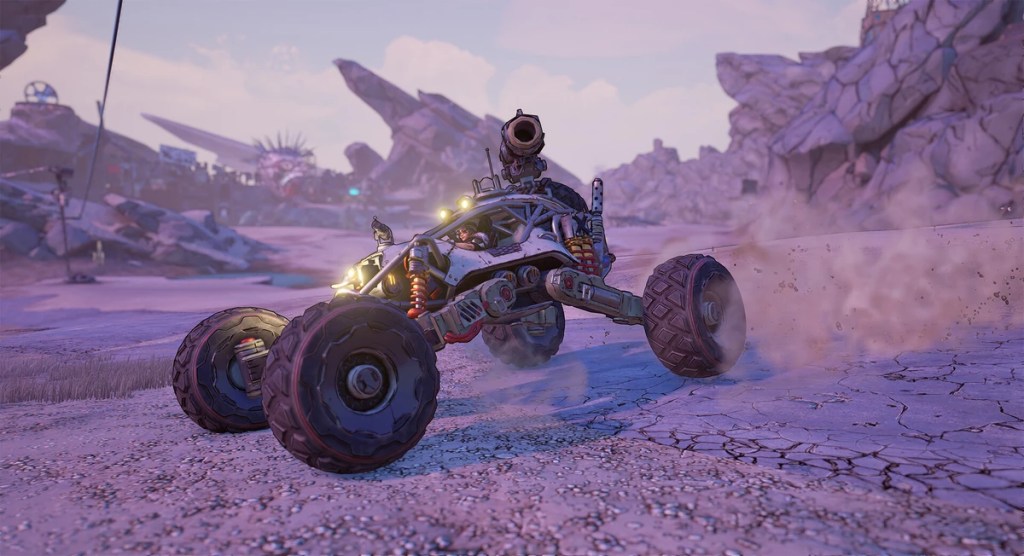
Borderlands 1 had a vehicle called outrunner but which looks basically identical to the BL2 light runner, so I’m going to refer to the BL1/2 design as the light runner and the BL3 design as the outrunner. There’s nothing about the outrunner design that seems like it would be bad for general audiences, but I personally dislike how it’s now much more lightly armored and has lots of shock absorbers and thin struts exposed. The light runner had a rugged look that helped make Pandora seem like a place where roads and garages were rare and bandit ambushes were common. The outrunner more looks like a dune buggy you’d take for a spin on vacation – an off-road vehicle, for sure, but not one built to keep going in spite of a light sprinkling of small arms fire.
I’ve talked about the three pillars of Star Wars before, and other than the fact that Star Wars hates wheels (everything is either treaded or hovers), the light runner fits right in with the space western scoundrel pillar (I call it “smuggler pillar” in that article because I only later realized that “scoundrel pillar” is a much better name for it), while the outrunner does not. Personally, I really like Star Wars and the biggest appeal of Borderlands for me has always been that it feels a lot like that scoundrel pillar of Star Wars but with guns that make the dakka dakka noises, which is basically the only change I have ever wanted to that aesthetic. Borderlands 3 leaving that behind to do something else is really disappointing to me, although I’m not sure how general audiences would take it.
Also it’s really dumb that in 2019 they’re still so shy about saying the word “fuck” in an M-rated video game full of blood and giblets and dismembered body parts used as scenery doodads, and their heavy use of “slap” as a replacement really draws attention to it.
 Chamomile Has A Blog